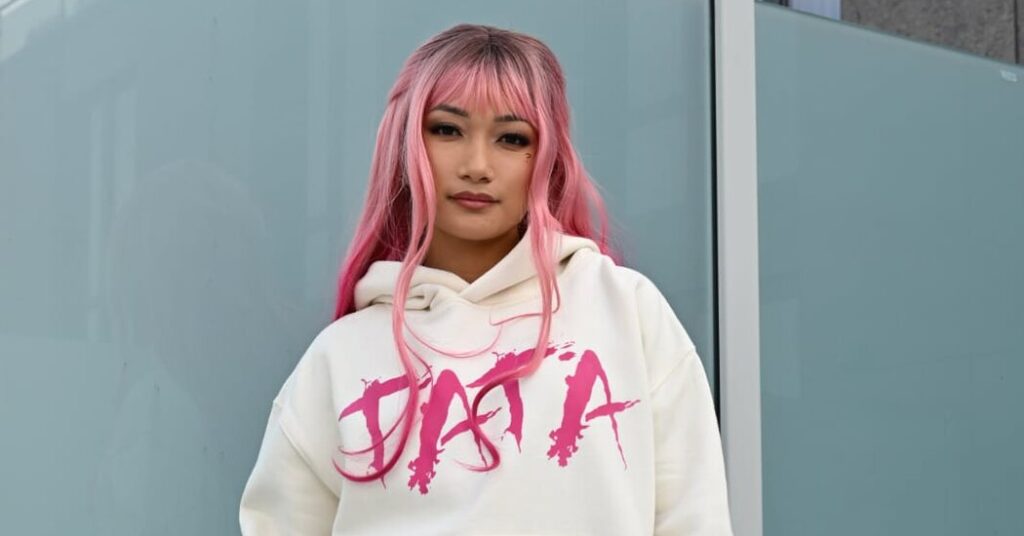
Timbaland has been producing shape-shifting hip-hop, R&B and pop music since the mid-1990s. He’s won four Grammys, created iconic hits with Jay-Z and Justin Timberlake and has been a mentor to artists including Aaliyah and Missy Elliott. His latest protégée is a slight, swaggering pink-haired Asian singer who got her start in his own imagination.
Working with several collaborators and a variety of multimedia tools, including the music-generation software Suno, which is powered by artificial intelligence, Timbaland created TaTa Taktumi from the ground up.
“I call it artist development, re-engineered,” he said on a recent video call alongside Zayd Portillo and Rocky Mudaliar, his partners in his A.I.-focused entertainment company, Stage Zero.
The company released TaTa’s first single, “Glitch x Pulse,” in October, describing her as an “A.I.-native pop artist.” With its spare, insidious beat, skewed cadence and futuristic sheen, the song has plenty in common with past Timbaland productions. But this one was built differently.
Timbaland, 53, began experimenting with A.I. music-generation software a couple of years ago, and his interest grew as its functionality evolved. Suno can generate entire songs out of simple text or spoken-word prompts. Users can also upload their own audio, and the software can construct or augment a song based on their instructions. (Last fall, Suno named Timbaland a strategic adviser to the company.)
“It’s verbalizing music, taking whatever is in your head and just saying it,” he explained. “Like, ‘This snare, I want it to have a fat bottom with 30 dBs of low end.’”
For TaTa, he uploaded demos he’d already recorded, then offered prompts describing what he envisioned. He’d often hum a melody or vocalize a beat and let the software interpolate it. “It can take what I’ve done, then translate it and add on to my melody,” Timbaland said. “I’m like: ‘Ooh, I wouldn’t have thought of that. Now I’ve got a whole other song structure.’”
“Glitch x Pulse” was part of a batch of songs created employing this basic formula. A second TaTa song, the sharp, eerie “Rack It Up,” which includes an inveigling synth hook and a winking verse from the Brooklyn drill rapper Fivio Foreign, was released on Tuesday, and there are plans for a full TaTa album.
“Rack It Up” arrives as conversation about A.I.’s role in music is heating up. “Walk My Walk,” a song credited to a fictional artist called Breaking Rust, faithfully mimicked a pained country lament. The English dance act Haven went viral on TikTok with “I Run,” a track that uses A.I.-generated vocals seemingly based off the very real singer Jorja Smith’s voice. (The song was removed from streaming services.) An A.I. Christian artist named Solomon Ray scored an iTunes hit with an album called “Faithful Soul.”
Although TaTa’s songs have been called “A.I. music” or “A-pop” — a description Timbaland has leaned into — they’re actually a collaboration between man and machine. The lyrics are written by human songwriters, and much of the musical foundation is also created by humans. The “Glitch x Pulse” video features a human performer playing the role of TaTa.
“It’s a hybrid,” Timbaland said, estimating 80 to 85 percent of the creative work is still done by living, breathing Homo sapiens.
TaTa’s ghostly vocals were partially generated by the software, though. Her character, her physical appearance and a back story grew from the songs themselves. “Tim’s process was going to our art department and them starting to sketch what that character was looking like even before A.I. was deep into it,” said Mudaliar, a film producer who originally planned to make a documentary about Timbaland before becoming his partner in Stage Zero. “We brought in writers to build her lore. We were thinking about it like you’re building intellectual property.”
The A.I. video-generation tool Veo 3 helped construct the visuals, but the goal was always to keep the character, the story and the music grounded in reality. “Even though these characters may not be real, they’re still referencing real human things, which is what all art does,” said Portillo, a songwriter and tech entrepreneur.
Nonetheless, the role of A.I. in the process has made Timbaland’s wholehearted embrace of it polarizing. The announcement in June that he was starting Stage Zero and creating an A.I. artist was met with ample criticism on social media. Young Guru, the Grammy-winning producer and engineer who has worked extensively with Jay-Z, wrote: “I swear I love you bro but this ain’t it … Human expression can never be reduced to this!!!”
The California-based rapper and singer Rexx Life Raj also registered his disapproval. In a phone interview, Raj explained that he was troubled by A.I.’s potential to exploit artists’ work while simultaneously putting their livelihoods at risk.
“A.I. is coming for musicians and creatives,” he said. “A.I. just saturates the pipelines for artists who are putting their lives into their music. Plus, we don’t know where it’s drawing its source material from.”
Suno’s algorithms have been trained on vast quantities of existing music, which is why the company is one of the targets of a lawsuit filed by the major recording labels for copyright infringement. Last month, it raised $250 million in a funding round and settled with Warner Music Group; the two companies then announced a partnership.
Timbaland wants to see copyright holders compensated for their contributions to making A.I. music-generation models work. But he believes much of the criticism is misinformed. To him, Suno and other A.I.-powered software like Udio are simply new tools, similar to MPC samplers or the pitch correction software Auto-Tune. Anyone worried that people won’t learn the fundamentals of musicianship, songwriting and studio engineering if A.I. can do it for them is already too late.
“Basic skills have diminished as digital music evolved,” Timbaland said. “You don’t have to know how to play chords. You’ve got a chord machine. People aren’t making drum loops because they’ve already got drum packages you just drag and drop.”
The ease and speed of the A.I. software means he no longer has to wait for singers or musicians to get to the studio to bring the ideas in his head to life. “If you’ve got to wait to call people to do it, you can lose that spark. Now we have tools that you never lose a spark.”
But to some, the friction of collaboration, as well as the sweat, frustration and missteps endemic to the process aren’t inefficiencies to be eliminated but vital parts of the peculiar alchemy of music-making.
“You don’t know what comes out of those human interactions, those tiffs in the studio, the back and forth,” Raj said. “The art and beauty comes out of those moments.”
Timbaland has a history of working at the bleeding edge between music and technology. In 2008, he teamed up with Verizon to release songs directly to the company’s mobile subscribers. The following year, he collaborated with Rockstar Games to create a music mixing video game called Beaterator. During the pandemic, he and fellow producer Swizz Beatz launched Verzuz, a series of head-to-head battle-of-the-bands-type contests between rival artists that became a hit on Instagram and later, Apple TV. Not all of his tech-minded endeavors have been that successful, but they all demonstrate a restless curiosity at his core.
“Tim’s a big advocate for anything that’s future forward,” Portillo said. “It’s not so much because of A.I. It’s more a thirst for tools that can be used to reinvent what we’re already doing. He’s a bloodhound for reinvention.”
Stage Zero is getting ready to introduce an A.I.-powered robot D.J. Mudaliar also mentioned plans for TaTa live shows, which would feature a human performer (or performers) bringing her to life onstage: “We look at her like a character, like Cinderella at the Disney Parks. Every park has actors playing those characters.”
As for the backlash toward A.I. music, Timbaland is willing to take the lumps that come with being an early adopter in an industry so often resistant to change.
“Right now, I’m more charged than ever because I get to do artistry in a different form,” he said. “Everybody’s not going to see the light when you see the light, but you have to stay in the light to make them believe the light. I know we got to take a lot of bullets, but people are going to thank us at the end.”
The post Timbaland’s Latest Protégée Is an A.I. Pop Singer appeared first on New York Times.