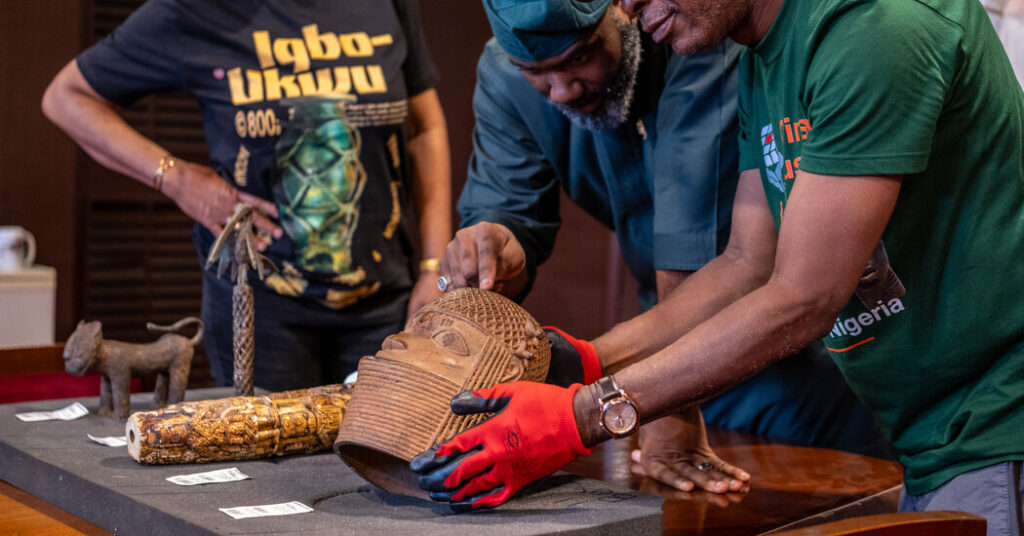
After 128 years in exile, the artifacts were finally home.
On display at the Benin City National Museum in Nigeria last month were about 100 Benin Bronzes — priceless items that British forces looted from a nearby royal palace in 1897. There were bronze animal statues, carved elephants tusks and imposing sculptures of the kings, called obas, who once ruled the ancient Kingdom of Benin.
For over a century, Western art critics had gazed upon these artifacts in European and North American museums and declared them masterpieces. Artists like Picasso fell in love with them, too.
But their new home in Benin City was a far cry from the state-of-the-art museum that many had hoped would house them after their return.
There were no high-tech climate or security systems. No expensive lighting showcasing the artifacts’ fine details. The accompanying labels were sheets of paper, stuck to the wall and display cases.
Nigerians had pleaded with Western museums to return the bronzes since the 1930s, but their calls largely fell on deaf ears until attitudes to returning colonial loot started to change in the last decade. In recent months, over 100 of the sculptures have come back to Nigeria, and hundreds more are scheduled to arrive in 2026 from museums in Sweden, Britain and Germany.
Yet now Nigeria faces new challenges: building a museum to display them, and ending the political infighting that has threatened at times to scupper the returns entirely.
That drama, pitting local power brokers against one another, has dominated the tale of the bronzes for several years. Western museums that wanted to correct a colonial-era wrong by returning the artifacts had expected them to go on show at the Museum of West African Art, a flashy new institution in Benin City, funded largely by Western governments and donors.
The plan appeared to be running smoothly until March 2023, when Nigeria’s president transferred ownership of the returned bronzes to Ewuare II, the current oba and head of the royal family from whom the British stole the treasures.
Ewaure II has opposed the MOWAA project, calling it an attempt to “re-loot” the bronzes from his family. With the bronzes now in his hands, the new museum pivoted to showcasing contemporary art.
Still, some in Benin City did not get the message that MOWAA had changed course. When it tried to open its doors in November, a mob gathered outside and intimidated visiting dignitaries, battered on windows with sticks and shouted slogans supporting the oba. The protest derailed the opening festivities, and weeks later, the museum remains closed.
Now, Ewaure II and the Nigerian government are looking to build a “royal museum” to house the bronzes, with plans to refurbish a dilapidated theater not far from the palace. Raising the money could prove tough, however, given that Nigeria has little tradition of arts philanthropy and Western donors have already funded a museum for the bronzes in Benin City.
The oba does not have any formal political power in Nigeria. But in Benin City, Ewuare II has significant cultural and religious influence. He lives in a palace in the middle of the city, hidden behind tall walls, and business leaders and politicians vie for his approval.
During a rare recent interview, the oba — dressed in white robes and sitting on a throne — said that the bronzes weren’t just artworks, as many Westerners saw them. “These were our way of record keeping,” he said. “They were our religion.”
They still play a role in the area, with bronze casters and wood carvers making them for the oba as well as tourists. Even the local soccer team’s logo is a bronze.
Ewaure II said he wanted his royal museum to be spectacular so that it would draw young visitors. He asked lawmakers to “make a museum like theater, make it like cinema, make it like things people have never seen before.”
Though he could not say when it would be ready, he knew who should foot the bill: Western governments and museums should pay for the royal museum, he said, especially since so many had funded the building of MOWAA. “All the money that was given to them was meant for us!” he said.
One person who will likely prove pivotal to what happens next is Olugbile Holloway, the director of the government agency that runs Nigeria’s museums. In February, Holloway signed a five-year agreement with Ewuare II, allowing his agency to manage the returned bronzes on the oba’s behalf and committing his agency to staff any royal museum.
During an interview last month at his office in the National Museum in Lagos, Nigeria’s largest city, four Benin Bronzes that had been recently returned from Dutch museums sat on a desk. It was overwhelming to have them back in Nigeria again, he said: “Imagine if your children had been kidnapped at night, and you’ve finally got them back.”
Holloway said fund-raising would be his biggest challenge. The planned royal museum would cost at least four billion naira, about $2.7 million, he said, and he wanted to raise that locally.
“That in itself would tell a story of us doing it for ourselves, rather than playing into the cliché of Africans going cap in hand to the West,” he said, but added that Nigerian philanthropists preferred to give money to education or health projects rather than to the arts.
Until a royal museum is built, Holloway said, the bronzes would go on display at other museums in Nigeria, such as the Benin City National Museum. This month, over 100 of the returned items will go on show in a revamped wing of the National Museum in Lagos alongside other historic Nigerian works of art. Holloway said he would send other returned bronzes across Nigeria to regional branches of the National Museum.
As he negotiated with foreign museums over further returns, Holloway said, he was trying to stagger the timeline while he developed these plans.
When the bronzes aren’t on show, Holloway said, his agency would keep the artifacts at the Oba Ovonramwen Storage Facility in Benin City, a two-story concrete building in the middle of a busy traffic circle near the royal palace.
On a recent visit to the facility, its rooms contained little aside from some empty metal shelves. It was sweltering inside, and a museum official said he had ordered air conditioning units, though the bronzes had survived in Benin City’s climate for hundreds of years before they were looted.
Such basic storage might displease some Western museums, but Holloway said that no one had no right to tell Nigerians what to do with their heritage. The bronzes belong to Nigeria, he said: “If we decide that, as a country, we want to smelt the bronzes down and put them in the ground, that’s our prerogative.”
Whatever they do, it may be difficult to interest the Nigerian public.
Victor Ehikhamenor, a Nigerian artist who has long campaigned for the Benin Bronzes’ return, said in an interview at his Lagos studio that the artifacts meant little to some Nigerians from different ethnic groups from the people of Benin City.
“There’s a saying here that a corpse that is not your own is like a log of wood — you don’t have the emotional attachment to it,” Ehikhamenor said. “The bronzes are a log of wood to a lot of people.”
Many Nigerians are also struggling to make a living, Ehikhamenor added, and viewing historical artifacts isn’t high on their “to do” lists.
To overcome that, Ehikhamenor said, museums should use the artifacts to tell exciting stories from Nigeria’s past or deliver inspiring messages about the country’s future. Its people once made some of world’s most acclaimed art, he said, and they could do that again. “You have to show people the story,” he said.
At the Benin City museum last month, the challenge of engaging Nigerians was obvious. On Nov. 3, the museum opened its display of returned bronzes, from the Netherlands, Germany and the United States. There was an initial flurry of interest in the exhibition, with Nigerian TV crews filming the opening and a group of British tourists visiting shortly afterward. But after the initial rush, bored-looking museum guides paced around for hours, waiting for patrons.
When two visitors finally appeared, however, they seemed gripped by the objects and what they represented. Queen Igninomwanhia, 58, a teacher, glanced into the vitrines holding the bronzes. As a tour guide explained how British soldiers had stolen them, Igninomwanhia kissed her teeth and shook her head.
She had seen other Benin Bronzes in the British Museum on a visit to London, she said, and wished Nigeria had such a grand setting to house them — but she was glad the artifacts were home. “We made these 500 years ago,” she said. “We were so enlightened.”
Igninomwanhia’s son, Max, 25, walked quietly behind his mother until he came to a case containing a carved elephant tusk. He pulled out his phone and started snapping photos.
It was his first visit to a museum, he said, adding that he would happily come back if the displays ever changed. “If more bronzes are returned,” he said, “there will be more to see.”
Alex Marshall is a Times reporter covering European culture. He is based in London.
The post These Looted Treasures Are Home. What Now? appeared first on New York Times.