Teyana Taylor has ordered two plates of chicken wings for the table. After last night, she’s not taking any chances.
The rest of us do not know this when we meet inside a deserted restaurant at a West Hollywood boutique hotel. Chase Infiniti arrives first and slides into the middle of the booth we’ve picked out, thinking ahead so it’ll be easier for her two “One Battle After Another” co-stars to join us. Regina Hall and Taylor show up together a couple of minutes later, still talking about last night’s Governors Awards, which reunited the trio after a few weeks apart.
“Lily Tomlin has not lost one bit of her sharpness or wit at all,” Hall says, laughing, giving a hat tip to the comedy legend who had presented Dolly Parton with an honorary Oscar.
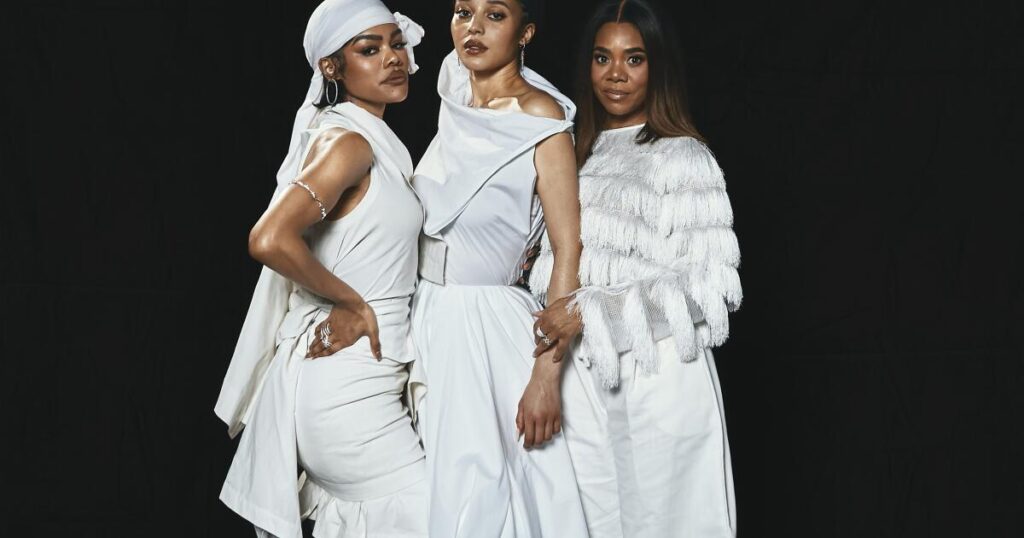
Then the wings arrive. The women, fresh off a photo shoot and still immaculate in their off-white designer wear, dig in. “You can have more because I ate your French fries last night,” Hall tells Taylor. “You absolutely ate the French fries,” Taylor says, smiling. “You was gonna eat the chicken as well. That’s why I got two orders. ”
They laugh. Taylor’s just getting rolling. “I went to the bar during the dinner and came back. And Regina’s like, ‘Somebody took my plate.’ And I look down and say, ‘Somebody ate my fries.’” She motions at Hall. “Goldilocks over here.”
The camaraderie is evident among the three women, principal players in Paul Thomas Anderson’s politically charged epic, a movie that defies categorization and invites repeated viewings, a film that contains big laughs and overflows with righteous anger.
Taylor and Hall play members of the French 75, a revolutionary group introduced in the movie’s opening moments. Taylor portrays Perfidia Beverly Hills, bold, thorny, confusing, contradictory. Hall’s Deandra is Perfidia’s opposite number: steadfast, focused, calm. When things go bad and we flash-forward 16 years, Perfidia is gone. Her daughter, Infiniti’s Willa, is left to deal with her absence as well as an unhinged military officer (Sean Penn) hellbent on tracking her down.
“Paul gives you a lot to talk about, for sure,” Infiniti says, as we dig into the movie’s complexities. “The beautiful thing about working with him is that he allows you the room to bring your own ideas. He had so much love for Willa already but was open to any ideas I had.”
“And you had some good ideas,” Hall interjects.
“A lot of movies that are being made right now are untouchable, and sometimes you just can’t relate,” Taylor says. “PTA’s characters are so beautifully flawed and so human and so raw that you come out of the movie and go, ‘Damn, did you go through that?’ That’s how you’re supposed to feel when you watch a movie. Shake the table. Shake the f— table. Have the conversations. Have uncomfortable but healthy dialogue.”
No character in film this year has sparked more conversation than Perfidia, who rats out members of the French 75 to avoid prison and abandons her daughter in the haze of postpartum depression. One of the movie’s signature shots — Perfidia, heavily pregnant, firing an assault rifle with the butt of the gun pressed against her swollen belly (“what not to expect when you’re expecting” is how Anderson described the image to me) — sums up her essence.
“This is a woman who has showed up for everybody, the revolution, the French 75 and [her partner] Bob (Leonardo DiCaprio), and it’s just kind of like, ‘Why do I have to sit and be this? Why do I have to play house?’ It’s very seldom that you see a woman actually able to be selfish and show up for herself without the world going for her throat. You might not agree with everything she does, and she doesn’t have a moment to redeem herself, besides that letter [to Willa] at the end. But everybody still loves Perfidia.”
“You do see the moment where she’s pregnant at the end,” Hall interjects. “You do see how her personality changed a tiny bit, but then she comes back to knowing, ‘I gotta take charge of who I am.’”
“This thing happens to women in real life,” Taylor says. “‘Oh, I feel like I’m shrinking myself. I gotta stand up and remind myself of who I am.’ PTA did a great job at representing every part of a woman. We can watch this movie and relate to Willa here and Deandra there and Perfidia’s strength and hurt over here. We’re all mirrors.”
“Paul’s surrounded by women,” Hall says, noting his long marriage to Maya Rudolph, with whom he has four children, including three daughters. “He’s a girl dad.” Infiniti jumps in: “He’s definitely a girl dad. He loves those girls.”
“You know why?” Hall says. “He has a sensitive heart. It’s lovely.”
“Look at his wife,” Taylor says. “Look at his daughters. I’m not saying this movie is literal, but I think Bob and Willa’s dynamic was so important to Paul as someone who has mixed-race daughters. He gets it.”
A waiter swings by the table with a huge basket of French fries. No one knows where they came from. Maybe it’s a cosmic make-good from last night, I suggest. Hall tentatively dips a fry into the truffle aioli sauce. “You wanna be classy?” Taylor asks her. “Just dig in like you did last night.”
“Fries are my weakness,” Hall says. “You can’t go wrong with the potato.”
“Now that y’all are breaking it down, I feel like Paul sees a lot of himself in Perfidia in regards to standing 10 toes down on who he is and being himself unapologetically,” Taylor says. “That’s why he’s able to create this f— badass who is unapologetically herself. That’s what we love about him. Agree. Disagree. PTA stands 10 toes down on who PTA is.”
I love this “10 toes down” expression.
“Every time you say it, I’m like, ‘This is genius,’” Infiniti says, smiling. “Genius.” Taylor laughs and finishes the last wing.
“All Paul’s films are unique, though you know it’s him, just like with Tarantino,” Hall says. “‘Boogie Nights’ is PTA but it’s so different from ‘Phantom Thread,’ which is so different from ‘Punch-Drunk Love,’ which is his version of a romantic comedy.”
During a Q&A for “One Battle,” Hall said she watched “Phantom Thread,” the movie where a wife feeds her husband poisonous mushrooms to make him dependent on her care, and told Anderson that he was on to something. “I have wanted to poison people,” she joked. “Ex-boyfriends, specifically.”
“What I learned from watching that movie is that Paul knew he needed to be poisoned a time or two,” Hall says. “Men know, right?”
The talk turns to all the running the women did for the movie, most of it cut down in the final edit as Anderson tightened the opening 40 minutes that focus on the French 75’s exploits. “Our knees and thighs were in pain,” Hall says.
Adds Taylor: “I was running across a field with a machine gun in my hand, running and jumping. I really thought I was Tom Cruise.”
“Tomasina Cruise,” Hall says, laughing. “Tommyana,” Taylor retorts.
The waiter comes over one last time and asks, “How were the wings?”
“Good,” Taylor answers. “Good and gone.”
And, too soon, so are we.
The post The women of ‘One Battle After Another’ aren’t afraid to ‘shake the table’ appeared first on Los Angeles Times.