In college football, one rule seems to always hold: When a player leverages his power, it’s a scandal. When a coach does the same thing, it’s just business as usual.
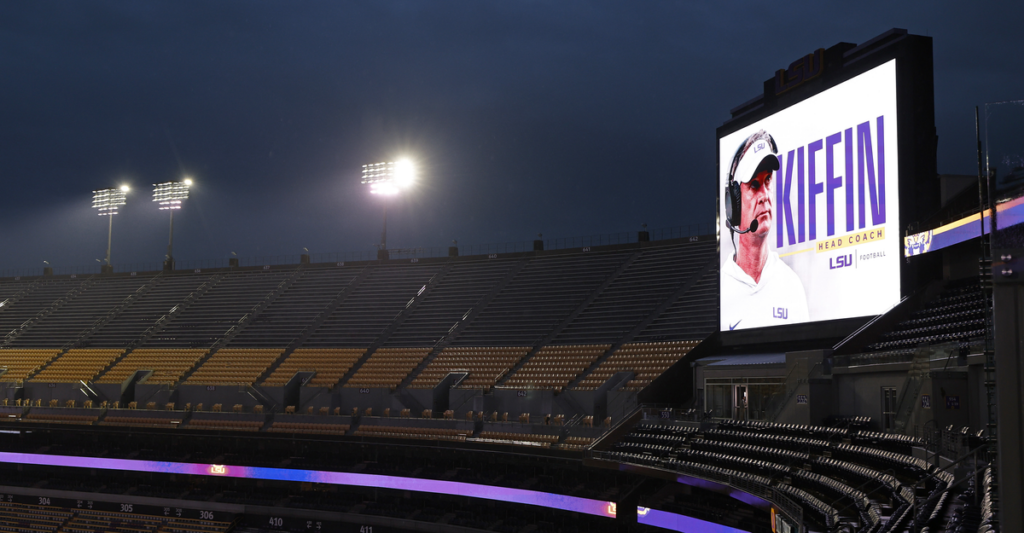
That dynamic is now playing out in the response to the decision of the longtime University of Mississippi coach Lane Kiffin to leave the team to become the new head coach at Louisiana State University. Kiffin led Ole Miss to a historic regular-season record of 11 wins and one loss, and the university is now poised to make its first-ever College Football Playoff appearance. The Rebels have a real chance of winning a national championship. LSU’s seven-year, $91 million offer was apparently enough to put all of that in jeopardy.
Imagine, for a moment, if a player had done any of the things Kiffin did as he secured his golden ticket to LSU. Imagine if a player had been playing footsie with two conference schools, as Kiffin did with LSU and the University of Florida after both programs fired their coaches in late October. Imagine if a player’s family had boarded a private jet and been given a personal tour of the city that’s home to the school courting his services—something Kiffin’s family reportedly did in Baton Rouge, Louisiana.
[Jemele Hill: A WNBA star goes scorched-earth]
Actually, we don’t have to guess, because similar scenarios have played out. When the former University of Tennessee quarterback Nico Iamaleava transferred to UCLA this past spring after reportedly holding out from practice because he wanted more name, image, and likeness (NIL) compensation from Tennessee, his circumstance was used as an example of how player greed is ruining college football.
“If they wanna play holdout, they might as well play get-out,” Mario Cristobal, the University of Miami head coach, said at the time.
By contrast, while appearing on ESPN’s morning show Get Up last week, the former New York Jets coach Rex Ryan said: “I don’t blame Lane Kiffin for going after it. Look at the landscape of college football, which I think is absolutely abysmal—not just the calendar, but the fact you let kids bail all the time. You know what? I’m going to make more money if I go to this place. What is the difference?”
The difference is that during this season alone, fired college coaches have cost schools nearly $200 million in buyout money, yet nobody is suggesting any rules or protections that limit the amount of guaranteed money a coach can be paid, nor is anybody creating any rules that might curtail coaches from job-hopping mid-season. The narrative that college players seeking a system that recognizes their fair market value is ruining the sport is etched in stone, but it’s the coaches who wrote the playbook on how to leverage and exploit.
In 2019, college football was flipped on its axis by new mandates that allow players to make money off their NIL. After a slew of favorable court decisions, athletes can now be paid directly by schools, transfer universities as many times as they wish, and still be immediately eligible to play. Multimillion-dollar coaches and National Collegiate Athletic Association (NCAA) leaders have argued that the pay-for-play system is creating chaos, uncertainty, and a structure in which donors and boosters are becoming more important than the coaches themselves and players have become hired guns with no real loyalty. Ironically, it was Kiffin who unleashed a blistering critique of players while appearing on the comedian Theo Von’s podcast in August. Kiffin complained that the NIL era has made players more entitled, less motivated, and selfish.
“People get too much too early,” Kiffin told Von. “They had this drive to get to the NFL because they want to play in the NFL. They want the money. Well, I’m getting the money already. So now I’ve lost some drive.”
When asked to elaborate on the challenges players are facing, Kiffin said, “They just get in their own ways. It’s that one word, ego.” This isn’t even the first time that Kiffin has left a team in the lurch, pursuing his own interests over that of the students he leads. In 2016, while Kiffin was the University of Alabama’s offense coordinator, he accepted a job at Florida Atlantic University. His hiring proved to be a distraction, and Kiffin was fired by Nick Saban, then Alabama’s head coach, ahead of the team’s national-championship game against Clemson University.
[Sally Jenkins: How to fix the mess of college sports]
Given that history, one might assume that Saban would have stern words for Kiffin now. Instead, on ESPN’s College GameDay last month, Saban campaigned for Kiffin to be allowed to coach Ole Miss in the College Football Playoff. (Ole Miss has since announced that Pete Golding, the team’s defensive coordinator, will lead the team in the playoffs.)
Meanwhile, Saban is working closely with the Trump administration to rein in NIL; at one point, it was reported that he might be assigned to co-lead a college-sports commission that Donald Trump wanted to create. In July, the president signed an executive order that characterized the recent player-friendly changes to college sports as an “unprecedented threat.” Currently, the NCAA is urging Congress to pass the Student Compensation and Opportunity Through Rights and Endorsements (SCORE) Act because it would grant the NCAA and its schools an antitrust exemption, thus allowing them to block players from being considered employees and prevent schools from facing further litigation. Saban has said that he is in favor of players being compensated, but earlier this year, he also called the current NIL climate “unsustainable.”
“All I’m saying: The people out there need to know this model is unsustainable. It’s not good for players,” he said on a podcast. If only he would act as though that were his true concern.
The post The Most Egregious Double Standard in Sports appeared first on The Atlantic.