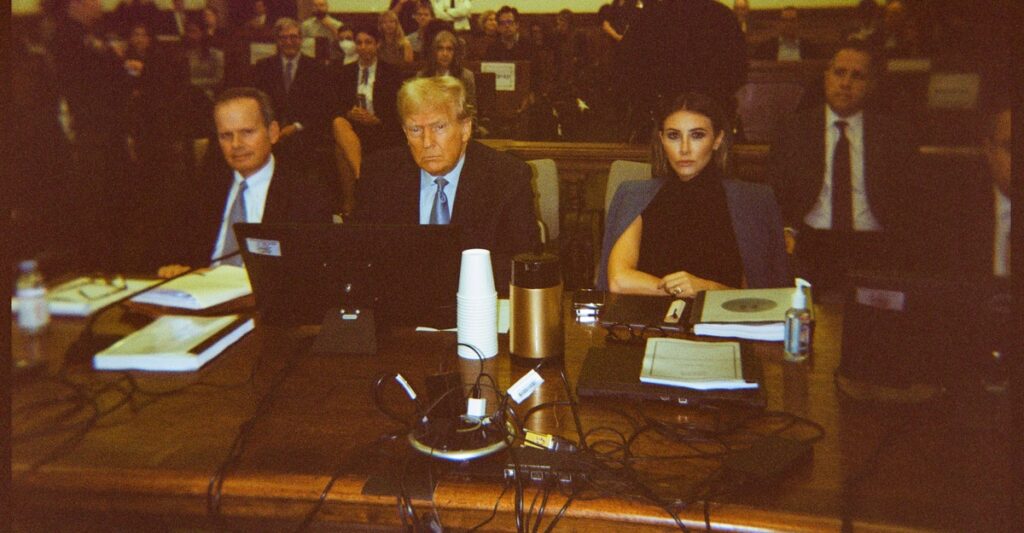
Yesterday, Alina Habba turned—where else?—to X, the Trump administration’s second-favorite social-media app, to announce her resignation from a job she did not legally hold. She had “decided to step down” as the top prosecutor in New Jersey, she wrote, after an appeals court ruled last week that she had lacked authority to serve in the role since mid-July. “But do not mistake compliance for surrender,” she warned. “You can take the girl out of New Jersey, but you cannot take New Jersey out of the girl.”
Habba’s resignation announcement was as baffling as the legal questions that booted her out of the office. At first, it seemed like the administration was giving up the fight to keep her in the job—until Attorney General Pam Bondi published a companion X post, several minutes later, clarifying that the Justice Department would be appealing the disqualification ruling. (Perhaps you can’t take the girl out of New Jersey after all?) The fog of confusion around Donald Trump’s effort to install Habba in the U.S. Attorney’s Office for the District of New Jersey has yet to entirely lift. Still, amidst the legal technicalities and blustering X posts, something quietly important happened: The judiciary stood up to the Trump administration’s abuse of power—and the administration backed down.
The peculiar drama around Habba’s appointment traces back to this August, when a district judge first found that Trump had illegally installed her in the role. The president had maneuvered to keep her in New Jersey as a way of getting around restrictions meant to prevent a president from appointing his cronies to powerful positions without Senate oversight. He did the same in other U.S. attorney’s offices across the country, selecting allies willing to harass his enemies. In the Eastern District of Virginia, he picked Lindsey Halligan, who secured meritless indictments against Trump opponents James Comey and Letitia James—a victory for Trump, until a judge found Halligan’s appointment illegal and tossed out both cases. Earlier this month, the week after Halligan’s disqualification, the U.S. Court of Appeals for the Third Circuit upheld the August ruling that Habba had been illegally appointed, too. Across the country, judges have disqualified two other U.S. attorneys and are weighing the legality of the appointments of two others.
[Read: The Trump lawyer scandal is about something much deeper than legal technicalities]
The Third Circuit was the first appeals court to consider Trump’s scheme—and its ruling was a major test for how the administration, ostentatiously belligerent toward the courts, would respond to the judiciary’s check on presidential power. For the first week following the ruling, the White House and the Justice Department said nothing at all. Habba’s X account, which after the lower court’s ruling had posted with messages of defiance, remained dormant. Then yesterday’s resignation announcement appeared.
Before 2025, the notion that executive compliance with a court order would be cause for special attention would have seemed absurd. But only weeks after Trump’s second inauguration, the administration began hinting at the idea of ignoring judicial rulings it disliked. It has since grudgingly moved away from that defiant posture—perhaps in part because district judges have developed their own techniques for making life difficult for the government if it refuses to comply.
The mechanics of criminal justice, in particular, offer judges opportunities for pushing back against spurious prosecutions and similar abuses, as the former prosecutor Randall Eliason recently wrote. In Virginia, the Comey prosecution has foundered not only because of Halligan’s illegal appointment, but due to judges’ objections to the many impermissible legal shortcuts the government appears to have taken along the way—such as searching for evidence without a warrant and informing grand jurors that they could indict Comey on the basis of information that Halligan had yet to actually produce. In New Jersey, following the initial court ruling against the legality of Habba’s appointment, judges slowed the operation of criminal courts until they could gain confirmation as to whether her actions cast doubt on the legality of prosecutions across the state. Habba’s X post suggests that this paralysis shaped her decision to step down “to protect the stability and integrity” of prosecutors’ work.
Even as the administration acknowledged its defeat, it found ways to complain. Habba framed herself as a victim of courts that “became weapons for the politicized left.” Likewise, Bondi decried “politicized judges.”
[Read: Pam Bondi, loyal servant]
More substantively, the department’s overly complicated response to Habba’s disqualification will also create new, unnecessary problems. Habba announced that she would be leaving the office and returning as U.S. attorney if the government succeeds in overturning the Third Circuit’s ruling. (Until then, she will serve as “Senior Advisor to the Attorney General for U.S. Attorneys,” a position that appears to never have been mentioned on the Justice Department website before yesterday’s announcement.) This strange setup will arm Habba’s challengers with the additional legal argument that the appeal should be dismissed as moot, given that Habba is not currently in the role. In another twist, Bondi also announced that the U.S. attorney’s office will be led in the meantime by not one but three prosecutors, all of whom have ties to Habba or other Justice Department leadership. Criminal defendants in New Jersey are sure to challenge this arrangement.
This past spring, the law professors Leah Litman and Daniel Deacon coined the phrase “legalistic noncompliance” to describe the Trump administration’s habit of wielding “an array of specious legal arguments to conceal what is actually pervasive defiance of judicial oversight.” As Litman and Deacon predicted, the government has since somewhat—though not entirely—backed away from this strategy in the face of stricter oversight from district judges and rising public disapproval. The Justice Department’s conduct in the Habba case might be understood as the inverse of how legalistic noncompliance conceals disregard for the courts: here, the government is complying, but in a posture of opposition that seeks to obscure to the public that the administration is actually doing what the judiciary requires.
The approach is not unlike that of a small child who allows their parents to take them home from the park, but screams the whole way back. Like the yelling child, the Justice Department’s unnecessarily complicated response to the Third Circuit ruling will probably cause some future headaches. But in the meantime, the government has, however sullenly, admitted defeat.
The post The Judiciary Won This Round appeared first on The Atlantic.