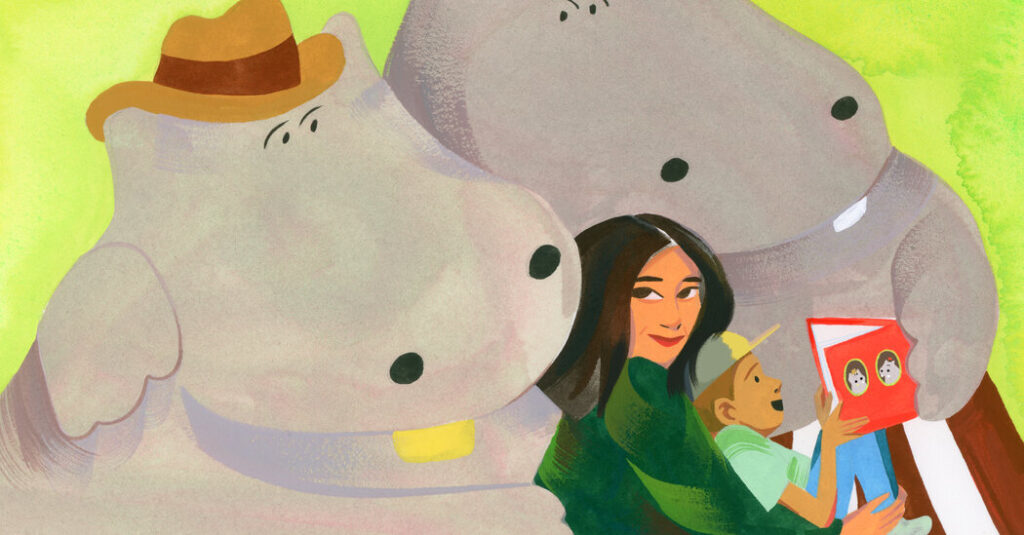
There are few books my nephew and I agree on. This is because he is 4, and I am 34, and believe it or not, that age gap really makes a difference. I have read him many, many library books: books about dump trucks celebrating Hanukkah; books about elite fire fighters named Brent who jump out of planes; books about dinosaurs in which one bites another, so there is blood in the illustration, and we have to flip back every two minutes to the page where there is blood so we can look at the blood and talk about the blood.
I’m not a tyrant of taste, but I think you can tell when a book is pandering to the supposed sensibility of children. The most special of children’s books talk to children as if they are people, because, of course, they are. My sisters and I have made it a tradition to read to my nephew not only the dinosaur books but also those we loved when we were little. These include the work of the author and illustrator James Marshall. As a kid, I read his books the same way an athlete runs drills — in an exhaustive repetitive cycle, as if they were preparing me for something.
“George and Martha” is my favorite series from Marshall. They are a pair of hippos who happen to be best friends experiencing true, enduring platonic love. They are named after the protagonists of “Who’s Afraid of Virginia Woolf?” (You know, classic kid stuff.) Much of their physical comedy stems from the fact that while they are hearty in the way all hippos should be, they have really tiny eyes. They do not seem to be saddled with the most begrudging of adult pursuits, like jobs, but they are constantly trying out new hobbies, like dancing and holding longstanding grudges.
But rereading these stories to my nephew, I discovered a layer of meaning I couldn’t access when I was a kid: the promise of adult friendship. How it could serve as an organizing principle as you aged, transforming your life into a shared experience, regardless of your marital status. How complicated those relationships can be, even when they are at their most loving. Take this classic “George and Martha” foible: Martha makes untold amounts of pea soup. George does not love pea soup, but he does not want to upset his friend. So he pours his pea soup into his loafers. Martha spots him and confronts him, forcing him to explain that he didn’t want to hurt her feelings. “That’s silly,” she says. “Friends should always tell each other the truth.”
This is a common refrain: that friends tell each other the truth, even when it’s hard. In one story, George is trying to sneak a peek at Martha’s diary. In the end, he asks her if he can just read it. The punchline? “No.” There are times when Martha wants to visit with George, and George wants to spend time by himself. Both feel misunderstood. Occasionally they stop speaking, but the cold shoulder never lasts long. They feel too lonely without the other.
Marshall died relatively young, at age 50. Years after his death, it was reported that he had succumbed to complications from H.I.V./AIDS. After I read “George and Martha” to my nephew, I listened to some recorded lectures that Marshall gave to college students in a children’s-book writing class. In one, he described his visits to schools, how the little kids would shriek with laughter when he drew a cigar in a chicken’s mouth. He followed in the tradition of wry, slightly mischievous illustrators and authors like William Steig and Maurice Sendak — the latter a friend of Marshall’s — who understood that the best way to get children to trust you was to show them the way we talk to ourselves, even if that involves subtle irony or a wordless side-eye. “I write basically to make myself laugh, and my friends,” Marshall said in one talk. Sendak, who wrote the foreword to a compendium of “George and Martha” stories, said that if Marshall’s genius was for friendship, “then George and Martha are the quintessential expression of that genius.”
I doubt that my nephew can fully grasp the range of that genius at his age. His friendships are sincere, but they mostly consist of scream-running on the playground. I was the same at his age (I still scream sometimes), and I eventually learned that I have always been the person I am because of the friends I have. They inform most everything important about me: the texture of my days, the small frustrations and petty grievances that grind me down, the gifts of my life. Everything I’ve written has begun as a conversation with one of them, and it always circles the same questions: How do we stay connected to the people we care about, through all the great misalignments that life and circumstance hurl our way? How do we care for one another through the shifting prisms of our personalities? The same people we love might drive us up the wall. That Marshall was able to capture the seriousness of that paradox through a loafer-wearing hippo is something special.
“If I remember with terrible pain my lost friend and colleague, it is only because James raised the art of friendship to an exhilarating height,” Sendak wrote. “He made me laugh until I cried. No one else could ever do that. He was a wicked angel, and he will be missed forever.”
All good friends are wicked angels, tempting us to a place of greater communion through the shared invitation of a joke. All good friends will be missed forever. My nephew and I are both old enough to understand the first part of this equation, still too young and too lucky to understand the second. But someday, we will.
The post The Illustrated Children’s Book I’ll Never Stop Recommending to Adults appeared first on New York Times.