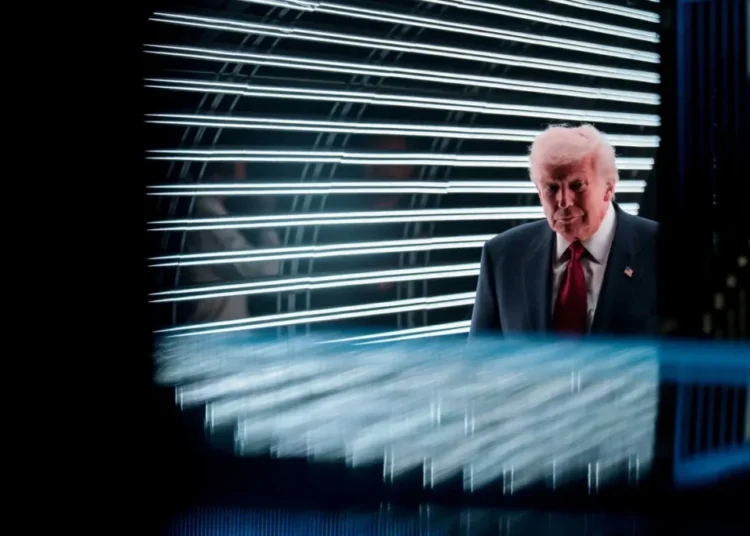
For President Trump, the affordability crisis is a “hoax” perpetuated by Democrats. For the customer checking out at Costco or Walmart, it’s a rising grocery bill threatening already fragile household finances.
On Nov. 29, claiming that he was reducing drug prices by “500%, 600%, 700%, and more,” Trump told his followers on Truth Social:
If this story is properly told, we should win the Midterm Elections in RECORD NUMBERS. I AM THE AFFORDABILITY PRESIDENT. TALK LOUDLY AND PROUDLY! President DJT.
The reality is that Trump does not want the story properly told.
I originally set out to try to put a dollar figure on how much the median family has lost this year as a result of Trump’s tax and spending policies, his tariffs and immigration restrictions and their effects on growth, inflation, wages, taxes and wealth.
This is no easy task, with multiple variables in play, each of which can worsen or lessen the cumulative effects.
Nonetheless, when I put it all together for the median household, I came up with an estimated net loss of $2,250 in 2025 spending power.
The median household income after taxes was $72,330 in 2024, according to the census. The $2,250 amounts to a 3.1 percent loss in spending power, more than enough to persuade quite a few voters that the economy under Trump has gone sour, an assessment confirmed by poll after poll. This disenchantment has begun to spread to Trump’s own voters.
The $2,250 estimate of net loss is admittedly a back-of-the envelope calculation. The experts I contacted cautioned that combining the dollar values of such disparate factors as G.D.P. decline and limited growth, inflation, higher unemployment and tariff-induced consumer costs is very likely to under- or overstate any possible estimate because the measures interact, sometimes strengthening one another and at other times resulting in double counting.
To reach this estimate, I combined the calculations of the costs and benefits of major Trump policies by the Yale Budget Lab; the Tax Policy Center, a joint project of the Urban Institute and the Brookings Institution; the Federal Reserve; the American Enterprise Institute; and the Penn Wharton Budget Model. I also contacted economists and public policy experts from these and other institutions.
As I dug into the research, something far more important than the specific dollar estimate of an average family’s loss emerged: Trump’s economic policies have put the nation on a long-term path of decline, in terms of gross domestic product, employment, capital investment and wage growth.
Martha Gimbel, executive director of the Yale Budget Lab, described in an email this process of slow-but-steady decline unleashed by Trump:
The policy mix of the Trump administration feels similar to Brexit to me. It is likely slowing growth down and lowering living standards relative to what would have been achieved without this policy mix.
But it’s unlikely to drive us into a recession immediately. Instead, the effects of the slower growth will compound over time such that in 10 years we’ll look back and wonder why we don’t have the economy that we thought we’d have.
Jonathan Haskel, a professor of economics at Imperial College Business School in London, and Matthew J. Slaughter, a professor at Dartmouth’s Tuck School of Business, drew similar conclusions in their Foreign Affairs article “America’s Brexit Phase: Trump’s Tariffs and the Price of Economic Uncertainty,” which appeared in June:
Unless Washington changes course fast, the United States will suffer many of the same consequences that the United Kingdom did in the aftermath of Brexit. If Washington continues to embrace “strategic uncertainty,” the United States, too, will likely face years of stagnating investment, sluggish growth in its economic output, and flat or even falling standards of living.
The biggest lesson of Brexit, Haskel and Slaughter concluded, “is that policy uncertainty can chill business investment, growth in productivity, and incomes — quickly, lastingly, and painfully. The supporters of Trump’s ‘strategic uncertainty’ approach have been forewarned.”
Trump argued that his One Big Beautiful Bill Act would restore America to greatness. In May, shortly before the measure was enacted, Trump declared:
We have the Big, Beautiful Bill. We got to get that done, and that will put our country in a position like it’s never been in. It’s a reduction of taxes. It’s tremendous incentives for companies to come from all over the world to come into our country. It’s great environmentally, but it’s not this environmental scam that we went through, we all went through. It provides for everything. It’s a big, beautiful bill, and I hope we can get it approved.
The analysts at the Penn Wharton Budget Lab saw it a bit differently:
By 2034, gross domestic product is projected to be 0.3 percent lower than under current law, while the capital stock will be 0.6 percent lower, and federal debt will increase by 7.7 percent. Work hours are expected to rise by 0.6 percent, even as wages fall by 0.4 percent.
The Yale Budget Lab calculated the combined financial costs and benefits of two signature Trump policies, the One Big Beautiful Bill Act on taxes and spending and his substantial tariff increases. It found that the net effect of the tax cuts with the higher costs from tariffs leaves a family in the middle of the income distribution roughly $480 poorer.
Those with incomes in the bottom three deciles lose the most — $2,160, $1,320 and $1,060 — according to the Yale Budget Lab’s calculations — while those in the top three deciles are the only winners, at $170, $830 and $9,670.
That’s just for starters. The lab’s analysis pointed to adverse impacts on economic growth and employment:
Tariffs slow real gross domestic product growth by 0.5 percentage points in 2025 and 0.4 percentage points 2026. In the long run, the U.S. economy is persistently 0.3 percent smaller, the equivalent of $90 billion annually in 2024 dollars.
The unemployment rate rises 0.3 percentage points by the end of 2025 and by 0.6 percentage points by the end of 2026. Payroll employment is about 460,000 lower by the end of 2025.
On the plus side, the Yale Budget Lab calculated that as a result of the tariffs, “U.S. manufacturing output expands by 2.9 percent,” but it cautioned that “these gains are more than crowded out by other sectors: construction output contracts by 4.1 percent and agriculture declines by 1.4 percent.”
In her email, Gimbel stressed the Yale Budget Lab’s finding that “the One Big Beautiful Bill Act was steeply regressive” and that “when combined with the regressive impact of tariffs, we found that the bottom nine deciles of the income distribution all end up worse off. By expanding the national debt, the bill was also inflationary, substantially increasing interest costs for households according to our analysis.”
In a detailed Nov. 12 report, “Tracking the Short-Run Price Impact of U.S. Tariffs,” Alberto Cavallo of Harvard Business School, Paola Llamas of Northwestern and Franco M. Vazquez of the Universidad de San Andrés showed the Trump tariffs had significant inflationary effects: “We estimate that the 2025 tariffs contributed about 0.7 percentage points to the all-items Consumer Price Index in six months.”
They concluded:
We find that the short-run retail tariff pass-through was quick, gradual and incomplete. It was quick to begin, with retailers responding rapidly to tariff news. It was gradual to unfold, as retailers adjusted prices progressively over time. And it was incomplete after six months, with about 20 percent of the tariff changes reflected at the consumer level. Given the uncertainty surrounding the tariff announcements, our results suggest pass-through may continue to accumulate gradually over time, putting persistent upward pressure on inflation statistics.
The One Big Beautiful Bill Act and the tariffs dominate the Trump administration’s economic agenda, but other administration policies are having a significant impact.
Take Trump’s immigration and deportation plans. The economic consequences run contrary to the president’s claimed goal of promoting American jobs and growth.
In “Immigration Policy and Its Macroeconomic Effects in the Second Trump Administration,” a July 2025 paper published by the American Enterprise Institute, a center-right think tank, Wendy Edelberg, Stan Veuger and Tara Watson contended “that the large drop in net migration in 2025 compared with 2024 will result in significantly slower labor force growth, slower employment growth and a decrease in G.D.P. growth of around 0.3 to 0.4 percentage points.”
Another July analysis, this time by Penn Wharton, “Mass Deportation of Unauthorized Immigrants: Fiscal and Economic Effects,” found that, under the assumption that Trump maintains a policy in which 10 percent of unauthorized immigrants are removed annually over four years from 2025 to 2028, deficits would increase “by about $270 billion before economic feedback effects and $350 billion with economic feedback effects”; the gross domestic product would be reduced by 1 percent and “high-skilled workers,” who comprise “63 percent of the working population, would see their wages fall over time by 0.5 percent, or $494 per year” while low-skill workers would see “their wages increase by 1.1 percent by 2034.”
In one respect, the substantial gains in the value of stocks and other equities during Trump’s second term — worth $2,500 or more for the median income family — would seemingly more than compensate for the losses.
The problem for Trump, however, is that what stocks the average family holds are largely — 65 to 75 percent — in retirement accounts that are difficult to access and don’t serve as spendable income.
Stock ownership is overwhelmingly concentrated among the top 10 percent of the income distribution, which holds roughly 90 percent of all the stocks in America. Those in the bottom 30 percent — a group that includes many MAGA supporters — experience little or no gains, on paper or in actuality, from the stock market.
It doesn’t end there. The damage inflicted by Trump’s policies may be substantially deeper and more widespread than what we see in the various models used by the Yale Budget Lab and other institutions.
Henry Holzer, a professor of public policy at Georgetown and a senior fellow at Brookings, wrote by email:
Issues like declining investor faith in our fiscal situation over time, or in the Fed’s ability to control inflation, cannot be estimated in these models; nor can the realignments of global trading relationships in favor of China among those who don’t trust the U.S. anymore.
So, whatever these models suggest about long-term costs, they are likely a small slice of the risks we face.
Ben Harris, director of economic studies at Brookings, pointed out in an email that Trump’s deficit-increasing tax and spending law, his immigration policies and other administration projects are having significant cumulative effects on growth, employment and interest rates.
In March, the Congressional Budget Office cited the negative consequences of the $3.4 trillion increase in the deficit resulting from passage of Trump’s One Big Beautiful Bill Act: “Over time, it (the deficit) slows economic growth, drives up interest payments to foreign holders of U.S. debt, makes the nation’s fiscal position more vulnerable to an increase in interest rates, heightens the risk of a fiscal crisis and increases the likelihood of other adverse outcomes.”
William Gale, a senior fellow in economic policy at Brookings, backed up Harris’s conclusions in an email:
The O.B.B.B.A. added $4.1 trillion to the federal debt over 10 years. This includes $3.4 trillion in tax cuts net of noninterest spending reductions and $700 billion of interest payments.
This will create all the usual problems associated with higher debt — lower capital stock, higher interest rates, slower growth, slower productivity growth and hence slower wage growth. The long-term effects are likely to be negative for the economy in terms of growth.
Trump’s tariffs, Harris wrote, will have a significant inflationary impact:
The rule of thumb is that for every percentage point increase in the average trade weighted tariff, the personal consumption expenditure (P.C.E.) price index rises by 0.1 percentage points. We have gone from around 3 percent to around 15 percent, so a 12 percentage point increase implies a 1.2 percentage point increase in core P.C.E.
As 2025 comes to a close, the damage the models predict is starting to become reality.
Last Thursday, for example, The Wall Street Journal reported in “This Year’s Layoff Tally Nears 1.2 Million, Highest Since Pandemic” that from “January through November, firms have laid out plans to cut 1.17 million posts. That’s the highest year-to-date level since 2020.”
Equally foreboding, Paul Krugman, in “MAGA’s Affordability Crisis Will Soon Get Worse,” which was published last week on his Substack, cited the looming prospect of a sharp rise in fees for health coverage under the Affordable Care Act.
Without congressional action, which appears very unlikely at the moment, Krugman presented data showing that premiums for those with coverage in Florida under the Affordable Care Act, to give one example, would more than double, to $2,200 from $899 a month for a married couple 40 years old and earning $130,000 with two children. For a 64-year-old couple making $90,000, monthly premiums would rise to $3,176 from $637, or to $38,112 from $7,644 a year.
These developments have prompted growing numbers of elected Republicans, along with White House aides and advisers, to pressure Trump to recognize and acknowledge publicly Americans’ deepening concerns over jobs, inflation and affordability.
For Trump to accede to these pressures would, however, require him to admit that his grandiose claims about how his policies would produce a bountiful explosion of prosperity were wrong.
He is not going to do that.
The Times is committed to publishing a diversity of letters to the editor. We’d like to hear what you think about this or any of our articles. Here are some tips. And here’s our email: [email protected].
Follow the New York Times Opinion section on Facebook, Instagram, TikTok, Bluesky, WhatsApp and Threads.
The post The Affordability Crisis Is Not a ‘Hoax’ appeared first on New York Times.