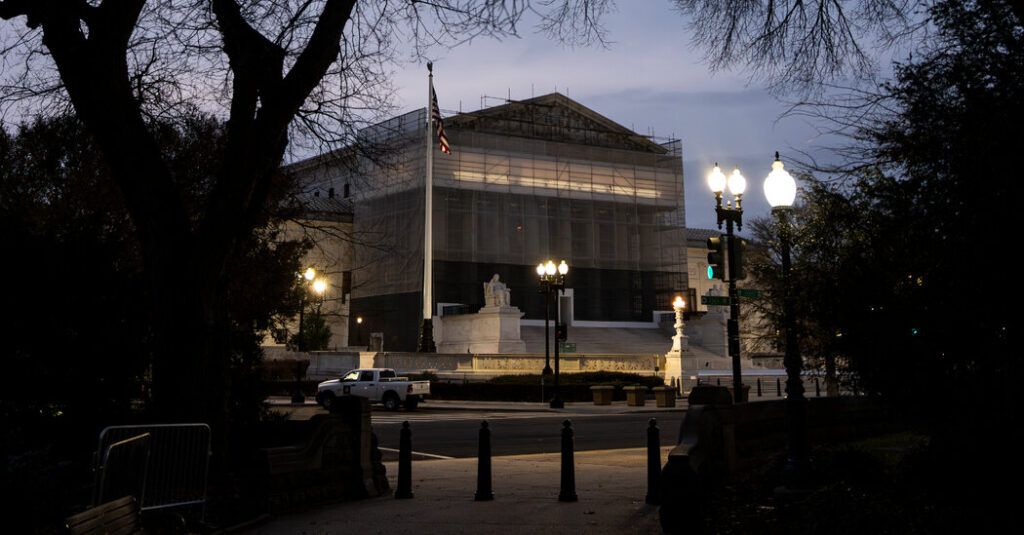
The Supreme Court on Tuesday will hear a major challenge to the way political campaigns are funded that could sharply reduce one of Democrats’ financial advantages in recent years.
Fifteen years ago, the Supreme Court dramatically remade the campaign finance landscape in Citizens United v. Federal Election Commission, a landmark case in which the justices struck down legal limits on independent political spending by corporations and unions, allowing a flood of new money to enter politics.
The court has been chipping away at campaign finance restrictions ever since. The case the justices will consider on Tuesday involves one of the remaining limits: how much money political parties can spend in coordination with candidates.
The case, National Republican Senatorial Committee v. Federal Election Commission, was brought by national Republican leaders, who argue that the limits violate the First Amendment, restricting their ability to reach and influence voters.
Depending on its scope, such a decision could swing the pendulum of power back toward the official political parties and away from super PACs. It could also allow parties to spend huge sums from big donors directly on candidates, potentially expanding the influence of big money compared with small-dollar contributions. Democrats in recent years have done better than Republicans at winning smaller donations.
In practical terms, a win for the Republicans could have an immediate impact on the midterm elections, shrinking one of the Democratic Party’s major financial advantages: lower costs for political candidates who directly buy broadcast advertising time.
Under federal law, broadcasters must offer political candidates low advertising rates. But they are not required to give super PACs those same low rates. Super PACs often pay double, triple and even four times as much money for the same TV spots as do candidates.
In recent years, Democratic candidates have tended to vastly out-raise Republican candidates, who have been more reliant on the support of super PACs and national party committees, which can accept larger donations. In practice, that means Democratic candidates have been able to take advantage of these lower ad rates more often than Republicans.
A ruling in the case is expected by July. If the court decides to allow unlimited spending by the parties in coordination with the candidates, party committees will suddenly also be guaranteed those cheaper rates — an outcome that campaign finance experts say would probably especially benefit Republicans and potentially save the G.O.P. tens of millions of dollars next fall.
While an individual donor can give only $3,500 to a candidate during an election cycle, a donor can give up to $44,300 to a national party committee’s general fund each year and hundreds of thousands more to specialty accounts. If the Supreme Court lifts limits on party committees to coordinate with candidates, the parties could use the large contributions they raise from wealthy donors to pay for low ad rates.
The ad price disparity is so big that Republicans have been testing various other ways to skirt the existing law while this challenge has been winding its way through the courts.
In 2026, the committees of both national parties that are focused on the House and Senate races will probably be financially closely matched. But the Republican National Committee itself has an edge over the Democratic National Committee, with far more cash on hand, about $91 million. The D.N.C. recently had only $18 million on hand after taking out a $15 million loan.
Democrats would probably make it a huge priority to raise money for the party committees should Republicans win at the court, potentially making a G.O.P. advantage short-lived.
The dispute before the Supreme Court began on Nov. 4, 2022, when national Republican leaders and two Ohio political candidates, including Vice President JD Vance, who was then running for the Senate, sued the Federal Election Commission.
The challengers argued that federal campaign finance laws unfairly limited political party committees “from doing what the First Amendment entitles them to do: fully associate with and advocate for their own candidates for federal office.”
The commission regularly updates limits on how much political parties can spend in coordination with candidates for each election cycle. According to court documents in the case, in the 2021-2 election cycle, the National Republican Senatorial Committee spent roughly $15.5 million on coordinated party expenditures with Republican Senate nominees, and the National Republican Congressional Committee spent roughly $8.3 million on coordinated party expenditures with Republican House nominees. These expenditures primarily funded political advertising.
Such spending limits between party committees and candidates were established in 1974 in the aftermath of the Watergate scandal and had been previously upheld by the Supreme Court in 2001 in a case brought by Colorado Republicans.
In that case, the justices found in a 5-to-4 decision that limits spending on were necessary. Eliminating the limits, the majority concluded, could allow wealthy donors to circumvent federal limits on contributions to individual candidates.
The limits are strict — a total of $7,000 for a federal candidate every two years. Super PACs, however, face no limits at all so long as they advertise independently of the candidates they are supporting.
The case now before the Supreme Court was previously heard by a panel of 16 judges on the U.S. Court of Appeals for the Sixth Circuit, a process called en banc review.
The challengers argued that the law and facts on the ground had changed since the Supreme Court’s 2001 decision, making it no longer binding on lower courts. They pointed to subsequent decisions by the Supreme Court tightening free-speech restrictions on campaign finance regulations.
In September 2024, the divided federal appeals court rejected that argument and upheld the legality of the regulation. In an opinion written by Jeffrey S. Sutton, the chief judge of the circuit and an appointee of President George W. Bush, the court held that “the key reality” was that “the Supreme Court has not overruled the 2001 Colorado decision.”
Judge Sutton noted that the court’s more recent rulings in other cases suggested a view that limiting money in politics violated the First Amendment, but said that lower courts did not have the authority to overrule Supreme Court precedent.
“A political party exists to get its candidates elected,” lawyers for the National Republican Senatorial Committee wrote in a brief asking the justices to weigh in, adding that “Congress has severely restricted how much parties can spend on their own campaign advertising if done in cooperation with those very candidates.”
The Biden administration had defended the regulation in court. But by the time the Supreme Court agreed to hear the case, President Trump had been re-elected. The Trump administration flipped sides and refused to defend the campaign spending limits. At that point, the court appointed a veteran Supreme Court litigator, Roman Martinez, to argue on behalf of the current law. The justices will also hear from lawyers for Democratic organizations, who intervened in the case and support the finance limits.
In a brief, lawyers for the Democratic National Committee and other groups argued that the case was not about the First Amendment but instead about “whether the Constitution guarantees parties an unlimited right — unique among political bodies — to subsidize the campaign expenses of federal candidates.” They added, “It does not.”
Abbie VanSickle covers the United States Supreme Court for The Times. She is a lawyer and has an extensive background in investigative reporting.
The post Supreme Court Is Asked to Take Another Ax to Campaign Finance Limits appeared first on New York Times.