This Is What the End of the Liberal World Order Looks Like
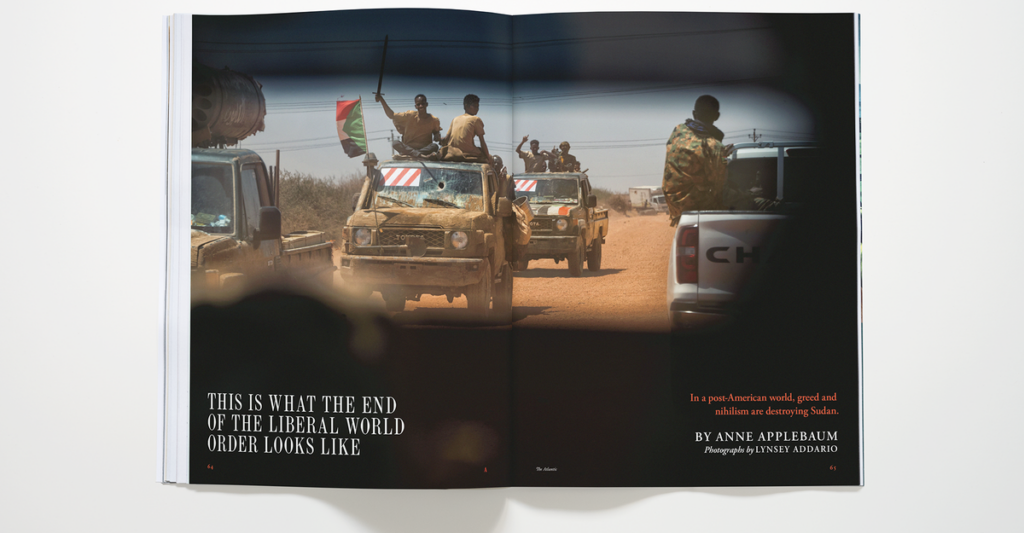
In the September issue, Anne Applebaum documented the anarchy and greed of Sudan’s devastating civil war.
I have studied Sudan all of my adult life. I lived there in 1980 and wrote my doctoral dissertation on Sudanese foreign policy. It’s a country, I learned, that breaks the heart of anyone who loves it.
In the years since, I have not found a single American article or book on Sudan that did not get some detail wrong. But Anne Applebaum’s “This Is What the End of the Liberal World Order Looks Like,” deeply depressing though it is, gets everything right. It even conveys, somehow, the feeling of Sudan.
I had thought that I should write something about the utter depravity of the current civil war, but now I don’t have to. The absence of any coverage was horrifying. The scale of the tragedy in Sudan has to be described before anyone will try to do anything about it.
Sally Ann Baynard Alexandria, Va.
In “This Is What the End of the Liberal World Order Looks Like,” Anne Applebaum writes that “Sudan is a good place to fight.” But we should also remember that Sudan is a good place to wage peace.
Beginning in 1989, Jimmy and Rosalynn Carter made Sudan a primary focus of their peace-building efforts. During the Second Sudanese Civil War, President Carter negotiated a six-month humanitarian cease-fire—during which international health workers were able to enter the country to support more than 2,000 Guinea-worm-endemic villages and distribute more than 200,000 cloth filters for drinking water. Now, less than 40 years later, we have forgotten the success of that effort.
The Sudanese people, too, have proved their skill as peace builders. In 2018 and 2019, young people—undeterred by decades of war and authoritarian rule—demonstrated nonviolently, culminating in the removal of the dictator Omar al-Bashir. After war broke out again in April 2023, ordinary citizens negotiated local peace deals. Today, Sudan’s Emergency Response Rooms, volunteer-led initiatives providing humanitarian aid to civilians, exemplify the resilience of the country’s citizens.
The Trump administration has taken important steps toward an agreement, but Congress and the White House must escalate their advocacy with Sudan’s warring parties and regional backers. Sudan’s fighters must allow humanitarian access everywhere it is needed, especially al-Fashir. And the global community must support negotiations for a cease-fire.
If there is nihilism in Sudan, let us acknowledge that it belongs not to the Sudanese people, but to the rest of the world. The Sudanese remain committed to conflict resolution. We must join them in the fight for peace.
Benjamin Spears Atlanta, Ga.
As a long-ago newspaper correspondent in West Africa, I greatly admire Anne Applebaum’s intrepid reporting on Sudan. Her judgment that the “liberal world order has already ended” there, leaving nothing “to replace it,” is hard to dispute. It does, though, presuppose that such an order ever carried political weight in Sudan or sub-Saharan Africa more broadly.
True, the World Bank, the International Monetary Fund, and other multilateral development and disaster-relief institutions labor in the field. So, as Applebaum movingly showed, do a number of extraordinary humanitarian NGOs. What has long been missing, however, is any coherent or consistent undertaking by the former colonial rulers and the United States to deter disorder and promote democratic stability.
The liberal world order failed a significant test on January 13, 1963, when Togo’s then-president, Sylvanus Olympio, was assassinated. That evening, the American, British, and French ambassadors to neighboring Dahomey (now Benin) and its president, Hubert Maga, considered whether and how to respond.
They concluded that no effective redress was feasible. The ambassadors’ governments were unprepared to act, and at the time, Dahomey’s military forces moved mostly on bicycles. Thus, until he died in office in 2005, Gnassingbé Eyadéma, the former French-army sergeant who masterminded Olympio’s murder, ruled Togo. His son succeeded him as president. Even without the title, he holds power there today.
Dahomey’s army chief of staff deposed Maga less than a year after Olympio’s death. Similar coups toppled leaders in Nigeria (six times), Ghana, Liberia, and other countries. Over the subsequent decades throughout much of Africa—not just in Sudan—the phrase liberal world order has carried the oxymoronic ring of the Holy Roman Empire.
Alfred Friendly Jr. Washington, D.C.
The Man Who Ate NASA
The agency once projected America’s loftiest ideals, Franklin Foer wrote in the September issue. Then it ceded its ambitions to Elon Musk.
Franklin Foer’s article “The Man Who Ate NASA” mentions only in passing NASA’s greatest achievement to date: the James Webb Space Telescope. The telescope is an unrivaled accomplishment. Its design, construction, and flawless deployment came about through international cooperation spearheaded by NASA. Such a project requires visionary, sophisticated leadership that respects all collaborators. A leader who lacks humility and demands obedience is unlikely to bring about a similar success, no matter his level of wealth and power. This is the great tragedy of Elon Musk’s ascendency within the space industry. This may be tragic for Musk, but if left uncorrected, it will be a still-greater misfortune for the United States and the international community.
Kathleen Early Campbell, Calif.
My Father’s Work
When the greatest musicians of the 1970s needed an instrument—or a friend—Nancy Walecki’s dad, Fred, was there, she wrote in the September issue.
I’m not a person of any fame, so it was a new feeling to see the face of someone I know when I opened the September issue. Fred Walecki and I were friends during our days together at the Vineyard Church in Los Angeles. In the early 1980s, we met for breakfast every Wednesday at Mary & Robbs, a diner up the street from Westwood Music. We’d discuss spirituality, sin, music, social issues—just about everything.
I was in my early 20s when I first met Fred, and in the first of the many crummy bands I’d end up in during that period. He was 10 years older and a kind of mentor to me. In her article, Nancy Walecki describes her father’s tireless joy for helping addicts of all stripes toward sobriety. One of the people Fred helped was a family member of mine. He had a way of making even something as serious as addiction feel lighter—and beatable.
Even though Fred knew many of my rock heroes personally, he never name-dropped. He was always just happy, warm, joyful Fred. The smile was real, and he was generous with his time with everyone, including me.
A few months ago, I returned to Westwood and found it to be a shadow of its former self. It’s a lot of empty storefronts now. Tragically, Westwood Music is one of them. Peering through the window, I wished that I’d kept some small memento from the place, which housed so many warm memories for me. Westwood Music was where virtually anyone could walk in, sit down on the couch with a cup of coffee, and have Fred treat you the same as he would Joe Walsh. And then Joe Walsh would walk in.
Mark Wagner Camarillo, Calif.
Behind the Cover
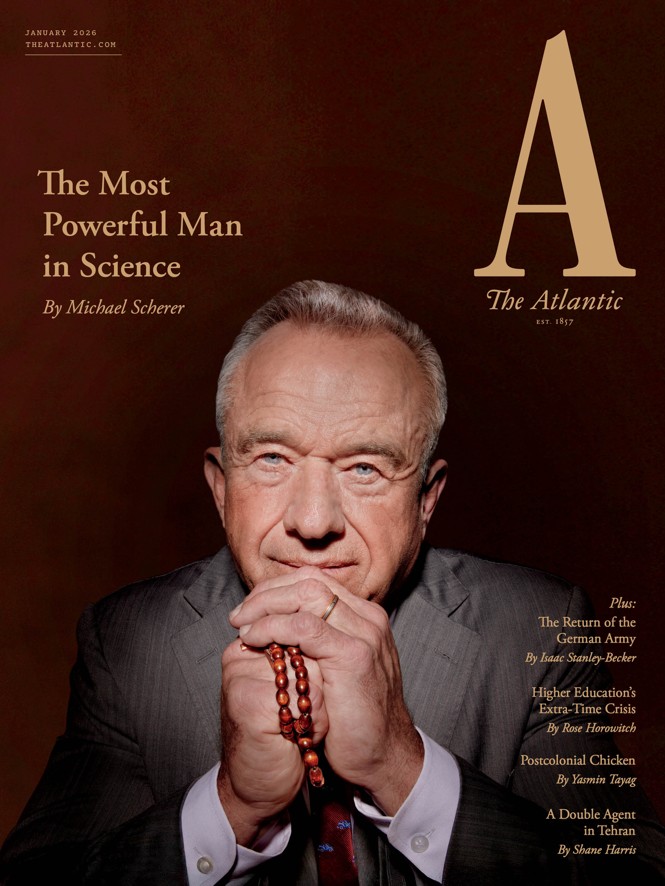
In this month’s cover story, “The Most Powerful Man in Science,” Michael Scherer profiles Secretary of Health and Human Services Robert F. Kennedy Jr. Kennedy has broken with his family and his former political party, and has attacked the scientific establishment. For this month’s cover image, the photographer Elinor Carucci—known for her intimate explorations of family and identity—captured Kennedy in his HHS office. Kennedy suggested that she shoot a portrait with him holding his rosary.
— Bifen Xu, Senior Photo Editor
This article appears in the January 2026 print edition with the headline “The Commons.”
The post ‘Sudan Is a Good Place to Wage Peace’ appeared first on The Atlantic.