Claire Lai is Jimmy Lai’s daughter.
Five years ago, my father, Jimmy Lai, was a large, robust man. Friends and family knew when they were coming over to our house for dinner that they were in for a feast. Dad loved to share the things he enjoyed, and he very much enjoyed good food. But his time behind bars in solitary confinement is taking its toll on his body.
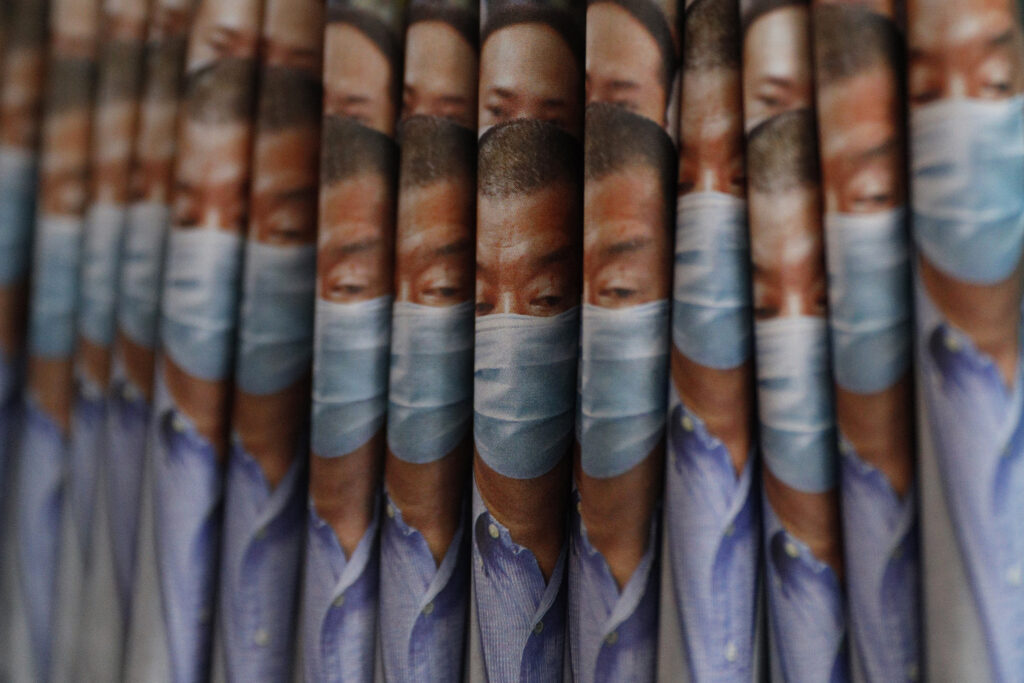
Half a decade since his incarceration as a political prisoner in Hong Kong, my father, who turned 78 on Monday, is suffering from rapidly deteriorating health. He has diabetes and hypertension, his hearing and vision are failing, he has suffered from months-long infections and is in constant pain that sometimes leaves him struggling even to stand up. But the most visible and alarming sign of his plight is severe weight loss.
I sometimes wear a shirt he wore back in the days when his arrests began in 2020, a time when he was still nicknamed “Fatty Lai.” The shirt would swallow him now. His decline has become a constant concern for our family. We know little of the medical care he might receive, because no outside physician has been allowed to examine him.
My father, a newspaper publisher, has faced trial after trial in Hong Kong for taking symbolic actions that would bring no consequences in most countries, such as lighting a candle in remembrance of the victims of China’s Tiananmen Square massacre and supporting peaceful pro-democracy demonstrations in Hong Kong.
For the past two years, my father has been on trial under Hong Kong’s arbitrary and draconian national security law. Both in the courtroom and during prison visits, I was able to observe him closely. His skin is drying up, his nails are changing color before falling off, and his teeth are decaying. His eyes are often dry and bloodshot. I’ve been told that some of this may be due to vitamin deficiencies, which wouldn’t surprise me, given his prolonged incarceration in a cell without direct access to sunlight or fresh air. My heart breaks thinking of his enduring five sweltering Hong Kong summers in a tiny, airless concrete box with a bed as tough as a wooden plank.
There have been some worrying incidents, too. In June 2024, he came to court pale and shivering so intensely that the proceeding was adjourned for the day. He was given a painkiller and sent back to his cell. Two months later, I received a call from a welfare officer saying a scheduled legal visit had to be canceled as my father was too unwell. Four months ago, his lawyers explained to the court that he had been experiencing heart problems for several months, and they had become so severe that he could not appear. He had no heart problems before his incarceration.
I grew up in a loving family, privileged and protected but never blind to the sacrifices, achievements and values of my parents. My father made his fortune in the apparel business, but by the time of my birth he was devoted to journalism. He founded the Apple Daily newspaper because he believes passionately that freedom depends on access to information.
People often ask how he is coping. His religious faith sustains him. He says God is with him at every step, prayer brings him joy, and the prayers of others bring him a lightness of being. The first thing he asked me to bring him after he was arrested was the Bible he kept on his nightstand at home.
He is innocent of any crime. But even though the Chinese government disagrees, I believe that setting him free would be to the government’s advantage. He has suffered enough, and unless something changes, he is very likely to become a martyr for freedom.
If released, he would leave Hong Kong and pose no threat to the regime. His crusading days are over, and he wishes only to live out his remaining time in peace with family, joining us around the dinner table again. The final arguments in his national security trial wrapped up at the end of August, and we await a verdict. May the government have the wisdom to see the better choice, and may he return to us soon.
The post My dad is shrinking to nothing. If China fails to act, he’ll be a martyr. appeared first on Washington Post.