Tokyo contradiction No. 1: This city is very old, with roots in a thousand-year-old fishing village, yet successive cycles of destruction and renewal have left it with relatively few historical landmarks. Tokyo contradiction No. 2: This city is very large, still near the tippy-top of the world’s population rankings, and yet its zoning-be-damned mix of glass towers and back street cottages make it uncommonly congenial. Easy to navigate, easy to love, the Japanese capital is an open-air museum of modern architecture and design, and lately there’s no place I prefer to wander through on a long layover, getting lost among the Ginza galleries and the Jimbocho bookstores between reservations at the sushi counter. Because — Tokyo contradiction No. 3 — this always-moving metropolis is also perfect for cultural digressions, and best discovered at an art lover’s leisurely pace.
Find these five and discover more art on our Google map of Tokyo.
1. The birth of the Buddha, tiny but sublime
At the entrance of the Gallery of Horyuji Treasures, a refined annex of Tokyo’s national art museum in Ueno Park, visitors look out onto a grove of cherry trees through an elegantly partitioned wall of glass. But sheltered from the light, in a dim and dramatically spotlit interior gallery, are my favorite works of sculpture in Tokyo: a tiny quartet of gilded bronze figures from the seventh century, depicting the birth of the Buddha with astounding economy and grace.
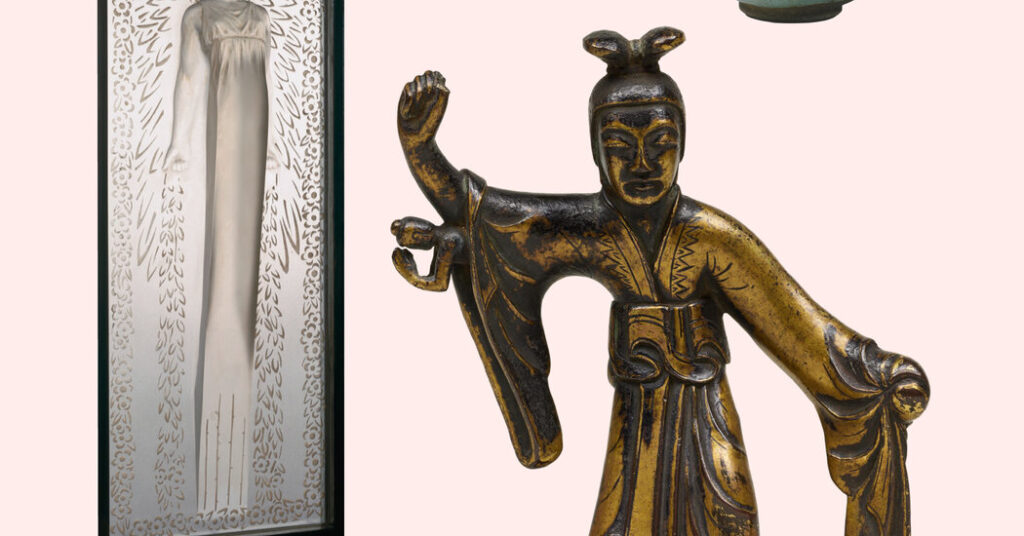
The tallest of the figures, though still just 6.5 inches tall, is Maya, the pregnant mother of Siddhartha Gautama. She appears mid-stride in a garden in present-day Nepal, raising her right arm to grasp the branch of a tree — and as she does her child emerges, headfirst, hands clasped in prayer, out of her gown’s right sleeve. Maya’s face is clenched, tense; the Asuka artist who sculpted her 1,400 years ago drew on imported Chinese examples to give this figure a rare new sense of individual character. But there is action alongside the devotion, as three other heavenly figures fall to their knees to celebrate the Buddha’s arrival. Their gowns are thrust out behind them, as if they’ve just swooped down.
These and the other Horyuji Treasures — masks, banners, lacquerware, calligraphy, guarded for a millennium by an order of monks — are very rare antiquities from the first years of Buddhist Japan. They were almost destroyed in the late 19th century, amid the whirlwind modernization of the Meiji Restoration.
Only in 1999, when the great architect Yoshio Taniguchi completed this exquisite permanent home, did they emerge from storage, into perhaps Tokyo’s most illustrious display of ancient Japanese art. The tone in Taniguchi’s concrete chamber is hushed, even severe, but my beloved Nativity scene stands apart. The moment of his birth is glorious but also surprisingly lighthearted, as if this world-changing moment were also a garden party.
Gallery of Horyuji Treasures, Tokyo National Museum, 13-9 Ueno Park, Taito.
2. A doorway from Europe to Asia, made of milky glass
The flip side of Tokyo’s forward-charging animation is that you have to hunt for historic architecture; even the emperor lives in a concrete building dating to the 1990s. But a rare and sumptuous Art Deco masterpiece, formerly an imperial residence and now the Tokyo Metropolitan Teien Art Museum, offers a portal to the early Showa period, when European modern design and Japanese craft merged to create a new manner of lush living.
The thresholds of that portal are four screen doors on the ground floor, whose inset panels were completed by the French glass pioneer René Lalique in 1933. The milky doors bulge with reliefs of elongated goddesses, whose bodies are ringed by hundreds of calligraphic chevrons: angels’ wings transformed into abstract sunbursts. Lalique never set foot in the house, or anywhere in Japan, but the doors are the somewhat unexpected survivors of a long mutual formation of European and Asian tastes. French artists and artisans had indulged a decades-long fixation with all things Japanese. Now, in Tokyo, their adoption of blocky color and flattened spaces came right back home.
The doors offered a suitably grand entrance into the home of Prince Asaka Yasuhiko, a junior member of the imperial family who would enter the history books for reasons other than design savvy. In 1937, a few years after the Lalique doors were installed, Asaka set in motion the Rape of Nanjing, one of the most gruesome atrocities in world history. The prince lost his title after his uncle Hirohito’s surrender, and the postwar government seized the mansion he and his wife built, with its sleek chairs and desks as curvaceous as an automobile. Modernity was still a thing of glamour in Prince Asaka’s 1930s house, but the coming fate of the royal and the country were as opaque as the glass.
Tokyo Metropolitan Teien Art Museum, 5-21-9 Shirokanedai, Minato.
3. An old Olympic Stadium with a roof that still awes
The Covid-delayed, zero-spectator Tokyo Olympics of 2021 did not leave much of a legacy here — certainly nothing to compare with the Summer Games of 1964, which remade the crowded, polluted postwar capital into a megalopolitan ideal. Along with the railways and expressways, the skyscrapers and shinkansen, the crowning glory of Tokyo 1964 was the Yoyogi National Stadium, an arena whose vigorously engineered roof has become a landmark of Japanese building ambitions.
Designed by Kenzo Tange, the architect of the Hiroshima Peace Memorial Museum (and, later, the Shinjuku tower, atop which Bill Murray and Scarlett Johansson idle in “Lost in Translation”), the stadium takes its form from a system of suspension cables, more familiar from bridge design. Draped from those cables is a roof that swoops down like a pair of misaligned hawk’s wings. Beneath is a grand, dynamic hall without a single interior pillar. The stadium declines to make a show of its monumentality. Slung low in Yoyogi Park, its iconic fanning roof does not jump out at you as you walk to the Meiji Jingu shrine or the shops of Harajuku. But inside, under the plunging canopy roof, you are in a cathedral of sweat and celebration.
During the U.S. occupation that followed World War II, American service members and their families lived in the area where this stadium sits; they used to call the neighborhood Washington Heights. The context is important, because in the years after the war, young architects like Tange faced not only conundrums of engineering but also challenges of national symbolism. How could modern architecture express a Japanese character without falling into the militarist nationalism of the past? In 1964, the answer lay in high engineering and pure form: in distilling this project of postwar reconstruction into a spectacular geometry.
Yoyogi National Stadium, 2-1-1 Jinnan, Shibuya.
4. A single chipped teacup, and an aesthetic of modesty
The big, crowded national museums in Ueno Park showcase Japanese art as its most aristocratic, devout and refined. But in a small museum on a residential side street in western Tokyo, much humbler objects take pride of place. At the Japan Folk Crafts Museum you will take off your shoes and you will keep your camera phone in your pocket. Then, in the dim light, you will discover a deceptively modest collection. A rustic iron brazier. A pair of slippers woven from straw. A broken bowl repaired with rivulets of gold.
These unprepossessing objects are embodiments of mingei, or “art of the people,” a term coined by the philosopher Sōetsu Yanagi, who founded this museum in 1936. The museum rotates its large holdings through its small spaces rather frequently, but one reliable source of low-key beauty are the instruments for preparing tea. On my last trip I found myself gazing at a single bowl of no great sophistication: a simple green glaze with scratches across its surface, and a wobbly and uncertain rim. It was precisely the modesty of this article that allowed it to take on, through ceremonial use, a kind of majesty.
In mingei the colors are muted, the finishes rough, and the artisans unnamed; indeed, this museum has a strong aversion to labels, in furtherance of Yanagi’s belief that ordinary objects can speak for themselves. (Its collection of 17,000 pieces is rather diverse, as Japan goes, with Korean and Chinese objects as well as crafts from Okinawa and from the Ainu, the Indigenous population of Hokkaido.) What the textiles, vases and baskets all have in common is a functional beauty that turns everyday things into things of value: if not financial, then perhaps spiritual. “Even the common articles made for daily use,” Yanagi wrote, “become endowed with beauty when they are loved.”
Japan Folk Crafts Museum, 4-3-33 Komaba, Meguro.
5. A visionary architect’s bookish retreat from the megacity
In a city so unromantic about historical preservation, contemporary architects don’t just keep Tokyo moving forward; they offer an argument for understanding a neighborhood, a capital, a country in time. Of all of today’s Japanese architects, the one who means the most to me is Toyo Ito. And the building of his I am most impressed by is at Tama Art University, Japan’s leading art school, where Ito built a quietly majestic library of concrete and glass.
During the school year the general public can enter the study spaces by reservation, but my favorite spot, a reading area on the ground floor, is open to all comers. Here Ito extends the incline of the site via a sloped concrete floor; irregularly angled rib vaults provide rhythmic variation, and perfectly recessed lunette windows dissolve the interior into the gardens outside. A cave, a cloister, a concrete arcade: In a city of 20 million, you need a place to cocoon.
Ito is the paterfamilias of a generation of architects (Kazuyo Sejima, Junya Ishigami, Sou Fujimoto) who transformed Japanese architecture into an airier, more transparent language. Where there had been heavy concrete, or postmodern ornament, now everything has become lighter and more natural: The newest technologies were deployed to make the cleanest and most minimal spaces. You could spend a week, or a year, hunting out these architects’ buildings all over the city. Or you could just pull up a book in here, beneath the arches, and let the light do its work.
Tama Art University Library, 2-1723 Yarimizu, Hachioji.
More Art to Discover
Find all of these on our Google map of Tokyo.
-
Kanei-ji Temple, Ueno: a usually quiet Buddhist temple of the Tokugawa shogunate (or what remains of it, after the Meiji Restoration). Home to a five-story pagoda and a curious memorial commemorating the lives of crickets and flies.
-
Old Asakura House, Daikanyama: a fancy home from 1919 and survivor of the Great Kanto Earthquake and firebombings, offering a rare glimpse of Taisho architecture and garden design. Take off your shoes!
-
Rikugien Gardens, Komagome: at last, a proper site of the Edo period. Come for a stroll and a bite; there are teahouses among the maples and ginkgos.
-
21_21 Design Sight, Roppongi: Museum of fashion, craft and other applied arts, in a hushed, low-slung building designed by the architect Tadao Ando with the clothing designer Issey Miyake.
-
Cow Books, Nakameguro: a small but well-stocked art bookshop along the river, with rare, covetable Japanese photography volumes and a large selection of 1960s and ’70s English-language titles. Good coffee, too.
-
Prada boutique, Aoyama: the epicenter of 2000s nostalgia, now one of the capital’s most iconic buildings, by the Swiss architects Herzog & de Meuron. The bulbous green diamond windows, the clash of resin and thick moss: The future was coming, once.
-
St. Mary’s Cathedral, Sekiguchi: a brawny Catholic landmark by Kenzo Tange, featuring an asymmetrical concrete cross clad in stainless steel. Watch, through the Brutalist gloom inside, as the light shines through the narrow glass.
-
Takarazuka Theater, Yurakucho: Tokyo home of the all-female, all-singing, all-dancing theater troupe. Wild, and wildly popular: Think Sapphic “Wuthering Heights” with a kick line.
-
Old Imperial Bar, Yurakucho: a cocktail lounge designed by Frank Lloyd Wright. Or at least there are some surviving Wright elements: After your first highball, it’s a distinction without a difference.
Jason Farago, a critic at large for The Times, writes about art and culture in the U.S. and abroad.
The post My 5 Favorite Works of Art in Tokyo appeared first on New York Times.