The percentage of medication abortions arranged via telehealth grew again in the first half of 2025, according to a report released Tuesday, despite Republican efforts to keep doctors in blue states from prescribing pills to women in states where abortion is illegal.
Twenty-seven percent of the nearly 592,000 abortions provided from January to June relied on clinicians prescribing and mailing pills to patients seeking care remotely, according to the report by #WeCount, a project from the Society of Family Planning, which supports abortion rights. The number, up from 25 percent at the end of 2024, comes as Republicans file lawsuits and enact legislation to try to curtail pill access.
The slight tick upward shows how telehealth has “become a lifeline” for women seeking to end their pregnancies, especially those who live under abortion bans, Ushma Upadhyay, co-chair of the study and a professor at the University of California at San Francisco, said in a statement Tuesday.
The availability of medication abortion through telehealth bloomed in 2023, when eight states enacted “shield” laws that allow providers there to legally mail abortion pills to patients in states with abortion bans. Seeing this pipeline as the biggest threat to the antiabortion movement, conservative politicians have unsuccessfully tried various legal and legislative strategies to stop the flow of abortion pills into their states.
The data shows that women are still turning to out-of-state providers for help ending their pregnancies.
In June alone, more than 14,000 women were prescribed abortion pills by providers in shield-law states, the report says. The total number of abortions in the U.S., via all methods, has been increasing since 2022, when the Supreme Court ended the constitutional right to an abortion in Dobbs v. Jackson Women’s Health Organization, the study shows.
The report’s authors say its figures are probably lower than the true number of abortions happening in the country. The project does not track abortions that occur without the direct involvement of a clinician, such as when a pregnant woman buys abortion pills from a website that does not require a professional consultation.
The group began tracking abortion numbers in April 2022, two months before the Supreme Court decided Dobbs.
Since then, the U.S. has seen a patchwork of state abortion policies, including bans, emerge, largely along party lines.
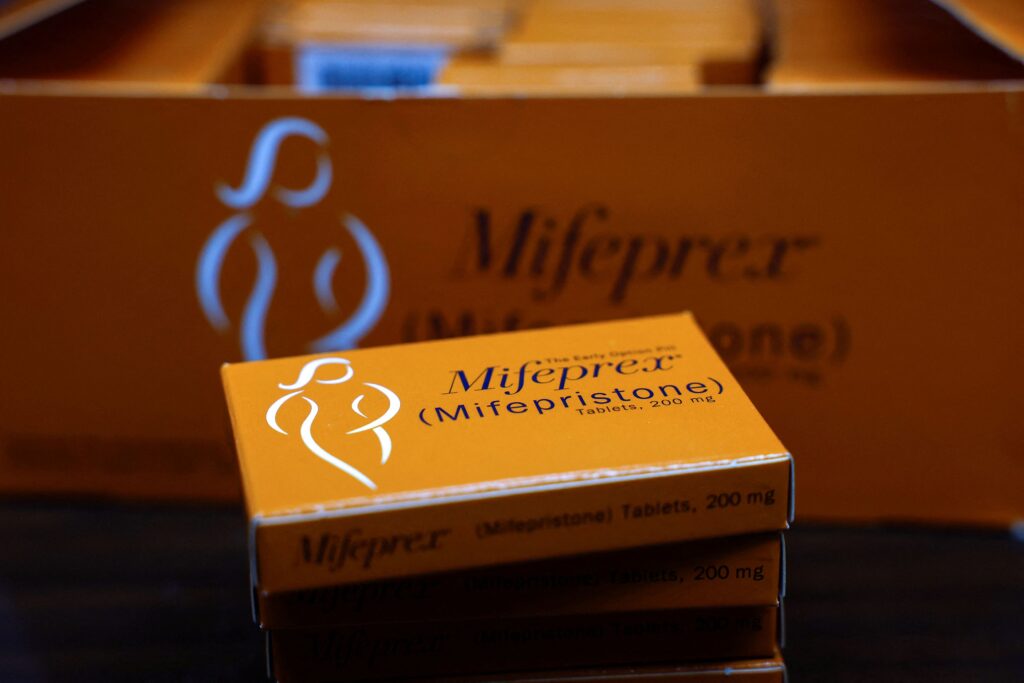
In Republican-led states, politicians and lawyers are waging legal battles to undo shield law protections. They pushed the Food and Drug Administration to start a review of mifepristone, the first drug in the typical two-step regimen for medication abortion. Last week in Texas, where abortion pills are banned, a new law took effectallowing almost any private citizen to sue a range of people involved in getting abortion pills to patients in the state.
Rachel Rebouché, a professor at the University of Texas School of Law specializing in reproductive health law, said the consistent rise in the number of telehealth abortions shows how well-versed women across America have become in how to get abortion pills and when to use them.
Even if one of the antiabortion efforts to halt that access succeeds, Rebouché — who is not affiliated with #WeCount — said medication abortion is “not going to go away overnight.” She predicted that people would find other ways to preserve access.
“It’s not impossible, but it’s going to be very hard to stop,” said Rebouché, who helped craft the shield laws.
Abortion advocates have responded to the conservative attacks by trying to strengthen protections for clinicians. They have formed coalitions to fight lawsuits against providers. They have spearheaded legislation to keep the names of providers and patients off pill packages to prevent legal repercussions. Those measures have allowed advocates to keep their pill-mailing networks in place.
Women are taking advantage. In states like Texas where the procedure is banned, all or almost all of the abortions that occurred within their borders took the form of mailed abortion pills, according to #WeCount’s data for the first half of 2025.
That was the case for Maria, a 33-year-old who lives in Indiana, where most abortions are illegal. She asked to use only her first name because she fears legal retaliation.
Maria searched online to learn about her options, starting with out-of-state clinics where she could get a legal abortion. But they were hours away, and she couldn’t afford to take the time away from her job and her two young daughters. Instead, she found a provider in Massachusetts who could mail abortion pills to her.
She was nervous she wouldn’t be able to afford them, but the provider offered a sliding scale of payments starting at $5. Maria paid $20, and the pills arrived days later in a generic white mailer.
Inside, along with the doses and instructions, was a note with handwritten messages from the volunteers who had packed it.
“We hope the best for you,” one wrote.
It was comforting, Maria said, to know that the strangers who helped her were on her side.
The post More women accessing abortion pills online despite red state efforts appeared first on Washington Post.