This personal reflection is part of a series called Turning Points, in which writers explore what critical moments from this year might mean for the year ahead. You can read more by visiting the Turning Points series page.
Turning Point: In an effort to protect young people, a new law in Australia set 16 as the minimum age to use social media platforms like TikTok and Instagram.
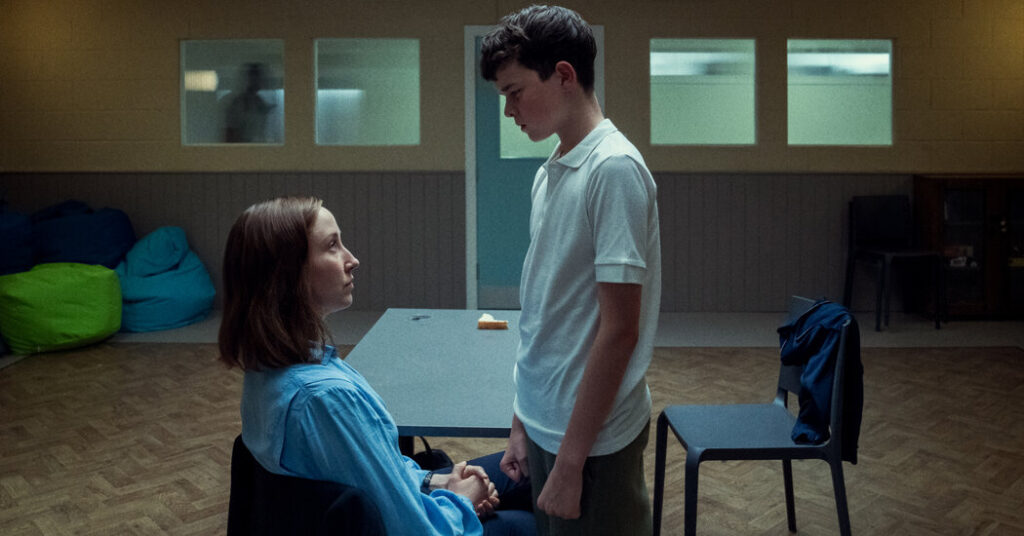
When I first started working on the Netflix series “Adolescence” with Stephen Graham, my knowledge of the “manosphere” was minimal. I dismissed it as something niche, a world foreign to me and full of people in which I had little interest. I discovered, through research, that I’d vastly underestimated its power and reach.
Stephen originally wanted to write a show about knife crime in Britain after hearing about a series of murders in which teenage boys had stabbed teenage girls to death; he wanted to better understand the motive behind these crimes. As we began the process of creating our main character, Jamie, a 13-year-old boy accused of killing his female classmate, Stephen had one rule: He didn’t want this to be the sort of formulaic drama that exclusively blamed the parents — that said that Jamie did this because his mother was an alcoholic or because his father was abusive. Instead, we set out to create multiple spheres of blame — schooling, home life, friendships — so we could really look inside Jamie’s head and consider a wide range of factors that could have influenced his rage.
But as I was building and researching Jamie, there was something about him I couldn’t quite find. That’s when Mariella Johnson, my writing assistant, said I should look at incel culture: a subculture within the manosphere of “involuntarily celibate” men.
The “manosphere” is a strange term and, like a lot of attempts to pin down what happens on the web, implies a uniformity that really isn’t there. How you define it often depends on how you think of it. It is perhaps best defined loosely: a set of online communities that focuses on issues relating to masculinity. Within it, you can find men’s rights activists (who believe women oppress men), “seduction” specialists (who teach members how to coerce women into having sex with them) and, perhaps, incels (who believe women purposely deprive them of sex). I say “perhaps incels” because many within the incel community dislike other members of the manosphere, and many within the manosphere dislike incels. But in truth, dislike is rampant among the subcommunities that might be grouped under a manosphere heading.
As soon as I came across a statistic that supports incel ideology — that 80 percent of women are attracted to 20 percent of men — I knew the manosphere would be a vital building block in finding who Jamie was. I thought, yes, this idea would have impacted me hugely as an impressionable, lonely 13-year-old who was very scared that “normal life” was beyond him. And while I don’t think, and don’t think “Adolescence” suggests, that Jamie became violent simply because he consumed these thoughts, I do believe he was fed damaging content that became part of who he was and is.
I subsequently spent a long time looking into incel content while working on the show. I read as many books on the subject as I could and spoke to young adults. I also explored lesser-known places on social media. Andrew Tate and the more prominent members of the manosphere didn’t interest me because I didn’t think they’d interest Jamie. They are, if you like, at the top of the waterfall. Spilling out from them are all sorts of people making less popular content, and I was looking for the midpoint in the waterfall.
The male teenagers making videos about their lives, talking about gaming or gym techniques or films, who then also talked about women — that was where I thought Jamie would live online, that is where young people told me they were going. As I scrolled, I noticed the packaging on their videos would say one thing, but I would find something else entirely inside. These young men would talk about their day-to-day, and within that, vent their frustrations about women. What appeared to be informal tips for how to improve your physique would descend into misogynistic rants filled with doubt and hate that I found extremely disturbing.
After spending time in schools both before and since, I don’t think all boys have been damaged by their online consumption like Jamie was, not to any degree — but some have. I’ve spoken to teenage girls who told me they don’t talk in class because of a group of boys who intimidate them. I’ve spoken to female teachers concerned about their own safety, who’ve been verbally and physically abused by those same boys. I am a parent of a 9-year-old boy and am scared of the environment he has been plunged into.
I have had many arguments about what the appropriate response to all of this is. As Stephen says, the most vital thing is conversation, and the best responses we’ve had were from friends or strangers telling us that after they watched the show, they have been able to talk to their children about what they consume online. Personally, I would go even further and challenge the notion that social media is something that young people should be exposed to.
Why? At a Smartphone Free Childhood meeting I attended, they hit us with shocking statistics: In Britain, the National Health Service has in the last 10 years seen a 70 percent decline in accidents happening outside for young people, while in the same decade there has been a 93 percent rise in incidents of self-harm. Three-quarters of all British children now spend less time outside than prison inmates.
Countries like Australia, France, Brazil and South Korea are trying to limit phone access for young people by enacting laws. It is not a matter of restricting freedoms — it’s about saying that maybe the plasticity of the adolescent brain is not quite ready for the addictive qualities of social media.
But we didn’t write “Adolescence” to give answers; we are not policymakers or polemicists. We wrote the show because we believed in the story and wanted to generate a series of questions about ways to look at the contemporary problem of male adolescence. I hope that it is something people continue to discuss because if we don’t, I do think the problem of male rage is only going to get worse.
Jack Thorne is an Emmy, BAFTA, Olivier, Tony and WGA Award-winning screenwriter, producer and playwright.
The post Mining the ‘Manosphere’ appeared first on New York Times.