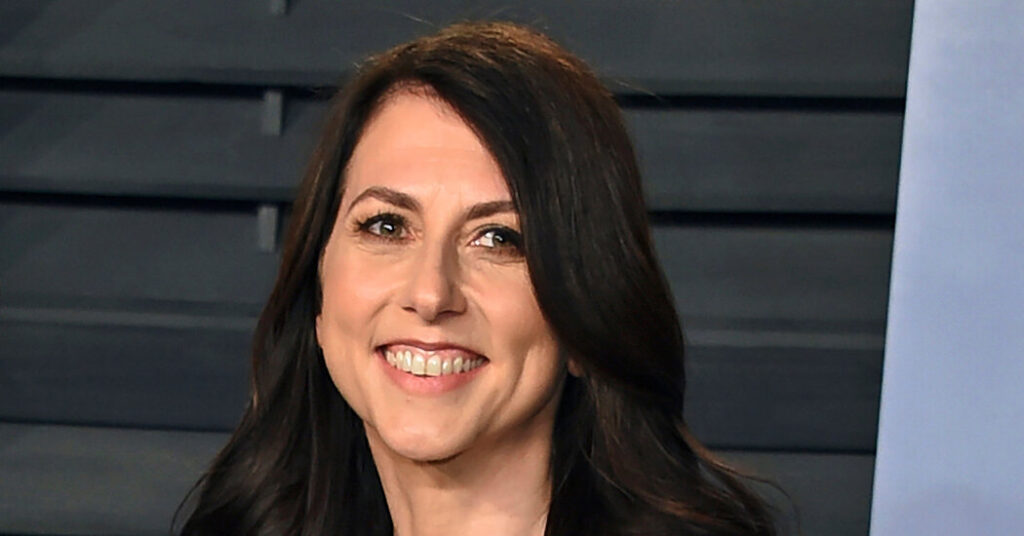
The philanthropist MacKenzie Scott announced on Tuesday that she had made donations in the past year totaling nearly $7.2 billion, vaulting the total value of her gifts to over $26 billion.
Since divorcing Amazon founder Jeff Bezos, Ms. Scott has come to embodya new brand of philanthropy. She has made large gifts to nonprofits that were distinguished not just by their dollar value but by the fact that she gave support to groups without dictating how the money should be spent.
Ms. Scott also has devoted a sizable share of her giving to groups that promote equity and racial justice. In a political climate where many donors have pulled back from such giving, Ms. Scott has made gifts to groups that support refugees and work to address climate change, and to historically Black colleges and universities. Conservatives, such as Elon Musk, have attacked Ms. Scott for her progressive leanings.
Her disclosure came one week after Michael and Susan Dell traveled to the White House to join President Trump in celebrating the more than $6 billion they had committed to so-called Trump accounts. That donation is expected to put $250 in accounts for 25 million American children to use when they turn 18, though some progressives criticized it for burnishing the president’s reputation in the process.
Ms. Scott is employing a subtly different public-relations strategy. She usually announces her gifts once or twice a year in blog posts and has criticized media coverage of her philanthropy that centers on the donations and not the recipients.
And so Tuesday, she included the $7 billion figure quietly, by updating the fourth paragraph of a blog post she had published in mid-October. She also updated the database maintained by her philanthropy, Yield Giving, with an additional 225 donations.
“This dollar total will likely be reported in the news,” she wrote in the post that was updated on Tuesday, “but any dollar amount is a vanishingly tiny fraction of the personal expressions of care being shared into communities this year.”
About 70 percent of those gifts went to organizations she had previously backed.
The largest disclosed donation was for $90 million, according to the database, going to an organization called Forests, People, Climate, which focuses on halting tropical deforestation. The next largest disclosed gifts were of $70 million each to the Thurgood Marshall College Fund, the Hispanic Scholarship Fund and the United Negro College Fund, which offer scholarships.
As she often does, Ms. Scott used her post to talk about all the ways that people with fewer resources give. “Who nurtured a child in the kitchen; who was kind to a stranger in line at a grocery store; who gave $50 to a local food shelter: These are not news stories. But all of it matters,” Ms. Scott wrote.
Phil Buchanan, president of the Center for Effective Philanthropy, which has analyzed Ms. Scott’s giving, said the size of her gifts was notable: roughly a median of $5 million, compared with foundations’ median grant size of about $123,000.
“A lot of folks predicted all kinds of problems with gifts this size,” said Mr. Buchanan, whose nonprofit received $10 million from Ms. Scott in 2021. “Across our data we’re seeing positive, transformative effects for these organizations.”
Nicholas Kulish is an enterprise correspondent for The Times writing about philanthropy, wealth and nonprofits. Before that, he served as the Berlin bureau chief and an East Africa correspondent based in Nairobi, Kenya. He joined The Times as a member of the editorial board in 2005.
The post MacKenzie Scott Announces $7 Billion of Giving This Year appeared first on New York Times.