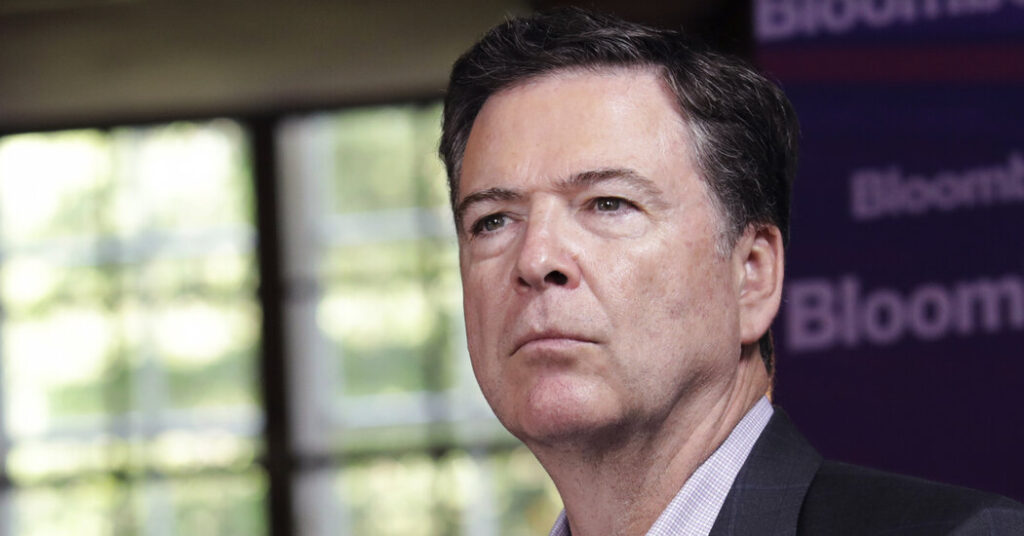
The Justice Department pushed back hard on Tuesday at a court order that undercut its plans to seek a new indictment against the former F.B.I. director James B. Comey, saying it was the result of a “strategic” effort by one of Mr. Comey’s allies to “obstruct” the government’s pursuit of the case.
In a 20-page court filing, prosecutors opposed the decision, issued over the weekend by a federal judge in Washington, that temporarily blocked them from gaining access to a crucial trove of evidence they used to bring charges against Mr. Comey in late September. The case against him centered on whether he lied to Congress in testimony before lawmakers in 2020.
The fight over the evidence amounts to a preliminary struggle preceding the larger question about whether — and how — the Justice Department might bring new charges against Mr. Comey as early as this week.
The bulk of that evidence came from communications between Mr. Comey and one of his close confidants, Daniel C. Richman, a former federal prosecutor who now teaches law at Columbia University. The Justice Department has claimed that Mr. Richman’s emails and text messages show that Mr. Comey lied about using him as a conduit to convey information to reporters about sensitive investigations.
Mr. Richman, however, has argued that the government obtained the files in violation of his constitutional rights. And he persuaded Judge Colleen Kollar-Kotelly on Saturday night to stop prosecutors from gaining access to the files until at least the end of this week, a move that effectively barred the Trump administration from using the materials to seek new charges against Mr. Comey in the coming days.
The showdown over Mr. Richman’s documents — and their use in a potential new indictment against Mr. Comey — is taking place because the Justice Department has been considering recharging him after a different judge, Cameron McGowan Currie, threw out the original case in its entirety last month.
Judge Currie dismissed the charges against Mr. Comey after she determined that Lindsey Halligan, the prosecutor personally picked by President Trump to bring them, had been put into her job as the U.S. attorney for the Eastern District of Virginia unlawfully. Judge Currie’s ruling also killed a separate case against another one of Mr. Trump’s longtime adversaries, Letitia James, New York’s attorney general.
In another embarrassing turn of events, prosecutors working for Ms. Halligan were unable last week to persuade a grand jury to return a new indictment against Ms. James. Despite that failure, the Justice Department has signaled that it may ask grand jurors in Virginia to bring a new indictment against Mr. Comey in the coming days.
In the face of her repeated missteps, Ms. Halligan, who had no experience as a prosecutor until two months ago, has clung to her title as U.S. attorney despite Judge Currie’s clear-cut ruling invalidating her appointment.
Ms. Halligan signed the filing opposing Judge Kollar-Kotelly’s weekend ruling and continued to identify herself as the U.S. attorney. Perhaps as a fail-safe measure, the filing was also signed by Todd Blanche, the deputy attorney general, and Robert McBride, Ms. Halligan’s chief deputy in Virginia.
In their filing, all three argued that Judge Kollar-Kotelly should dissolve her order barring the government from having access to Mr. Richman’s files because it is legally impermissible for someone to use a civil action “to attack an impending federal prosecution.”
The proper procedure, they said, would be for Mr. Comey to seek to suppress the evidence against him when and if new charges were actually filed.
The government’s filing largely sidestepped the basic claims that were raised over the weekend by Mr. Richman, who argued that prosecutors violated his rights when they seized a trove of his emails and text messages while conducting a separate investigation in 2019 and 2020, during Mr. Trump’s first term in office. That inquiry was conducted to determine whether Mr. Comey had leaked information to the news media through Mr. Richman about Hillary Clinton’s use of a private email server.
In his request to Judge Kollar-Kotelly to keep the government from having access to his files again, Mr. Richman claimed that the prosecutors in the first investigation had scrutinized more of his messages than the original search warrants permitted. He also claimed that they improperly held onto the trove of communications after the inquiry ended without charges being filed.
Most important, Mr. Richman claimed that when prosecutors in Virginia renewed their investigation into Mr. Comey just two months ago, they failed to obtain new search warrants to look at his messages again, which Judge Kollar-Kotelly found was in violation of basic constitutional protections.
Mr. Richman was expected to respond to the government’s filing by Tuesday evening, and the judge could soon issue another ruling either reversing or perhaps extending her ban on the government using the evidence.
Alan Feuer covers extremism and political violence for The Times, focusing on the criminal cases involving the Jan. 6 attack on the Capitol and against former President Donald J. Trump.
The post Justice Dept. Fights Roadblock to Pursuing Comey Case appeared first on New York Times.