They left home in a fearful scramble during the summer, seeking refuge on the grounds of a racetrack that had been transformed into a makeshift evacuation center after war erupted between Thailand and Cambodia. Now, five months later, they are back in the same tents, which had been left standing.
Sopida Puprakhon was among the thousands of people who huddled under blankets on Monday night, sleeping next to a motor racing track at the Chang International Circuit stadium in the Thai city of Buriram. Like in July, she was there because a decades-old border dispute between Thailand and Cambodia had erupted again in deadly fighting.
“I’ve gotten used to living this way, with the fear,” said Ms. Sopida, 33, who arrived at the center with her 2-year-old son, her 74-year-old mother, and four containers of clothes, bedding, pillows and blankets.
The new wave of fighting between Thailand and Cambodia has killed at least 10 people, injured nearly two dozen and displaced hundreds of thousands. On Tuesday, a new front in the clashes appeared to open near the Gulf of Thailand, as the Thai Navy said it had conducted “military operations” to expel Cambodian forces that had encroached on Trat Province.
That region is hundreds of miles away from the ancient temples that had been a focus of the dispute earlier this year. Tensions spilled over again on Monday, when Thailand launched airstrikes on Cambodia. Each side has blamed the other for firing the first shot, as shelling resumed across parts of the nearly 500-mile long border.
While the contours of the current conflict are similar to the five-day war in July, this time feels different.
The rhetoric on both sides appears to have escalated.
On Tuesday, Rear Admiral Surasant Kongsiri, the spokesman for the Thai Defense Ministry, told reporters that “military actions will be continued until Cambodia changes its standpoints and returns to the peace process.”
Cambodia’s de facto leader, Hun Sen, said Cambodian forces had exercised restraint to allow civilians to move to safety. Now, he said, they would retaliate.
“Now we fight in self-defense,” Mr. Hun Sen wrote on Facebook on Tuesday. “Cambodia wants peace, but we are forced to retaliate to protect our land.”
Cambodian tanks were being ferried to the border province of Banteay Meanchey, with residents waving at the soldiers in support. Hundreds of thousands of Cambodians had evacuated from border areas, the authorities said. In Siem Reap, some were sheltering inside the Chroy Neang Ngourn Pagoda.
In Thailand, the authorities were better prepared than during the last conflict to host evacuees, who were from four border provinces.
Ms. Sopida, who comes from the district of Ban Kruat, said she received an alert on her phone on Sunday afternoon, urging people to leave their homes because fighting had erupted again. She called her mother to grab the essentials she had packed in August.
In Surin Province, hundreds of people were sheltering at the Sutthi Thammaram temple. On Tuesday morning, children were playing badminton while older evacuees sat together and enjoyed the sun. Some were snacking on instant noodles.
“This is the second time we have sheltered people because of the war,” said Suban Punasiriko, the deputy abbot of the temple. “The temple is always open as a place for refuge.”
Many Thais who live near the border said they had no clear prospect of returning home. But all of them were certain about one thing: their lives on the border would never feel safe again.
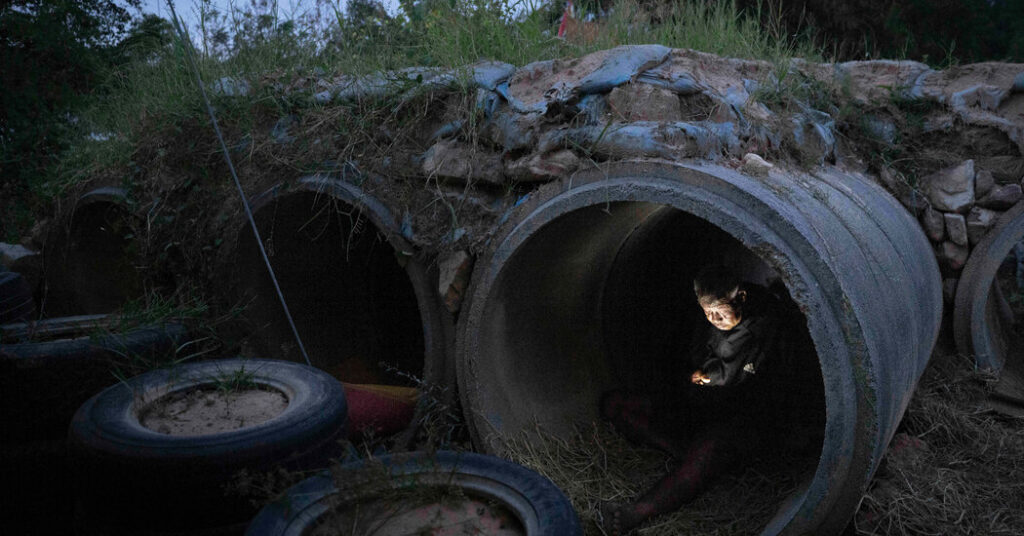
In Buriram, Wuttisak Nakprakhon, 47, said he and his friends dug a hole in the ground to create a bunker next to his house after he returned home after a cease-fire took effect in July.
“Since the last time, we were told that we must prepare and to not be complacent,” he said, sitting next to his go bag, which was packed with four sets of clothing.
Even with their lives upended, I did not sense anger or desperation at the evacuation center in Buriram, just a feeling of helplessness to be at the center of an intractable conflict. Dozens of people gathered on a grassy field to watch a Thai comedy on a giant screen. Children played soccer, laughing as they chased the ball down along the racing track.
The track is owned by Newin Chidchob, the founder of Thailand’s governing party and a mentor of Prime Minister Anutin Charnvirakul. On Monday night, Mr. Newin surveyed the motor racing circuit dotted with tents, clusters of Thai residents and a makeshift hospital.
“No one isn’t tired. You have to understand that we want this to be the last time,” he said, speaking to a group of doctors and nurses from the hospital. “This round is going to be long and tougher.”
As they laid on straw mats placed on raised pallets, both Ms. Sopida and her mother, Ka Mao Saopria, said they had eaten and slept well.
Ms. Ka Mao said she had lived on the border for decades without fear. But recently, she said, soldiers had started saying in jest that they probably should harvest their rice sooner rather than later. Her family took the remarks seriously. She said she was worried about her 35-year-old son and her 64-year-old husband, who stayed back home as “village defense volunteers.”
“I wish in my heart that it would just end so I can be at home with my family,” Ms. Ka Mao said.
Phuriphat Dejsuphong contributed reporting from Buriram, Muktita Suhartono from Surin, Sun Narin from Banteay Meanchey in Cambodia and Kittiphum Sringammuang from Bangkok.
Sui-Lee Wee is the Southeast Asia bureau chief for The Times, overseeing coverage of 11 countries in the region.
The post In Thailand and Cambodia, Taking Shelter (Again) as Fighting Reignites appeared first on New York Times.