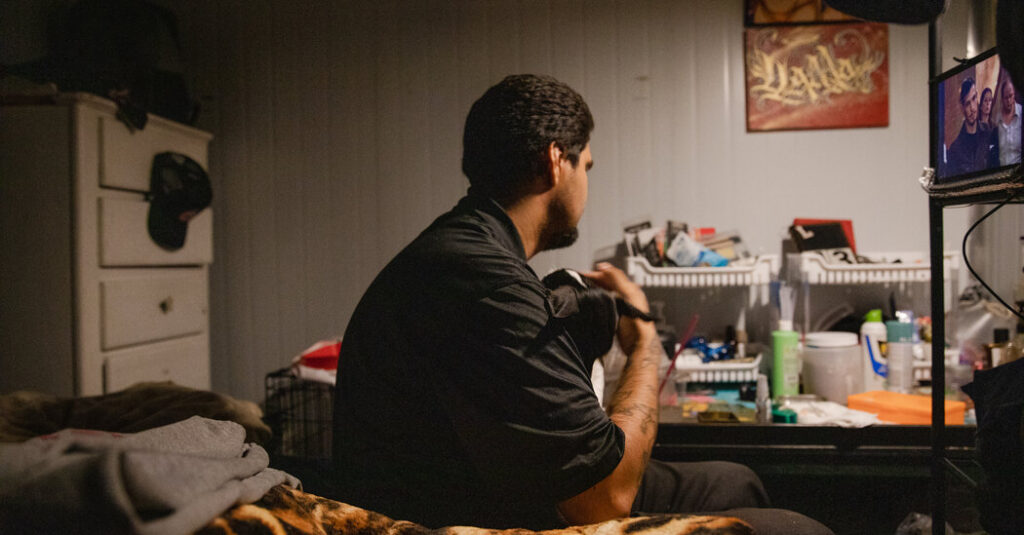
The storage unit, cold, dark and airless, was smaller than a parking space and crammed with belongings. In the center of the room, a foldout bed sagged beneath two brown polyester blankets.
Junior Estrada moaned and pulled them over his head.
He had lived there for more than three months, and on a Saturday in mid-October, he woke up just before 8 a.m., sick with aching bones and a cough. He hadn’t showered in two days. He took a swig of cold and flu medicine.
“I do not want to go. I do not want to go,” he said.
Mr. Estrada faced a four-hour shift serving tacos at one minimum-wage job and six more hours busing tables at another. He had about $17 in cash and -$3.12 in his bank account.
“I have to go,” he said. “I have to.”
Outside, the neighbors, all in their own boxes, were stirring. There was a man who managed a bike store. A woman who left before dawn to bag groceries. And a nursing student who was seen coming and going in his scrubs. About a dozen all told, they lived in a cluster of sheds and storage units tucked behind a house in California’s San Fernando Valley. There was no running water or power. Rent was about $600 to $800 a month.
Mr. Estrada, a 33-year-old father of two, sat up in his unit, beside a clothes rack piled with books on graffiti and gardening.
“Beans, you’re hot, bro,” he said. A piebald rat terrier crawled out from under the covers and into his lap. Mr. Estrada emptied a can of dog food into a bowl and sanitized his hands. There was nowhere to go to the bathroom, so he didn’t. He lit a joint, dressed and packed his 300-watt power station into his backpack.
A co-worker once noticed him charging it and asked: Are you homeless? “I was like, ‘I guess you could say that,’” he recalled telling her. “‘But no, I’m not.’”
He and his neighbors lived in the margin between those with shelter and those without, in the kind of substandard homes that had mushroomed across California in response to the state’s affordability crisis. For Mr. Estrada, who asked to be identified by a nickname in this article to protect his privacy, the living conditions meant barely seeing his 8-year-old daughter and 6-year-old son, who lived less than five miles away with their mother.
They had never visited him in the backyard unit, because Mr. Estrada did not think it was safe. He had not seen them in weeks. “I’m just kind of done living like this,” he said. “I miss my kids. I want to be able to wake up and shower.”
In about two weeks, Mr. Estrada would turn 34. His goal was to move out by his birthday.
In California, the average price for a one-bedroom rental is about $2,100 a month. To afford this, a person earning minimum wage would need to work 98 hours a week, according to the National Low Income Housing Coalition. Many working poor find other options.
In one instance, a three-story medical building in Pico-Union, Los Angeles, was subdivided into 15 illegal units, some so tiny they could fit only a twin mattress. The electrical system became overloaded and a fire reduced the top floor to ash. In another, a family of five paid $1,800 a month to live in a storage shed in the backyard of a single-family home in San Francisco’s East Bay.
“It’s hard to call it affordable housing, because it’s not meant for people to live in,” said Matt Brinton, a Los Angeles lawyer who represents tenants in dangerous living situations. But this is how many thousands of people in California put a roof over their heads, he and other experts said.
In the past two years, Mr. Estrada had lived in the granny flat of a friend, a car in his brother’s backyard and a cubicle in the dormitory of a long-term hostel.
In July, he moved into the backyard unit, which he said was advertised as “off grid.” It cost $750 and required a $200 deposit to hold the room. Back then, electricity was provided by a generator that thrummed so loudly he couldn’t sleep. Residents shared a single portable toilet. Sometimes, Mr. Estrada said, he took a “bird bath” by rinsing himself with bottles of water.
On this Saturday morning before work, he stepped from his room into the backyard, where nine tiny structures were jammed together and shaded by bits of tarp. He called out to a neighbor: Could she please walk the dog while he was out?
At the front of the property, Mr. Estrada opened the gate onto an otherwise quiet cul-de-sac of single-family homes with white picket fences, neatly clipped lawns and rose bushes. Walking to the bus, he recalled the first time he was evicted.
Junior was 8 years old. A neighbor, he said, knocked him out with a broom for playing on her grass. His father confronted the neighbor, he said, and Junior and his friends egged her house. The landlord kicked Junior’s family out.
When he was 14, his parents divorced. A couple of years later, Junior became addicted to methamphetamines. He did several stints in rehab and finally stopped taking the drugs around 2015, he said, adding that he used cannabis to self-medicate. He said he had been diagnosed with attention deficit hyperactivity disorder and bipolar depressive disorder. Sometimes, he cried seemingly out of nowhere.
“I don’t have full control of my emotions,” he said. “I get mad quick. I get sad quick.” Being hotheaded, he said, had caused him trouble in the past. Living in the storage unit did not help his mental health. The trash, the flies and missing his children, Mr. Estrada said, “takes a toll on somebody.”
Outside the bus stop, he walked into a 7-Eleven, where he poured himself a Big Gulp and gave a dollar to an older man with a walker. He rode 20 minutes to a nearby taqueria, where he worked as a cashier and server, politely greeting each customer, mostly in English, and passing off orders to the kitchen staff, mostly in Spanish. He refilled drinks and packed salsa into small plastic containers. After four hours he grabbed his backpack, took more cold medicine and got on another bus.
On the way to his second job, Mr. Estrada called his children. “Am I going to see you tomorrow? You ready to play with Beans?” he said. His daughter, whom he nicknamed Peas, loved sports and scary movies, but not the nightmares that came after. His son, whom he called Eazy, was energetic and down to earth.
He told their mother he planned to see two apartments and hoped she would sign off on the children visiting wherever he landed. Mr. Estrada hung up the phone. “Yeah, I’m seeing my kids tomorrow,” he said, smiling. “I just have to find out where.”
He texted his boss at the taqueria, “sorry to bother you sir.” He told him he was going to see his children and wanted to take them out to eat. “Do you think I could get my check?”
Mr. Estrada said that most months, his paychecks were barely enough to cover his full rent, child support, phone bill, a membership to the gym where he showered, bus fares and meals. But the greatest hurdle to moving was the upfront cost, which often included a security deposit and at least a month’s rent, though some landlords accepted less.
He finished his day with a shift busing tables at a winery, where a tomahawk steak costs $140, and where he ate his first meal of the day, a plate of gnocchi marinara from the kitchen. He still had two hours till the end of his shift.
By the time he got back to his unit — after more than 10 hours on his feet, after more than three hours riding or waiting for buses, after walking Beans and making his bed — it was almost 2:30 a.m.
He said he often dreamed about dying. But, lately, his dreams had been good. “I’m in a fancy car; I’m in a nice house; I got money,” he said.
“My kids are living with me.”
When Mr. Estrada took Beans outside the next morning, one resident lay asleep in an office chair. Another, pushing a cart of five-gallon jugs, was headed out to buy water. And a man wearing a gray robe and moccasin slippers emerged from the house, drinking straight from a carton of oat milk.
He was the landlord, Gregory William.
The city had charged Mr. William, 44, with seven misdemeanors, including using land for unzoned purposes, unlawfully erecting and altering buildings, and failing to secure permits and comply with previous orders.
Mr. William acknowledged that he had been “pushing the envelope” but said he was helping people in a broken economy that had left them unable to meet their most basic needs.
“People are not getting paid living wages; they’re not breathing wages,” he said. “That’s horrible.” He defended his setup as transitional housing of last resort.
He lived in the house, where he slept on a mattress surrounded by mirrors — an arrangement he called his “Lazarus Chamber,” which he said prevented his energy from dissipating at night. He said the experience of being a landlord had led him to practice what he called “non-emotionism,” since he believed emotions were “part of death’s cycle.” He said he wanted to turn the property into a school promoting his belief system.
Like many of his tenants, Mr. William grew up itinerant, he said, and in his 30s, found himself living in a small dwelling in someone else’s backyard.
In 2013, he fixed up a van, with a plan to live in it, he said, but quickly realized he could make money by renting it out. He spent more than a decade as a “vanlord,” leasing about two dozen motor homes for people to live in, he said, until last spring, when the authorities confiscated the last of the vehicles. Mr. William bought the three-bedroom house in late 2022 and installed the storage units, he said, as a place for evicted tenants to store their belongings.
People with nowhere else to go started living in them.
Mr. William said he set rent on a sliding scale based on each tenant’s income. He initially provided water, electricity and a shared kitchen and bathroom. But about a year ago, he said, the utility company cut off services. So Mr. William connected the batteries of his two Teslas to the house and backyard to provide power (he said the storage units were fire proof). In September, he sold the cars to invest in cryptocurrency. After that, he lowered residents’ rent so they could afford power stations, he and tenants said.
It was around this time that Mr. Estrada, fed up with the lack of utilities, stopped paying a majority of his rent, he said. Mr. William said Mr. Estrada never paid it in full.
The Los Angeles Police Department said that in the past two years, it had received about 50 calls relating to the property, many about neighbor disputes, loud music or people making a racket.
“I would say this one is not a huge blip on the radar,” Capt. Brian Wendling, of the West Valley Division, said in an interview. “We have all kinds of unpermitted dwellings all over the place.”
A spokeswoman for Mayor Karen Bass said that “all Angelenos deserve safe and affordable housing,” but did not respond to some tenants’ claims that they had sought government assistance, to no avail.
Asked about the property, the city attorney’s office said it would not comment on pending litigation.
Back in his unit that Sunday in October, Mr. Estrada psyched himself up. “Thank you for my blessings,” he said, crossing and repeating himself. The calendar on the wall with his work schedule had one word scrawled into the box for the day: “FREEDOM.”
He was going to take a shower, see his children and view two potential rentals, both nearby. One, for $500 a month, was a living room in a shared house with a man caring for his grandmother. The second, for $1,270, was a private room, also in a shared house. Each landlord said his children were welcome.
Mr. Estrada planted a kiss on Beans’s head. “Guess what you’re wearing today? Yes. Yes. Breaking it out, homie. Got to look good for the kids.” Mr. Estrada clasped a thick gold-link chain around Beans’s neck and tied a blue paisley bandanna on top of it.
He looked out the window. “It’s a good friggin’ day,” he said. “It’s nice out. It’s not cold. It’s not too hot. It’s perfect. Birds is chirping. Like God said, ‘This was the day.’”
Mr. Estrada caught a bus to McDonald’s, where he met his children, and they spent the afternoon at the park. That evening, he visited the $1,270 room. The property manager said it was his if he paid a $500 deposit that week.
By the following weekend, Mr. Estrada had gotten his paychecks and paid the deposit. He hoped he could get enough shifts to save a month’s rent by the move-in date, just a few days after his birthday.
He pictured an afternoon with his children in the new place, a projector casting “The Karate Kid” spinoff “Cobra Kai” onto a freshly painted white wall while they gorged on ice cream, pausing only to take Beans out to walk. Mr. Estrada planned to replace Beans’s crate with a kennel that looked like his own little house.
But a few days later, the property manager told him she had misunderstood the owner’s rules: Dogs weren’t allowed.
Mr. Estrada resumed his search, $500 poorer until he could chase down his deposit.
The day Mr. Estrada turned 34, his co-workers at the restaurant bought him a tres leches cake and sang “Happy Birthday.” His boss gave him a $100 bonus. At the winery, there was another celebration, and dessert.
By late November, he still had not found a place. But he was going to have to leave the storage unit, if not on his own terms. Mr. William had given the residents notice: He was planning to sell the property, and they had 30 days, until Christmas Eve, to move out.
Mr. Estrada thought of a couple of relatives he might crash with, but each lived hours away by bus from his work and his children. With no other way to spend an evening with them, he paid $120 for a night at the Valley Inn, where they ordered pizza and watched the Disney Channel. He considered buying a car so that at least he could get around more easily, and in his little free time, scoured listings for rooms on Facebook, but found none.
“They’re asking for all this money,” Mr. Estrada said of prospective landlords, “but they don’t want dogs, they don’t want kids coming over.” He felt like giving up.
It was early December when a manager of one of the places he was interested in wrote back. The space was $1,200 a month (plus $70 for Beans). The setup was familiar: an outbuilding partitioned into four motel-style rooms that shared a tiny kitchen and bathroom, tucked behind a home in the San Fernando Valley. There was electricity and running water. His children could stay the night.
The day after he got the keys, Mr. Estrada opened the door to his new room, which came with a wardrobe and a double bed. “Yeah, this is it — I got a heater, I got A.C., oh, I’ve even got a trash can, wow,” he said. He tested the mattress by bouncing on it, planned where to put his couch and artwork and unpacked his socks and underwear.
“See how quiet it is,” he said.
Alain Delaquérière contributed research.
Livia Albeck-Ripka is a Times reporter based in Los Angeles, covering breaking news, California and other subjects.
The post In L.A., $750 a Month to Live in a Backyard Storage Unit appeared first on New York Times.