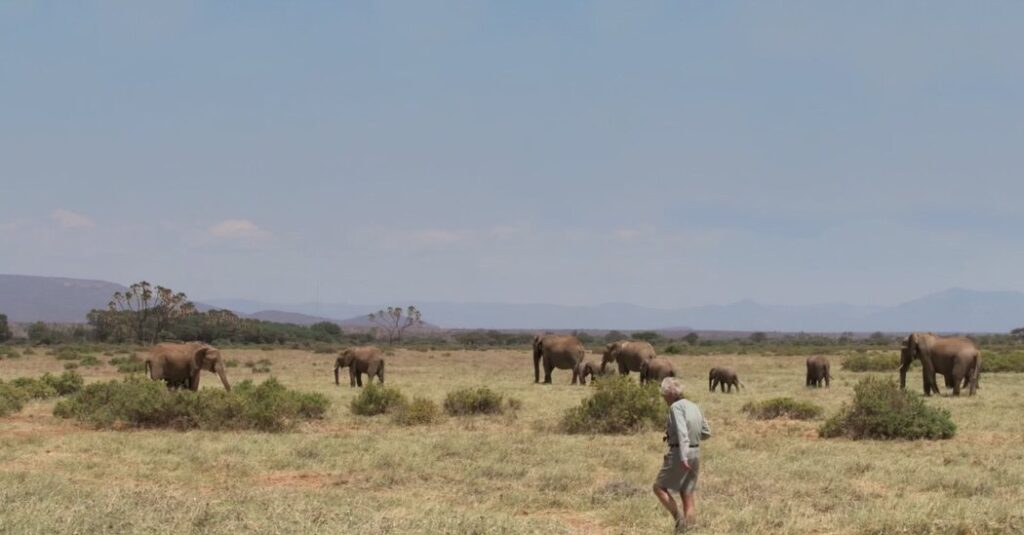
Iain Douglas-Hamilton, a world-renowned expert on elephants who was one of the first to study their intricate social behavior in the wild and dedicated his later years to fight poaching, died on Monday night at his home in Nairobi, Kenya. He was 83.
His family did not specify the cause of death.
Mr. Douglas-Hamilton had been charged at by elephants, shot at by poachers and was nearly killed by a swarm of bees. But throughout, he kept a flicker of amusement in his eye, somehow always aware that he was leading a charmed life and accomplishing work he deeply believed in.
He came from a storied, aristocratic British family and was an expert zoologist . But he had a knack for boiling down complicated subjects and communicating them with just about anyone. He became one of the most visible and urgent advocates for protecting elephants and went on to found his own conservation organization, Save the Elephants.
“Anyone who studies elephants, and certainly it happened to me, becomes intensely aware that you’re dealing with a sentient species, a species where the individuals are thinking their own thoughts,” he said in a film on his life that was released last year.
Elephants grieve, they have long life spans, they learn from their elders and they form intricate social units, led by strong females, he said. “The thing about elephants,” he concluded, “is that they have a lot in common with human beings.”
Jane Goodall, a lifelong friend who died this year, met Mr. Douglas-Hamilton in the 1960s when he was living in Tanzania and beginning his groundbreaking work on elephant behavior.
“Immediately we talked as people who understood who animals are,” she said in the film about his life. “There’s no question that Iain’s legacy will last forever. It was he who brought the elephant as a sentient being to the attention of the world.”
Iain Douglas-Hamilton was born on Aug. 16, 1942, in Dorset, England, the younger of two brothers. His father, Lord David Douglas-Hamilton, was a Scottish nobleman, amateur boxer and World War II fighter pilot. Flying back from a mission in a badly shot-up plane, he died in a crash when Mr. Douglas-Hamilton was not quite two.
Mr. Douglas-Hamilton’s mother, Prunella Stack, was a well-known figure in her own right. Born in India and inspired by what she learned from yoga, she became a pioneer in the women’s fitness movement and went on to lead an international women’s organization that attracted thousands of members.
He grew up in England and Scotland, and attended the same boarding school, Gordonstoun, where King Charles III studied. He took up zoology at the University of Oxford, originally thinking he would study lions. But when he was 23, he relocated to Tanzania to focus on wild elephants in Lake Manyara National Park.
It was there that he began building an extensive dossier of each elephant he encountered, taking photos of their faces, tracing their lineages and mapping their territory.
At first, he assigned them numbers. But as he studied the herds more closely, learning to recognize individuals by the distinctive shape of their ears, he gave each one a name. Soon, he was on a first-name basis with hundreds of them.
Mr. Douglas-Hamilton made breakthroughs in deciphering elephant communication and the choices they made as they moved across vast stretches of terrain in specific social groups. He was one of the first wildlife researchers to fly around in a small plane and count animals from the air, leading to aerial surveys across the continent.
In 1969, he dropped in at a party in Nairobi and met a dark-haired Italian photographer, Oria Rocco, who was born in Kenya.
“He was quite taken by me so we started dancing, but he wasn’t a very good dancer,” she remembered. “And then I said: ‘Well, what are you doing here?’ And he said: ‘Well, I do elephants.’ ‘You do elephants? What does that mean?’’’
“It was the first time that I’d met somebody who was actually studying elephants and not shooting elephants,” she laughed.
The two married in 1971. They moved to Tanzania, where Mr. Douglas Hamilton continued his studies. His typical work clothes were an open khaki vest (and no shirt), khaki shorts and no shoes, his long, blond bushy hair bouncing behind him. The couple soon had two girls, whom they gave Swahili names — Saba, which means seven, and Dudu, which means bug. Both daughters are deeply involved in the wildlife world.
As poaching surged in the late 1970s, Mr. Douglas-Hamilton shifted from research to defense. What the world was witnessing, he said, was “an elephant holocaust.” He rushed into Uganda as it was emerging from a war to stand up a guard force for the country’s elephants, which had been decimated. In 1989, he helped persuade the Kenyan government to burn its stockpile of seized ivory — a defiant, photogenic moment that grabbed attention around the world.
Throughout it all, he continued his research, working with Kenyan veterinarians to tranquilize elephants and put collars on them that transmitted radio signals. He also kept his eyes on elephants as far away as Mali, where he was fascinated by a remote group that undertook especially long journeys to watering holes.
Around 2010, he started picking up distressing signals again. An unusual number of elephants across the continent were dying from unnatural causes. It was the first sign of another epic slaughter.
The reason: ivory trinkets. An insatiable demand for them was being driven by China’s enormous new middle class. Some of Africa’s most majestic parks descended into war zones, as a motley assortment of rebel groups, heavily armed gangs and even soldiers from government militaries backed by the United States blasted apart elephant herds, sometimes killing calves and their mothers from military helicopters.
The poachers themselves might get $100 for a pair of tusks. But by the time that same ivory hit the streets in China, it could be worth tens of thousands of dollars.
Mr. Douglas-Hamilton swung into action to fight the trade. He organized a campaign that tried to change attitudes at the source — in China. He helped bring Yao Ming, China’s N.B.A. basketball star, and other Chinese celebrities to East Africa, turning them into ambassadors for the cause.
He spent the last years of his life mostly in Kenya, often at Elephant Watch Camp, his family’s game lodge in the Samburu National Reserve, a beautiful stretch of northern Kenya where his research center was also based. He was often a smiling figure tucked into a corner at the dinner table. One of his jokes was: “Most people who are sat next to me are either really rich, really successful, or really beautiful. Which one are you?”
During one evening in 2023, he was strolling with his wife at another property of theirs in Naivasha, Kenya, when they were attacked by a swarm of bees. He tried to shield Ms. Douglas-Hamilton with his body and was stung many times. He went into anaphylactic shock and nearly died, and never quite got his strength back.
He is survived by his wife, his daughters, and six grandchildren. Saba and Dudu, along with Frank Pope, Mr. Douglas-Hamilton’s son-in-law, are continuing his legacy at the research center and the family’s lodge, and through conversation efforts across Africa.
“If any elephants survive in Africa today, it’s thanks to this man,” read the headline in a recent article in The Telegraph newspaper.
His final work was trying to figure out how to protect wildlife as climate change and population growth pressed more people and elephants together.
“The next challenge will be to coexist, for human development and animal development to go side by side,” he said. “I have side of me that’s really quite optimistic.”
Jeffrey Gettleman is an international correspondent based in London covering global events. He has worked for The Times for more than 20 years.
The post Iain Douglas-Hamilton, Elephant Expert and Protector, Dies appeared first on New York Times.