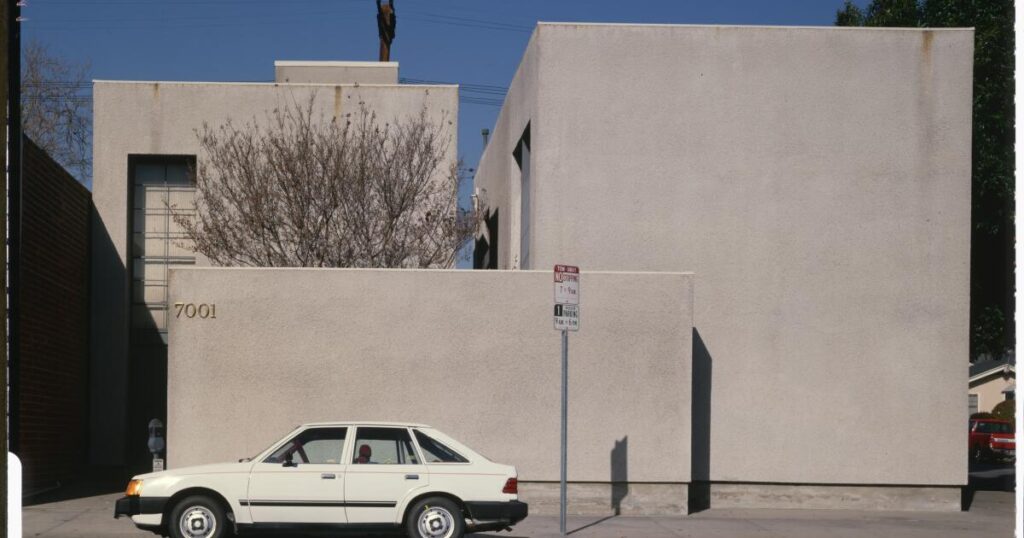
The early 1980s Los Angeles of my childhood always felt like a place where you could brush against greatness and not even recognize it.
Take the strange, faceless building at Melrose and Sycamore avenues, just up from the house where I grew up. It stood apart from the Melrose Avenue hodgepodge, which included an auto body shop, an old bookstore famous for selling movie scripts, and a trendy boutique that sold vintage fedoras and marked the beginning of Melrose’s turn as a fashion mecca.
In a street filled with signage screaming for your attention (“THOUSANDS OF BOOKS,” yelled the bookseller), that corner lot had nothing. Just two concrete-plastered boxes seemingly closed off to the world. The only hint of life was a tree growing from what appeared to be some kind of courtyard hidden from view. I passed by all the time — sneaking a Chunky bar at the corner liquor store, grabbing an ice cream cone from Baskin-Robbins.
I didn’t give the building a second thought until my best friend and I started a little weekly newspaper we photocopied for 3½ cents a copy from a shop a few doors away. Jack and I hit up Melrose merchants to buy ads (usually just their business card), and a few agreed to help these teenage publishing tycoons. Because of this, cracking the code of that strange little building became a brief obsession. One day, I found a door around the side and knocked. No answer. So I left a copy of our paper and returned a few days later. No luck. So I gave up. Why was I wasting my time with this piece of junk?
It took another 15 years to learn that the concrete box I so easily dismissed is one of L.A. architectural treasures. It is called the Danziger Studio and was one of architect Frank Gehry’s first L.A. commissions.
Even back in the 1960s, it was hailed as something special. Architecture critic Reyner Banham called it a brilliant elevation of the “stucco box” so ubiquitous around the city. As it turned out, the surface was not concrete but “a gray rough stucco of the type sprayed onto freeway overpasses. Gehry had to learn the decidedly unconventional technique himself,” according to the Los Angeles Conservancy.
In his obituary for Gehry, Christopher Hawthorne described the studio as a “spare, even self-effacing stucco box, plain outside and filled with light and surprising spatial complexity inside.” The building “looked Modern but also suggested sympathy for the postwar visual chaos of L.A. evident in the work of artists such as Ed Ruscha and David Hockney.”
I discovered the provenance of the hidden gem in the 1990s, when Gehry had reached “starchitect” status with his shape-shifting museum in Bilbao, Spain, and just before he gained legend status for L.A.’s Disney Hall. The Danzinger Studio shared none of those over-the-top designs. But that made me more impressed. I started driving by whenever I was in the neighborhood, slowing down in hopes of understanding what made it great. One day, I even gave it a walk-around, assuming it must look a lot better inside. (It turns out it does.)
I came to appreciate its beauty and grace — as well as something much larger about L.A. design. Suddenly, my idea of great architecture broadened beyond the ornate church, grand mansion, distinctive Spanish Colonial or gleaming glass skyscrapers like the Westin Bonaventure hotel. I gained a respect for the simplicity of design and function over style, like a cute working-class courtyard apartment, the streamlined simplicity of a May Co. department store and even the crazed efficiency of a mini-mall.
I have wondered whether I would have valued the Danziger Studio had it not been designed by Gehry. But it didn’t matter, because this discovery gave me the confidence to have my own, sometimes unpopular, L.A. opinions. I am in the minority, for example, in loving the much-derided 1960s brown-box addition to the old Times Mirror Square complex just as much as the landmark Art Deco original. And sorry, the mini-mallat 3rd Street and La Cienega Boulevard is one of my favorite L.A. buildings, period.
Trust me. I know.
The post I called it a piece of junk. It turned out to be a Frank Gehry L.A. masterpiece appeared first on Los Angeles Times.