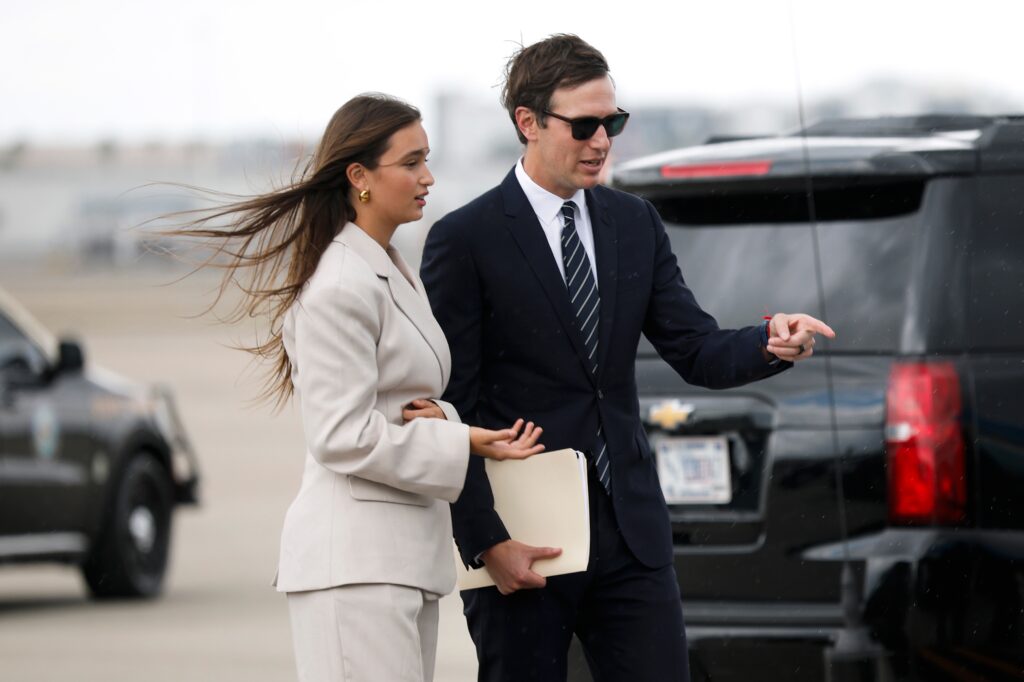
As soon as he finished negotiating a ceasefire in Gaza in early October, Jared Kushner said he was returning to his family and day job in Miami, where he heads a multibillion-dollar private equity firm. His involvement in high-stakes peacemaking was only temporary, Kushner said, joking that his wife might change the locks if he didn’t get home soon.
Yet before the month was over, he was back at the epicenter of international diplomacy, trying to forge an elusive deal to end the war between Russia and Ukraine for his father-in-law, President Donald Trump.
Early last week, Kushner and White House envoy Steve Witkoff traveled to Moscow for a five-hour session with Russian President Vladimir Putin. The duo met with Ukrainian officials in Geneva and Florida before the Putin meeting, along with Secretary of State Marco Rubio, and without Rubio for three days in Miami late last week. No breakthroughswere reported on Trump’s multi-point plan, which critics say yields significant advantages to Russia and little for Ukraine.
The part owner of a family real estate business, Kushner was an omnipresent figure during Trump’s first administration, where he served with his wife, Ivanka Trump, as a senior White House adviser and was put in charge, with mixed results, of portfolios ranging from Middle East peace to revitalizing American innovation and infrastructure and jump-starting stalled criminal justice reform.
Kushner’s sudden reappearance as a major player in Trump’s second-term foreign policy has sparked questions about his significant overseas financial interests and about Witkoff, a fellow real estate mogul and presidential golf buddy, whose five one-on-one meetings with Putin earlier this year seemed to achieve little.
But while he now holds no formal office or title, Kushner has worked behind the scenes since he left government, both in Trump’s 2024 campaign and since he took office again.
“I felt like this was a very, very important conflict to see completed, and I was happy to get involved,” Kushner told reporters in a briefing on the Gaza deal in early October. “My intention, though, is to go back to the role I was in before, which is just an available adviser to Steve and whoever else asked. … I’ve gotten to the place in my life, with the age of my children, where I can do that now.”
Explaining Kushner’s presence in the Gaza negotiations, Trump told a Cabinet meeting that “I put Jared there because he’s a very smart person and he knows the region, knows the people, knows a lot of the players.”
Asked for comment, representatives for Kushner directed The Washington Post to the White House.
Deputy White House spokeswoman Anna Kelly said that Trump and Witkoff “often seek” Kushner’s input “given his experience with complex negotiations.” Kushner is “an informal, unpaid adviser, who pays his own travel expenses,” as does Witkoff, Kelly added.
It is an avocation Kushner can well afford. Forbes magazine assessedin September that he had reached billionaire status, his assets a combination of his ownership of Affinity Partners, the private equity company he started in 2021; his 20 percent interest in his family’s Kushner Companies; the $100 million home where he and wife Ivanka Trump and their three children live on an exclusive Miami island; and assorted “cash, artwork and other personal investments.”
Much of the start-up money for Affinity came from sovereign wealth funds in Persian Gulf states — Saudi Arabia, the United Arab Emirates and Qatar — whose leaders Kushner dealt with during Trump’s first term, when he wrote a proposal for a rump Palestinian state and Israeli ownership of much of the West Bank. That plan died an unremarked death. A more successful endeavor was the Abraham Accords, the agreement of four Arab states to normalize diplomatic relations with Israel that Trump hopes to expand on this term.
One of Affinity’s largest investments is in Israel’s Phoenix insurance and assets management company, in which it is the biggest shareholder.
Affinity and Kushner, along with three Persian Gulf countries, are also named in SEC filings as investors in a hostile takeover bid of Warner Bros. Discovery launched Monday by Paramount Skydance, headed by the son of billionaire Larry Ellison, a major Trump supporter. Netflix had already won a bidding war against Paramount Skydance for the purchase, but Trump said Sunday that he would be “involved” in the administration’s assessment of that deal, which he said “could be a problem” given Netflix’s already large share of the streaming market.
On Monday, Trump professed to not having spoken to Kushner about Paramount Skydance’s hostile bid.
Kushner has long been dogged by questions about his many potential conflicts of interest, given his unique diplomatic and business relations with Middle Eastern governments. Insinuations that there was something improper about his dealings were “despicable,” Trump press secretary Karoline Leavitt told reporters when the issue first arose over Kushner’s participation in the Gaza negotiations.
Kushner took a milder approach when asked about his business interests in the region during an October interview with Witkoff on CBS’s “60 Minutes” about the Gaza agreement.
“What people call conflicts of interest, Steve and I call experience and trusted relationships that we have throughout the world,” he said. “If Steve and I didn’t have these deep relationships, the [Gaza] deal that we were able to help get done … would not have occurred,” he said.
Kushner and Witkoff said they brought a dealmaking sensibility to the talks, an approach that distinguishes them from traditional diplomats. In ongoing conversations with Israel and Arab partners, Kushner has concentrated on moving ahead with construction projects in Gaza and the future investment and economic benefits to all involved, according to people familiar with those talks who spoke on the condition of anonymity because they were not authorized to discuss them.
But while the early phases of the deal — aided by Trump’s willingness to pressure Israeli Prime Minister Benjamin Netanyahu on a ceasefire and partial troop withdrawal — were widely hailed as a success, the rest of the agreement to bring permanent peace, the dismantlement of Hamas, reconstruction of Gaza and possible Palestinian statehood has stalled.
The relationships Kushner brought to the Gaza negotiations are lacking in Ukraine and Russia. He first met Volodymyr Zelensky in June 2019, weeks after the Ukrainian president was elected, when he was seated next to him at a dinner in Brussels.
“That whole dinner was organized in order to connect Zelensky with Kushner, but it did not work,” said a person with knowledge of the event, who spoke on the condition of anonymity to discuss a sensitive political matter. Zelensky — a comedian with limited English whose diplomatic experience at the time was having played an accidental president in a television series — seemed incapable of small talk and the two barely interacted, the person said.
Seven weeks later, Trump would ask Zelensky in a phone call to investigate his political rival, Joe Biden, in what would become the basis of Trump’s first impeachment.
Beyond Witkoff’s apparent failure to budge Putin during talks on Ukraine earlier this year, questions about his neutrality arose when leaked phone conversations between him and Putin foreign policy adviser Yuri Ushakov, published by Bloomberg News, appeared overly sympathetic to Russia’s position.
Trump defended Witkoff’s comments on the call as a “standard form of negotiation,” while indicating that Kushner might join him in an upcoming meeting with Putin. One person familiar with the situation said that Witkoff had personally asked Trump’s son-in-law to participate.
The Trump plan, drafted after conversations among Witkoff, Kushner and Kirill Dmitriev, a Russian businessman under U.S. sanctions who heads his country’s sovereign wealth fund, landed with a thud in Kyiv and other European capitals, where it was seen as capitulation to Moscow. Subsequent talks have pared it back, although Putin firmly insisted in his meeting with Witkoff and Kushner on some of the parts most onerous to Kyiv, including handing Russia territory in eastern Ukraine that it has not won on the battlefield.
European and Ukrainians say that Kushner’s participation, despite his inexperience in the subject, has been welcome.
Tensions were high when Rubio, Witkoff and Kushner met with Europeans and Ukrainian negotiators in Geneva just before the Thanksgiving deadline Trump had publicly set for acceptance of the proposal, said Deputy Foreign Minister Sergiy Kyslytsya, a member of Ukraine’s negotiating team.
Kushner’s presence was a shift in the U.S. approach, Kyslytsya said, but he asked questions and listened to the answers.
“I think the presence of Kushner was very valuable, no matter how unconventional it may have looked … and as long as it is legitimate, I think that the application of unconventional means and forms is necessary,” he said.
One senior European diplomat said that unlike Witkoff, Kushner took notes in the Geneva meeting with Ukrainian officials, giving more confidence that agreements struck would be memorialized and outstanding issues followed up on.
Witkoff, the diplomat said, focused on the territorial elements of the deal, urging the Ukrainians to give up the unconquered portion of Ukraine’s Donetsk region to achieve peace. Kushner, they said, was more mindful of Ukraine’s position and quicker to take in new information.
“He’s smart and he has a soul,” said another European diplomat, who spoke on the condition of anonymity about the closed-door sessions.
Russia, Trump told reporters Sunday, is “fine with” what emerged out of last week’s Miami meeting between his negotiators and Kushner and Witkoff. “But I’m not sure that Zelensky’s fine with it,” he said.
On Monday, Zelensky told reporters traveling with him as he flew around Europe seeking support, “The Americans are searching for a compromise.” But, he said, Ukraine would not surrender territory Russia has not won on the battlefield.
O’Grady reported from Kyiv. Lizzie Johnson, Serhiy Morgunov and Isaac Arnsdorf contributed to this report.
The post How Jared Kushner became Trump’s indispensable second peace envoy appeared first on Washington Post.