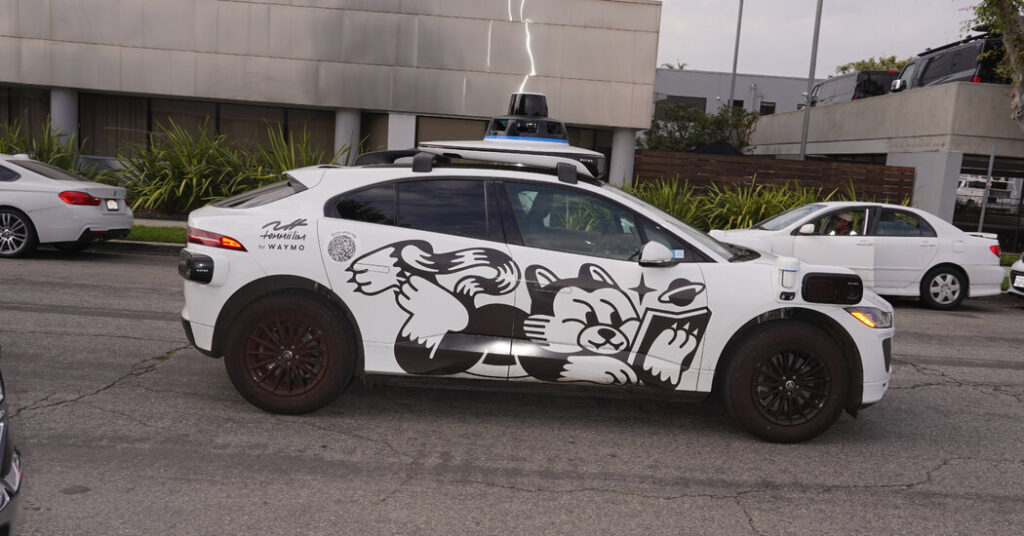
This is one cool cat. He is laid-back, literally — lying on his stomach, with a book, like a teenager on vacation, feet kicked into the air. He seems fully relaxed and enjoying the ride.
Tommii Lim, a Los Angeles street artist who has spray-painted his share of buildings, created this character to appear on another public surface: the sides of a Waymo self-driving car. And the cat is intended to promote Waymos as a feel-good experience. You don’t have to make small talk with a driver. You control the music. Hands-free is carefree, the image suggests, as the robo-taxi navigates traffic by itself.
Lim’s cat is part of a larger art program at Waymo designed to give its futuristic fleet of about 2,500 cars, mainly operating in San Francisco, Phoenix and L.A., a dash of personality and local flair. This year Waymo commissioned six artists from those cities, including Lim, to design car “wraps,” essentially giant decals that look like custom paint jobs. There are currently about 200 artist-wrapped cars in use, which makes spotting one like finding a secret Labubu. (And, no, you can’t request one as a passenger.)
“Getting people where they need to go safely is our top priority,” said Arturo Siguenza, a brand and creative strategy manager at Waymo, but he added, “the artists wraps are an opportunity to put a smile on our rider’s face when they’re able to see cars with a cool or quirky design.”
In October, a Waymo in San Francisco’s Mission District killed a real cat, a beloved bodega tabby known as Kit Kat, prompting residents and politicians alike to speak out against the dangers of autonomous cars. Lim’s cat was designed before Kit Kat made headlines.
It was Lim’s first experience wrapping a car, he said by phone from Thailand during a long-running international mural tour. Like the other artists, he worked with staff at Muros, the agency hired by Waymo as an intermediary.
“They wanted something representing the joy of autonomous cars, or how I would feel riding in one,” Lim said. They did not pile on guidelines, he added: “Personally I try not to do projects like that, where they try to art-direct you like crazy.”
Siguenza said the company first experimented with art wraps in 2015 in Austin and officially began the current program in 2022 with four Bay Area artists before branching out. The Phoenix muralist Nicole Poppell painted a soaring, stylized image of a cactus wren — the state bird of Arizona — inspired by her childhood dreams of flying; another features a friendly array of desert animals and plants. Also from Phoenix, Stormy Mae Nesbit created two bold, stylish portraits of black women with full, flowing hair against pink or orange flowering backgrounds.
In Los Angeles, Ashley Dreyfus created trippy scenes with her plush-toy-looking creatures cheerfully piling into a Waymo, with a ’60s-era psychedelic palette heavy on pinks and greens. In addition to his cool-cat, Lim painted a chill dog on its cellphone, with its hair — or ear — blowing in the wind. (Neither he nor the artists would disclose payment for these wraps.)
Of course, corporate-artist collaborations are not new. And there’s a rich history of artists painting and wrapping cars, especially in Los Angeles — an early nexus for hot-rod antics, lowrider culture and a wide variety of street art. Even today, to drive through the streets of L.A. is to spot, along with building walls punched up Kenny Scharf, various cars that he painted called “karbombz.”
But Waymos are robots as much as they are cars. Far from just a blank canvas for self-expression, the self-driving car is the ultimate product and symbol of Silicon Valley’s immense financial resources and techno-utopian ambitions. The white electric Jaguar I-Pace SUVs that make up Waymo’s current fleet are outfitted with a complex system of A.I.-assisted software and sensors, including radar, lidar and cameras. Originally a team within Google’s Self-Driving Car Project, Waymo was spun off into a separate company in 2016 under Alphabet, the holding company. It has since raised about $11 billion in venture capital, which helps make the current prices of rides competitive with Ubers in some markets.
The vehicles look vaguely alien, with a whirring lidar unit on top where a police siren might sit. “This technology is like eagle-eyed vision with eyes in the back of your head,” as Lawrence D. Burns, an auto executive and Google consultant, once said. Privacy watchdogs, far less upbeat, have called the cars “surveillance cameras on wheels” and flag their potential to become police tools. (Some speculate this is why, during anti-ICE protests in Los Angeles, Waymos were vandalized and set on fire.)
This points to deeper reasons, beyond a simple cool factor, why Waymo has teamed up with local artists instead of using, say, A.I.-generated designs. Even if Waymos are proving safer than many expected (the company has released a trove of data to this effect), art remains an easy way of making the intimidating vehicles more approachable or even personable. Just as some food-delivery bots have faces or names that make them seem friendly, art lends Waymos — which make human drivers superfluous — a human touch.
Some passengers like the vibe. “It’s joyful watching a Waymo with art pull up,” said S.C. Stuart, who has already logged 147 rides, or 1,098 miles, as a passenger, most often to or from her work at the Institute for Creative Technologies at the University of Southern California, where she works as a writer-editor.
Recently, she recalled, “I had a really long day at work, and when the car pulled up it was one of Stormy Nesbit’s. Her work was elegant and exuberant and powerful, I just felt really good getting into her car.” As a fellow creative, she pointed out the artists’ signatures displayed prominently near their work, making them easy to find or tag on social media.
Mimi Ito, a cultural anthropologist who runs the Connected Learning Lab at the University of California, Irvine, compared the art wrapping to the big pink mustache that Lyft cars used to wear on their grilles. “It signals this sort of quirky humanity,” she said. “It helps disrupt the narrative that these gigantic soulless companies are just scaling a standardized product,” and “bulldozing over everything.”
The media theorist Peter Lunenfeld, who teaches a “design futures” course at the University of California Los Angeles, says illustrative art is often used to defang threatening technology. He compares the Waymo wraps to Google Doodles, which distract people while they are using a complex and opaque search engine algorithm that is “almost fully beyond our ken.”
He also recalled how American bomber planes during World War II often featured “cheery and cutesy” characters — Donald Duck in aviator goggles was a favorite — painted on their noses. “Do I think Waymo is Fat Man and Little Boy?” he asked, using the nicknames for the atomic bombs dropped on Nagasaki and Hiroshima. “No, but I think Waymo illustrations are a way to reassure us that the terrifying things that we’re building aren’t going to kill us.”
The post How Art Is Driving Waymo’s Feel-Good Branding appeared first on New York Times.