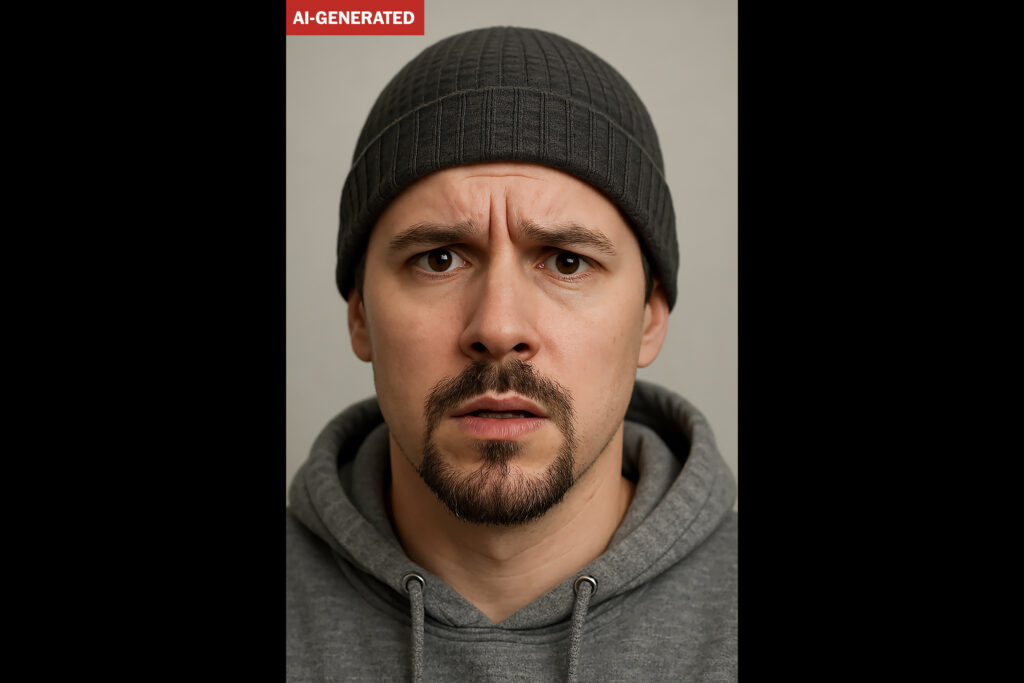
After a late November shooting in a Phoenix suburb, police released an apparent mug shot of their suspect — a middle-aged man wearing a hoodie and beanie with a goatee — and appealed to the public for tips.
It came with a warning: “This AI-generated image is based on victim/witness statements and does not depict a real person.”
The Goodyear Police Department’s computer-generated image of their shooting suspect almost looks like a photo. Officers say it’s not an AI fabrication, though, and it was sourced in the same way as a typical composite sketch. They interviewed a witness, drew a sketch based on that testimony and fed it into ChatGPT to produce a lifelike image.
Police around the country are using AI-powered tools to sort through evidence, identify suspects through facial recognition software and perform administrative tasks like report writing. But Goodyear’s police department appears to be one of the first to substitute hand-drawn sketches of suspects with lifelike images generated by AI.
Experts warned the practice could distort an already unreliable process for identifying suspects or be subject to scrutiny in court. But the Goodyear officer who usually draws sketches of suspects — and is now responsible for using AI to re-create them — has endorsed AI image generators as a powerful and attention-grabbing police tool.
“We’re now in a day and age where if we post a pencil drawing, most people are not going to acknowledge it,” said Mike Bonasera, who produced the images.
Bonasera has sketched suspects for around five years, he said. Forensic art requires officers to undergo dedicated training on drawing facial features as well as interviewing witnesses and victims before they pass a certification exam.
He isn’t often called on to pick up his pen — Bonasera produces between five to seven sketches each year — but the practice remains an important investigative tool when police have no good surveillance images of a suspect, he said.
Earlier this year, Bonasera fed some of his old sketches into ChatGPT and was struck by lifelike images generated by the AI, which he said resembled the real suspects the sketches had been matched to. He said he sought approval from department leaders and the Maricopa County Attorney’s Office and, in April, used AI for the first time to generate a suspect image in an attempted kidnapping case that police shared to the public.
“We are hopeful that these new techniques and AI technology will assist in solving more complex cases in the future, here in Arizona and around the country,” the department wrote at the time.
Bonasera said the department received a deluge of tips after sharing the AI-generated image in April, which convinced him to repeat the process in November. He believes Goodyear residents, particularly younger ones, are more likely to engage with the photorealistic images AI creates than a hand-drawn sketch.
“People are so visual, and that’s why this works,” he said.
He added that using AI to generate images helped the witnesses he interviewed better visualize the suspects they were describing. Bonasera generates the AI images with his witness present, he said, and they were able to suggest small details and changes that he could quickly incorporate. The suspect in the most recent AI image has a dumbfounded expression, which Bonasera said was something the witness noted repeatedly.
The images have not led to arrests. Both cases where Goodyear police used an AI-generated suspect image remain open, spokeswoman Mayra Reeson said.
Experts said that Goodyear’s police department could be in uncharted territory. Bryan Schwartz, an associate clinical professor of law at the University of Arizona who studies the use of AI images in law enforcement, said he has not encountered any other American police departments using AI to generate suspect images.
In at least one other instance, a police department’s use of an AI image sparked a backlash, though it wasn’t for depicting a suspect. In July, the Westbrook Police Department in Maine confessed to an AI image snafu after posting an image of evidence from a drug bust that had been altered by ChatGPT. An officer had used the chatbot’s image editing capabilities to add a police department seal to the photo, and did not realize that ChatGPT also distorted the image in the process, WMTW reported.
(The Washington Post has a content partnership with OpenAI, the creator of ChatGPT.)
Police departments relying on AI image generators for suspect sketches could be vulnerable to biases in their training data, Schwartz said. AI image generators compile a picture after analyzing a vast sum of sample photos, and biases in the collection of images they’re trained on — for example, having more photos of people of a certain race — can impact their output.
“That was something we saw early on with some of these generators,” Schwartz said. “That they were really good at creating White faces and not as good at creating some of other races.”
Andrew Ferguson, a professor of law at George Washington University, said that while an AI-generated image may seem more lifelike, it’s not necessarily more reliable than a drawing produced by a person. If sketches lead to a case that goes to trial, forensic artists often have to defend their work in court, and it’s harder to interrogate the decisions of an AI tool than a human.
“In court, we all know how drawing works and can evaluate how much reliability to give the human drawn sketch,” Ferguson wrote in an email to The Washington Post. “In court, no one knows how the AI works.”
Both Schwartz and Ferguson added that depicting a suspect using hand-drawn sketches based on witness testimony already carries flaws that could be magnified by using AI.
“Maybe sketching a suspect from memory using words is not the best way to identify a criminal suspect,” Ferguson wrote. “Adding AI to the process does not fix the problem.”
Bonasera said he asks detailed questions to inform both his hand-drawn sketches and the AI images he generates from them and reviews the process with his witnesses, who sign off on the images. He added that an image of a suspect drawn from memory, whether by hand or created by AI, is used to generate leads but would not be enough to inform an arrest.
“It’s the same argument, either [if] it’s a composite sketch or it’s an AI drawing,” he said. “My job is to say, ‘Hey, this is the witness or victim’s image that they had in their head and they were happy with it and they said that’s the person.’”
Other law enforcement agencies have contacted Bonasera to ask about his AI images, he said. He plans to use AI for all of his suspect sketches going forward.
The post Have you seen this (AI-generated) man? Police swap suspect sketches for AI. appeared first on Washington Post.