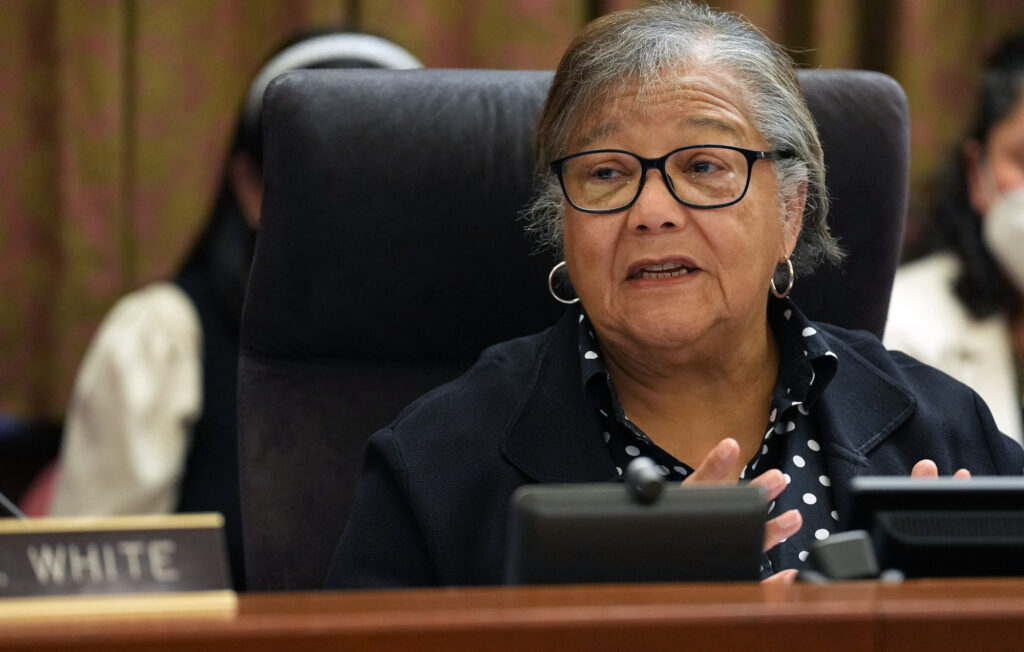
After 13 years on the D.C. Council, Anita Bonds (D-At Large) has told residents she will not seek reelection in 2026 — further shaking up what is bound to be a highly competitive 2026 election cycle that could usher in a new slate of elected leaders.
Bonds, 80, told residents that she was not planning to seek reelection during a Saturday brunch event at the Point. It was time, she said, “to invite new energy, new capacity to the table and to work hard to continue to make sure that our city has what it needs so that all of us are valued.”
“So I’m hoping you’ll accept the fact that I am not going to seek reelection. But I’m going to work with you so that we get some good, good, good people, because we still have that task before us,” Bonds said, according to video of her remarks captured by attendees including Bill Rice and Tom Donohue, an advisory neighborhood commissioner in Ward 8.
The 2026 elections could bring a sea change to D.C. politics, with a wide-open mayoral election — Mayor Muriel E. Bowser (D) is not seeking a fourth term — and a whole slate of D.C. Council seats that could change hands. Bonds, who did not respond to a request for comment, joins council member Brianne K. Nadeau (D-Ward 1) in deciding not to run again, while multiple other lawmakers are seeking higher office and their seats could become open if they win.
Among them, council member Janeese Lewis George (D-Ward 4) became the first high-profile candidate to enter the mayoral contest last week. Council member Kenyan R. McDuffie (I-At Large) is considering entering the race — and because of the rules for at-large seats, he would have to quit the council to do so, making room for another competitive council election.
Two other lawmakers, Brooke Pinto (D-Ward 2) and Robert C. White Jr. (D-At Large), are challenging Del. Eleanor Holmes Norton (D), who is 88, for her seat in the House.
On top of it, council member Trayon White Sr. (D-Ward 8) goes on trial for a federal bribery charge in March, and would have to vacate his seat if convicted.
Charles Wilson, chairman of the D.C. Democratic Party, said that in his 25 years watching D.C. politics, “I haven’t seen an election cycle as consequential” as this one.
“To say the 2026 election cycle will be exciting is an understatement,” he said. “With so many open seats and competitive races, D.C. residents have a real chance to shape the direction of the city.”
Bonds has been involved in D.C. politics for decades, since before the city even had a local government — working for Marion Barry’s first campaign for the board of education in 1971 and, later, for mayor. She spent years working in D.C. government, including in the mayoral administrations of Barry, Sharon Pratt Kelly and Anthony Williams, before moving from a behind-the-scenes player to the D.C. Council in 2012.
Bonds, who currently has oversight of election and labor issues, previously chaired the council’s housing committee, where she often clashed with advocates who pressed for more innovative solutions to the affordable housing crisis.
But she has become perhaps most known for her work advocating for seniors, such as a bill she passed in her first term to significantly reduce property taxes for seniors who are longtime D.C. residents. Others enhanced seniors’ access to nutritional food and health care resources.
Donohue, the advisory neighborhood commissioner, said there were “audible gasps” Saturday when Bonds announced to the crowd her decision not to run. Bonds, he said, reflected on her time in office and also solicited ideas from residents about what needs her attention in 2026, her final year.
“I think she really wants to hear the input of the residents and really wants to make the last year beneficial and successful,” he said.
Thinking about the number of open or competitive races, Donohue said, it began to sink in how seriously D.C. residents need to take the upcoming election — especially, he said, with the top job on the line.
Bowser, who has been in office for nearly 11 years, developed significant experience leading the city during times of crisis — including most recently the unprecedented federal intervention in D.C.’s justice system. That ongoing situation, Donahue said, demands a mayoral candidate and lawmakers who have the right policy vision and approach to the city’s home rule challenges.
“I think there needs to be a really strong push in educating the community about how serious this next stage of D.C. politics is, because the next person is going to have to navigate that relationship with the president,” he said. “The line that Mayor Bowser has walked, she had it down. And now it’s almost going to be like a brand-new council — brand-new everything.”
On top of the large number of competitive races, voters are expected to use a new voting method starting with the 2026 June primary election: ranked-choice voting. The method allows voters to rank candidates in their order of preference; lower-performing candidates are eliminated and votes for them are redistributed until one candidate surpasses 50 percent. The city is changing its method after voters passed a ballot initiative in 2024.
Advocates of ranked-choice voting say it’s ideal for crowded races, where under the traditional voting method, sometimes a candidate can win with under 30 percent of the vote. And many of D.C.’s contests are shaping up to be quite crowded.
Six candidates have lined up in the Ward 1 Democratic primary to replace Nadeau. Norton, who has faced escalating scrutiny over her age and energy level, has drawn a dozen Democratic challengers in the delegate race, where candidates are pitching themselves as the best bulwark against congressional Republicans’ intervention in the city’s affairs.
Wilson said that even though the D.C. Democratic Party previously opposed ranked-choice voting, it would be aiding in a large voter outreach campaign to ensure that voters understand how it works — especially given the high stakes of every race on the ballot.
“The choices we’ll make in 2026 will affect how we tackle our biggest challenges,” he said.
The post D.C.’s Anita Bonds won’t run again, further shaking up 2026 elections appeared first on Washington Post.