Canada is making an aggressive effort to attract highly-skilled researchers from around the world, including H1-B visa holders in the United States who are coming under growing pressure because of the Trump administration’s restrictive immigration policies and cuts to research funding.
The Canadian government on Tuesday said it would spend more than $1 billion over the next few years to attract and retain scientists from around the world, including those at major hospitals and universities.
It also said that in coming months it would create an “accelerated pathway” for U.S. H1-B visa holders. H1-B visas are issued to highly skilled people working for American companies and are concentrated in major industries that compete for global talent, such as technology and medicine.
“As other countries constrain academic freedoms and undermine cutting-edge research, Canada is investing, and doubling down, on science,” Mélanie Joly, Canada’s Industry minister, said in written comments to the press, without explicitly mentioning the United States.
In an interview with The Times on Tuesday, Ms. Joly said that the new money would create 100 new research chairs, by funding not just individual senior researchers at the top of those efforts, but their entire teams and labs.
She said her top priority was to lure back Canadian researchers.
“For decades, Canada has had a brain drain issue, and now we are in a brain gain mode,” Ms. Joly said. “My message to Canadians around the world is: it’s time to come home.”
But she added that the push to attract top global researchers was also about creating a stable environment for those wanting to move to Canada.
“If you want to live in the best country on the earth, that is also the safest, and the one that will actually respect your work and offer you the right environment flourish, well, come to Canada,” she said.
The question of H1-B visa holders, on whom the U.S. tech industry, in particular, relies, has opened a fault line within President Trump’s base and unsettled planning in the tech, pharmaceutical and other highly competitive industries.
Influential figures in the tech world, such as Elon Musk, fiercely support maintaining the pathway for high-skilled immigrants, while others from the so-called MAGA movement demand that the number of H1-B visas be slashed alongside all other types of immigration into the United States.
The questions around the long-term prospects of highly skilled immigrants in the United States create an opportunity for Canada and other developed economies to attract some top scientists concerned about their status in the United States or affected by the Trump administration’s cuts to research funding.
Throughout the year, major Canadian academic and health care institutions have been actively recruiting in the United States.
In April, Toronto’s United Health Network, a major hospitals and research network, said it was recruiting 100 researchers directly from the United States.
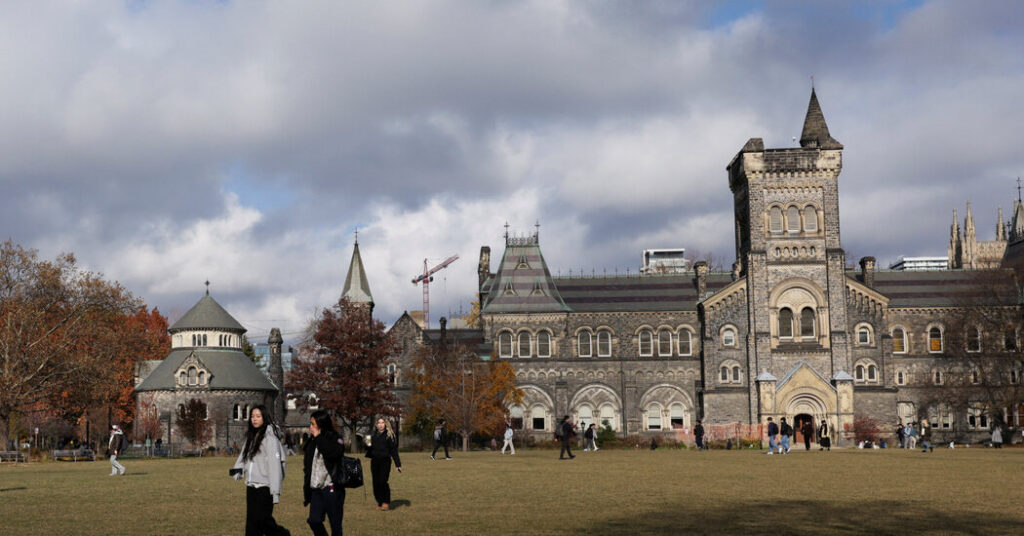
The University of Toronto, Canada’s top academic institution and one of the world’s highest-ranked universities, lured several top humanities and social sciences professors from Ivy League schools during the year.
In just the past few weeks, the University of Toronto announced it had also attracted two M.I.T. professors, of planetary science and economics, as well as a Stanford economist, Mark Duggan. Mr. Duggan will become the new director at the Munk School of Global Affairs & Public Policy, which is considered Canada’s equivalent to the Harvard Kennedy School of Government.
The new funding announced by the Canadian federal government on Tuesday, 1.7 billion Canadian dollars, or $1.2 billion, will finance salaries for researchers, new infrastructure, awards for top experts in their fields and benefits to recruit early-career scientists, the government said in an announcement.
Ms. Joly, the minister, said the drive would focus on bringing research talent into Canada and linking it to tangible benefits for Canadian industry and innovation.
The program is similar to others in Europe, as large developed economies seek to capitalize on the challenges faced by international researchers in the United States, and offer younger researchers alternatives to American universities to start their careers.
Canada’s economy is much smaller than that of the United States and experts stress that retaining high-skilled talent is not easy, unless the recruitment policy is matched with more private-sector opportunities in key industries, including technology and medicine.
Though generally regarded as a good place to live, Canada has long had trouble retaining highly-skilled and in-demand workers.
A study published recently by the Institute for Canadian Citizenship found that one in five immigrants to Canada leave the country within 25 years of arriving, and those that hold doctorates are nearly twice as likely to leave as those with a bachelor’s degree.
The research suggests that Canada might do more to keep those coveted global movers integrated and anchored, or face the prospect of losing them quickly when policymakers in other places try to recruit them. Ms. Joly said the new funding was a key step toward keeping researchers in Canada for longer.
Matina Stevis-Gridneff is the Canada bureau chief for The Times, leading coverage of the country.
The post ‘Come North!’ Canada Makes Play for H1-B Visa Holders With New Talent Drive appeared first on New York Times.