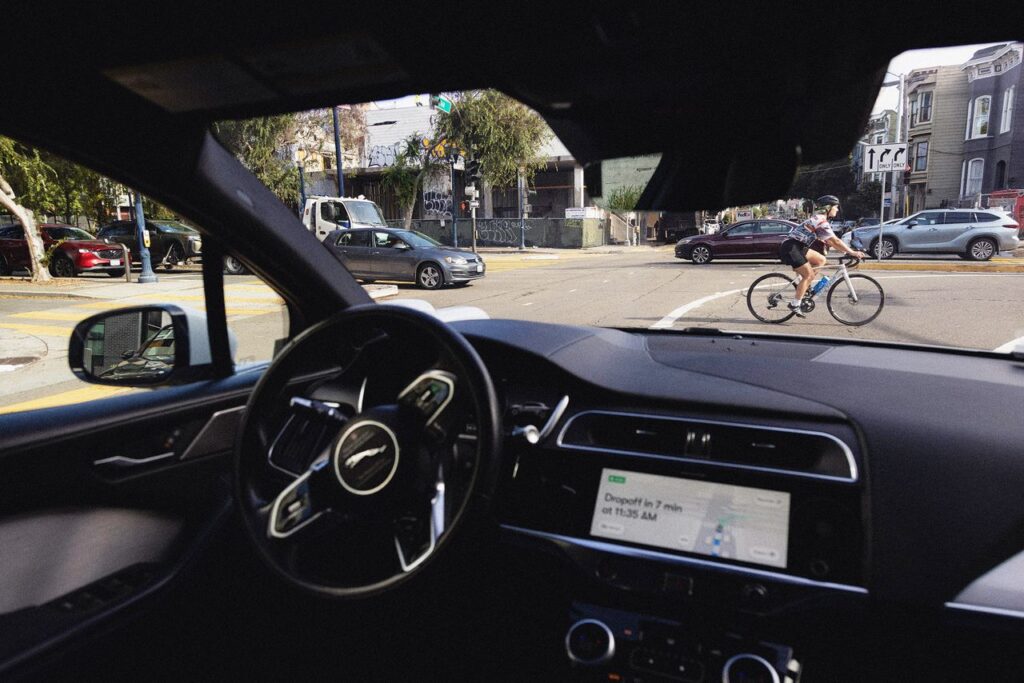
Los Angeles is a car city, and it’s rarely more obvious than from a vulnerable perch on top of a bicycle. Among big cities in the US, LA has a middling-to-bad reputation for bike riding. A lack of connected cycling lanes and safe crossings led one national cycling advocacy organization to recently rank LA’s bike network 1,136th in the nation. The city’s auto leanings are inscribed on its infrastructure—with deadly consequences. According to one local outlet, at least 12 Angelenos have died while riding this year.
So it’s surprising that Eli Akira Kaufman, the executive director of the LA county cycling advocacy group BikeLA, is pretty excited about a car. Specifically, a car driven by a robot.
For more than a year now, the Alphabet subsidiary Waymo has been picking up riders in the western half of the city. Kaufman likes what he sees. “They don’t drive stressed, tired, inebriated, racist,” he says. He finds Waymos pilot predictably, mostly adhering to traffic laws. When he’s riding, “I deprioritize them in terms of my level of concern. I can focus on the human drivers.”
Kaufman’s feelings represent a shift for the cycling community, and something like a schism. For years, some bike riders have viewed the efforts of autonomous vehicle tech developers—and the automakers supporting them—with deep suspicion. Self-driving cars are, after all, cars, which are heavy and dangerous; more than 40,000 Americans die in traffic incidents each year. Moreover, if autonomous vehicles neatly replace the cars and trucks of today, advocates worry that other forms of transportation lose out. The long-term result of doubling down on auto travel might be sprawling cities with few opportunities for low-cost, emissions-free ways to get around. Exactly, one might argue, the sort of cities that exist today.
But as more self-driving vehicle services pop up around the country, they have racked up a safety record that, while far from definitive, seems to improve on the performance of humans. Waymo’s latest data suggests that, in the cities where it operates, its vehicles are involved in 92 percent fewer crashes that injure pedestrians, and 78 fewer crashes that injure cyclists.
This has led some cycling advocates to take a more pragmatic approach to the tech. “I don’t think anyone, including autonomous vehicle operators, think that taking drivers out of the equation is going to single-handedly solve America’s traffic safety crisis,” says Joe Cutrufo, the executive director of BikeHouston. Waymo began testing in Houston in May, and the Texas city has seen testing from companies including Nuro and Cruise. “But we need to be open-minded about solutions that can bring results quickly.”
As more of the new tech pops up on city streets, activists are asking a question that moves well beyond wheels: How should a future city be?
Budding Relationships
Cycling groups say that some autonomous vehicle developers have mostly done what other transportation companies don’t: They’ve shown up. Waymo’s representatives hop on Zoom meetings with bike lobbyists. They make appearances at local events. “Companies like Waymo and Zoox have proactively approached us, asked us about their technology, and asked us to meet with their engineers,” says Kendra Ramsey, the executive director of CalBike, a California bicycling advocacy group based in Sacramento.
The autonomous vehicle industry also writes checks. Waymo sponsored last year’s National Bike Summit in Washington DC, a lobbying event hosted by the nonprofit League of American Bicyclists, and will sponsor next year’s event, too. Local groups, including BikeLA and BikeHouston, count Waymo among “partners,” and Zoox joined the Alphabet subsidiary—and organizations including Caltrans and AARP California—as sponsors for CalBike’s annual meeting.
Bicycle advocates say that autonomous vehicle companies do not control what they say about them, and Waymo says its funding is part of a larger conversation with bike riders. “We believe we can help make a difference not just with our technology, but by partnering with advocacy groups around the country to learn from them, make progress towards our shared mission, and integrate their feedback into our product, research, and advocacy efforts,” Arielle Fleisher, Waymo’s policy research and development manager, wrote in a statement sent to WIRED. (Zoox did not respond to WIRED’s questions, but spokesperson Marisa Wiggam said the company does incorporate cyclists into its software training.)
Earlier this year, representatives for League of American Bicyclists, one of the largest bicycling members organizations in the country, traveled at Waymo’s invitation and expense to downtown LA to film a promotional video with the company. LA is not a fun place to bike, says Ken McLeod, the group’s policy director, but biking around an autonomous vehicle felt pretty safe. The group continues to push for federal autonomous vehicle legislation that would require tech developers to prove that their tech can identify and parse people on bikes and foot. Generally, he says, autonomous vehicle companies “have been very willing to listen and seem responsive to our concerns and issues that we raise.”
Just spending time around autonomous vehicles could affect bike riders’ perceptions, suggests work by Alex Gaio, a postdoctoral researcher at Trinity College Dublin. Gaio’s research found that in cities in northern Europe and Canada, spending time on a bike around autonomous vehicles led to “marginal” increases in comfort and trust. In surveys, bike riders told the researcher that they missed the nuances of human-to-human interaction: the waves and nods from drivers that told them they were seen and therefore, safe.
Overall, though, Gaio’s research indicates that bike riders’ attitudes about AVs had little to do with the technology itself. “The biggest factor that influenced people’s comfort and trust was the layout of the infrastructure that was afforded to them,” says Gaio. Give the people safe places to bike, in other words, and they’ll feel better about biking. “The fundamental needs remain unchanged,” he says.
Blocking the Bike Lane
Some cycling advocates warn that partnerships with the tech developers have their limits.
In San Francisco, where autonomous vehicles began testing a decade ago, advocates with the San Francisco Bicycle Coalition have for years protested what they call an “unchecked” expansion of autonomous vehicles on public roads. “A lack of regulation and transparency around these vehicles pushes us as a society further into car dependency,” says Krissa Corbett Cavouras, the group’s spokesperson. The Coalition was dismayed, for example, when the city adjusted a plan to prohibit private vehicles from the city’s main downtown artery, Market Street, by allowing Waymo, Uber, and Lyft to drive there.
The Coalition is also frustrated by autonomous vehicles’ pick up and drop offs, which sometimes happen in bike lanes. Vehicles “should unfailingly obey traffic laws,” says Cavouras. In June, a local cyclist sued Waymo, alleging that she was doored by a passenger after a robotaxi pulled in to drop them off in a bike lane, throwing her onto another Waymo that had also pulled into the lane.
Waymo’s Fleisher called pick up and drop off “a complex challenge,” and said the vehicles are designed “to take the safest action available during the few minutes we are picking up or dropping off riders.”
In Austin, where Waymo, Tesla, and the startup Avride all operate robotaxis, bike riders also appreciate the predictability that comes with riding around them, says Alejandro de la Vega, who chairs the city’s volunteer Bicycle Advisory Council. But “we’re afraid [the technology] will take away momentum and excitement from solutions we know work, like transit, walking, and biking,” he says. One close call: In 2023, the Texas Department of Transportation proposed and then withdrew a plan to transform a local walking and biking trail into an autonomous vehicles corridor.
Cycling proponents say they’re not overly optimistic about autonomous vehicles’ role in safe street advocacy. They are, after all, companies, with goals related to the bottom line. But in LA, Kaufman hopes the firms begin to advocate more proactively for policies that make cycling better. “The ideal is that they recognize safer streets that are better designed for people actually support their network as much as they support our lives,” he says.
The post Can Bike Riders and Self-Driving Cars Be Friends? appeared first on Wired.