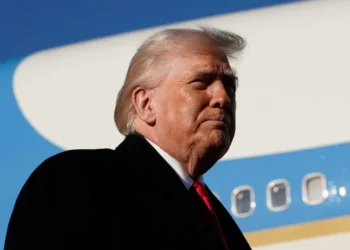
By thrusting himself into negotiations over rival bids by Netflix and Paramount to buy Warner Bros., President Trump appears to have found another way to expand his power at a time when the Supreme Court is cutting back on Congress’s ability to check presidential authority.
A law empowering the government to block mergers does not specify a personal role for presidents to leverage that authority on a whim or for their own benefit. Congress gave that power to two agencies — the Federal Trade Commission and the Justice Department’s antitrust division — to use based on their analysis of market power concentration and consumer harm.
Mr. Trump, however, declared on Sunday that Netflix’s bid “could be a problem” because of its market share, asserting, “I’ll be involved in that decision.” On Monday, it emerged that the private equity firm of his son-in-law, Jared Kushner, was backing the bid by Paramount, even as Mr. Trump also pressured the company over a decision by its subsidiary, CBS, to air an interview on “60 Minutes” that criticized him.
And in a resonant coincidence, the Supreme Court heard arguments on Monday over a law that shields the F.T.C. from direct presidential control. The Republican-appointed supermajority signaled it was likely to overturn a 90-year precedent, meaning that the agency, and a host of others Congress created as independent, would be put under Mr. Trump’s thumb.
What Mr. Trump intends at this point is, as is often the case, difficult to say. An unconventional president, he constantly tests the boundaries of his power, sometimes in idle public musings that are provocative but lead nowhere and sometimes in ways that eventually push past norms of self-restraint and into new legal territory.
Herbert Hovenkamp, a University of Pennsylvania professor and a renowned scholar of American antitrust law, said the F.T.C. and the Justice Department’s antitrust division are supposed to enforce antitrust law based on a set of guidelines about market share and other defined standards for determining when a merger is illegal. He described Mr. Trump’s move as troubling.
“If we give this executive power to the F.T.C. and the antitrust division but then permit the president to engage in post hoc manipulation, that is very, very bad law enforcement policy because it means we no longer have a rule of law,” Professor Hovenkamp said. “We no longer have a defined set of standards for determining whether the law has been broken.”
A law known as Section 7 of the Clayton Antitrust Act of 1914 bans mergers when “the effect of such acquisition may be substantially to lessen competition, or to tend to create a monopoly.” Either agency may enforce it, and they have developed shared guidelines for what kinds of mergers violate that standard and will trigger enforcement litigation.
The conservative legal movement has sought to overturn Congress’s ability to create independent agencies run by bipartisan boards of commissioners, part of a generations-long push to weaken regulation of business interests. The members are appointed by a president to fixed terms, and may not be removed early without a cause, like misconduct.
The Supreme Court is now controlled by Republican appointees who emerged from that movement. Increasingly, the bloc has embraced the so-called unitary executive theory, a revisionist understanding of the Constitution developed by the Reagan administration legal team in the 1980s. Under the doctrine, presidents must be able to personally direct and control any officials who exercise executive power, including by firing them at will.
The same supermajority expanded presidential power last year by granting Mr. Trump absolute immunity from prosecution for any crimes he may commit using his official power over the Justice Department. Since returning to office this year, Mr. Trump has directed investigations and prosecutions of his political adversaries, trampling the post-Watergate norm of departmental independence over criminal law enforcement decisions.
That move to openly weaponize his authority over the Justice Department is part of a broader effort by Mr. Trump and his team to push a maximalist vision of executive power. On the domestic policy front, that also includes seizing greater power over the federal civil service and spending decisions, and challenging Congress’s power to create independent agencies.
At the same time, Mr. Trump has looked for other levers to exploit, such as threatening law firms with adverse government actions like stripping lawyers’ security clearances unless they agree to provide free services for causes he favors. His decision to wade into the bidding war for Warner Bros. combines aspects of several of those moves.
The authority of the department’s antitrust division and the F.T.C. to block corporate mergers is a matter of civil, not criminal, law. But it carries its own extraordinary implications for the structure of American society and sometimes — including the rival bids for Warner Bros. — staggering sums of money are at stake. The norm that presidents ought not get involved in trading favors for such decisions also carries overtones of the Watergate era.
During the Nixon administration, the Justice Department brought antitrust cases against the International Telephone and Telegraph Corporation but then settled them on terms favorable to the company. It then emerged that President Nixon had ordered the department to drop the enforcement effort after an I.T.T. subsidiary secretly pledged to make a large donation to fund the 1972 Republican National Convention, at which Nixon expected to be renominated.
Citing that historical precedent, Peter L. Strauss, a professor emeritus of law at Columbia University who opposes stronger versions of the unitary executive theory, said if the Supreme Court did put the F.T.C. into Mr. Trump’s hands, it would remove a potential restraint on a politicized antitrust division. Currently, if a president told the Justice Department not to bring a case that on the merits should be brought, the F.T.C. could act as a guardrail by doing so itself.
“A balanced F.T.C. would be harder for the president to try to control,” Professor Strauss said. “But if the F.T.C. is just another member of the executive branch, as equally subject to the president’s oversight and dictation as the Department of Justice, then that goes away.”
Mr. Trump himself has a history with antitrust issues and Warner Bros. in particular. In his first term, when AT&T sought to acquire Time Warner, Mr. Trump opposed the deal while extensively criticizing coverage of his administration by CNN, a Time Warner property.
In November 2017, Mr. Trump’s Justice Department filed a lawsuit to block the acquisition based on an unusual interpretation of antitrust law. But federal courts allowed it to go through, rejecting that interpretation. The dispute on its face did not center on the shadow Mr. Trump’s comments had cast over the department’s intervention.
Mr. Trump’s assertion that he will play a role in the fate of the rival bids for Warner Bros., including HBO, adds a new twist. Instead of holding a threat over one proposed deal, he is announcing he is open to tilting the scales between two rival propositions.
The implicit threat is obvious: Executives and shareholders weighing the bids now have to consider the risk that picking one he opposes is more likely to lead to an attempt to block the deal. While courts could ultimately allow a merger to go through over the objections of the executive branch, at best there would still be costly and time-consuming litigation. The desire to avoid ending up in court gives Mr. Trump informal sway.
Conversely, picking a bid he favors could mean the White House prevents any enforcement action — even if a merger does seem to violate the market concentration standards. The bidders, therefore, have incentives to court Mr. Trump’s favor, as heads of both Netflix and Paramount have already started doing.
“Whether Trump actually does interfere, just the threat of interfering is going to switch the balance of power dramatically,” Professor Hovencamp said.
Charlie Savage writes about national security and legal policy for The Times.
The post Asserting a Personal Role in Warner Bros. Battle, Trump Expands His Powers Again appeared first on New York Times.