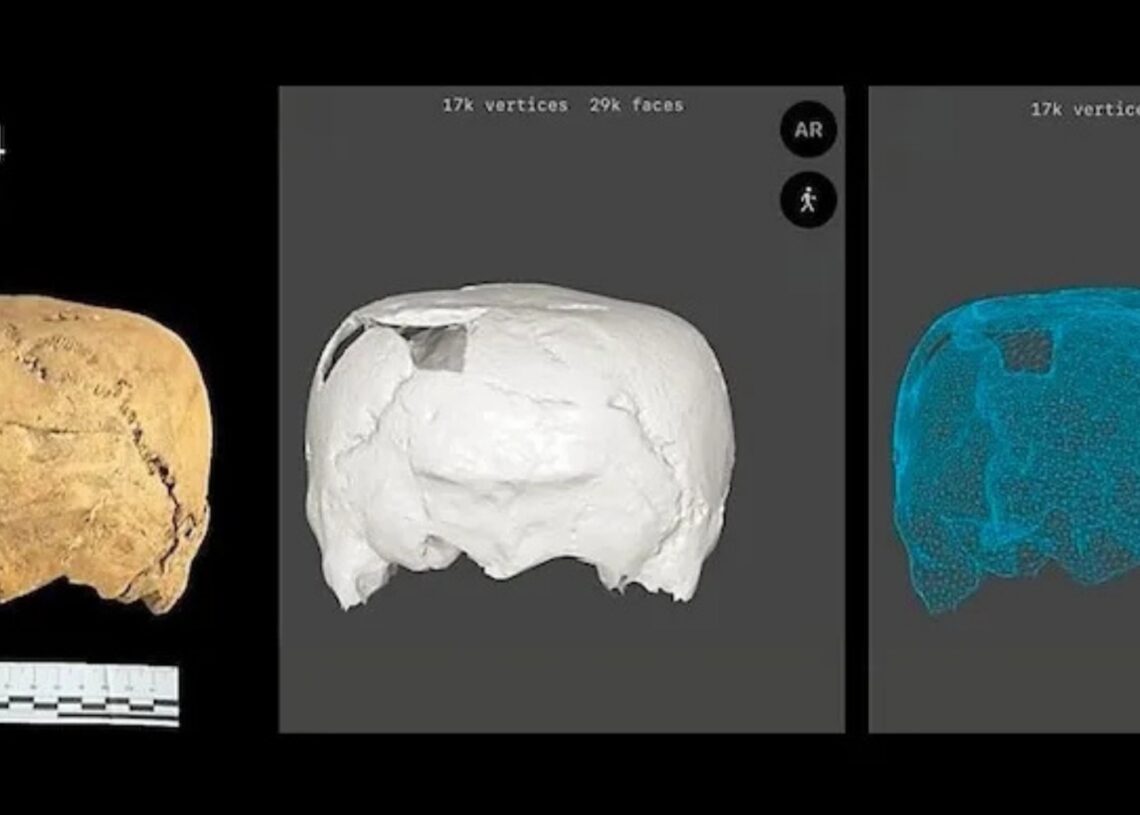
Archaeologists in Mexico have uncovered a 1,400-year-old skull shaped like a cube, and it’s unlike anything they’ve seen in the region. The find came from Balcón de Montezuma in Tamaulipas, and it immediately stood out because the usual cranial modification styles there don’t come anywhere close to this.
According to a translated statement from Mexico’s National Institute of Anthropology and History (INAH), the skull belonged to a middle-aged man who lived in a village that flourished around A.D. 400. Dozens of circular houses filled the settlement. Cranial modification wasn’t unusual there, but this shape absolutely was. Biological anthropologist Jesús Ernesto Velasco González said modified skulls from the area usually point upward in an erect shape created by soft padding. This one, though, was flattened across the top, giving it a blocklike structure specialists refer to as a parallelepiped.
Most people have seen those long, cone-shaped skulls from other Mesoamerican cultures that look a little extraterrestrial. People did this by wrapping a baby’s head with fabric to make it stretch longer over time. The Balcón de Montezuma version was different. It changed the skull shape by making it taller and flattening the top, forming a shape seen in regions like Veracruz and Maya lands, but never in this specific area.
Cube-Shaped Human Skull Dating Back 1,400 Years Found in Mexico
Because the style matched groups outside Tamaulipas, researchers checked whether the man was local or a visitor. Chemical analysis of his bones and teeth showed he grew up in the area and probably lived his entire life there. His head shape didn’t come from travel. It came from whoever raised him.
What the shape meant is still an open question. Across Mesoamerica, distinct head forms marked cultural identity, social rank, or group affiliation. Velasco González and his team suspect this case signals a cultural exchange or influence that hasn’t been mapped yet. It suggests the community’s traditions were more blended than researchers assumed.
INAH Tamaulipas director Tonantzin Silva Cárdenas says the ongoing review of older excavations is helping fill gaps about the site’s connections to other pre-Hispanic groups. It won’t answer every question, yet it adds evidence that the communities in Tamaulipas were connected to broader cultural networks.
The post Archaeologists Found a Cube-Shaped Human Skull in Mexico appeared first on VICE.