For a few weeks this fall, it felt as if Kyiv had been taken over by Kazimir Malevich, the 20th-century avant-garde artist whose “Black Square” painting helped to revolutionize art.
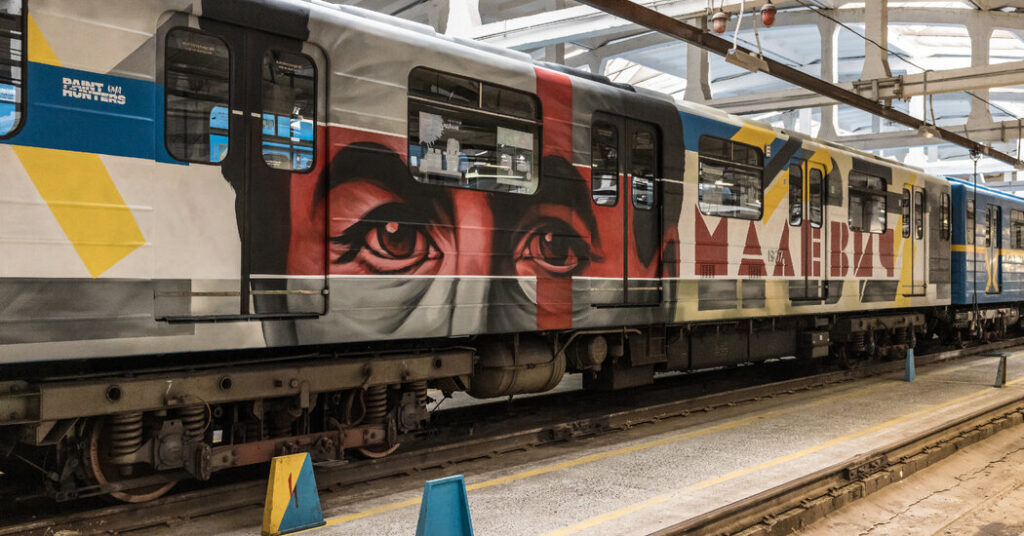
Movie theaters in the Ukrainian capital screened a biopic of the painter. A major exhibition re-created his designs in a large plastic installation. Subway carriages were painted with his designs. Even a trendy restaurant joined in, offering a Malevich-themed menu that featured a salty cake served on a painter’s palette dotted with butter blobs. To spread the butter, you had to use a brush.
In a country that has strived to shake off Russian cultural influences, celebrating Malevich — an artist known around the world as Russian — might have seemed odd.
But Malevich was born and raised in Ukraine, then part of the Russian Empire, and though he built his career in Moscow, he maintained strong ties with his homeland. So for Ukrainians, it was a chance to reclaim an artist long absent from their cultural narrative.
“We are all proud that he is Ukrainian,” Sviatoslav Vakarchuk, a Ukrainian rock star, wrote on social media. He posted a photo of himself wearing a T-shirt made by the biopic’s producers that read “I’m Ukrainian. Malevich.”
Efforts to showcase Malevich’s “Ukrainianness” are the latest front in a culture war between Ukraine and Russia that has unfolded alongside the fight on the battlefield. Ukraine is trying to take back heritage that Kyiv says Russia has appropriated or destroyed over centuries of domination, first under the Russian Empire and then under the Soviet Union.
The campaign has involved lobbying museums worldwide to relabel as Ukrainian works long identified as Russian and reviving the legacy of Ukrainian writers killed under Stalin. Many Ukrainians have also embraced folk songs and poetry to counter Moscow’s efforts to erase their culture.
Reclaiming Malevich may be Ukraine’s most challenging cultural battle. Most of his works sit in Russian museums, leaving Ukraine with almost none — a gap that has allowed Moscow to showcase the artist as its own in countless exhibitions. Many world museums, including the Museum of Modern Art in New York, continue to present Malevich as Russian.
It’s a battle Ukraine believes is worth fighting. By taking ownership of a name recognized around the world, Kyiv wants to assert Ukraine’s cultural weight and give its allies another reason to support it after nearly four years of war.
Malevich is best known as the founder of Suprematism, an abstract art movement that prioritized geometric shapes and pure colors over realistic representation. His works changed the course of art, influencing genres like Dadaism and Surrealism, and inspiring generations of artists, including Piet Mondrian and Mark Rothko.
“What Ukraine really needs now is to fight for people’s attention,” said Yaroslava Gres, founder of Ukraine WOW, an agency promoting Ukrainian culture that organized the Kyiv exhibition.
She added, “Explaining our culture and our connection with the world, showing our best pieces of art, is far more effective in getting people to know Ukraine, to love Ukraine.”
Malevich, born in 1879 in Kyiv to a Polish family, grew up in Ukrainian villages, where his father managed sugar factories, and later moved to Russia to pursue an artistic career. His identity straddles Ukraine, Russia and Poland — typical of an era when all three countries were part of the same empire.
For decades, however, the world knew only Malevich’s Russian side, a reflection of Moscow’s long cultural dominance, scholars say. Russia was where he honed his art and exhibited his works, including “Black Square,” which was first shown in 1915 in St. Petersburg, where he died 20 years later.
But it was also in Soviet Russia that Malevich faced repression during Stalin’s crackdown on intellectual circles, making it impossible to display his abstract art in his final years.
Few knew that Malevich spoke Ukrainian growing up, that he first studied art in Kyiv under the prominent Ukrainian painter Mykola Pymonenko or that he returned to Ukraine in the late 1920s to teach at the Kyiv Art Institute. Malevich identified himself as Ukrainian in his diaries.
Tetyana Filevska, an art historian and Malevich specialist, said she first learned of the artist’s Ukrainian roots in the mid-2000s, while working on a project with Polish art experts. “I had no idea he had any connection to Ukraine,” she said. “No one in Ukraine actually spoke about it.”
The discovery sent her digging deeper. She organized tours of Kyiv to show where Malevich had lived and studied, and gave lectures about how Ukrainian peasant life had inspired his art. In 2015, after one such lecture, a woman approached her and introduced herself as the daughter of Malevich’s former assistant at the Kyiv Art Institute. She had a treasure at home: dozens of pages of articles and notes written by the artist that had never been studied.
Ms. Filevska turned the archives into a book, “Kazimir Malevich. Kyiv Period 1928-1930,” which she said helped convince scholars who had long been skeptical of the artist’s Ukrainian roots. A few years later, a documentary brought her research to a wider audience.
Ms. Filevska said it would be wrong to relabel Malevich solely as Ukrainian. “We cannot take him out of the Russian context,” she said.
But, she added, she would like Malevich’s Ukrainian identity to be recognized — starting in Ukraine itself.
Though Ukraine became independent in 1991, the country’s cultural scene long remained shaped by Russia. Music, TV shows and books were mostly Russian. So was Malevich.
“We grew up with the feeling that he was Russian,” said Maria Prus, a marketing researcher. “We grew up with the feeling that Ukrainian culture is something small, while Russian culture is something big.”
Ms. Prus, 31, was visiting the exhibition organized by the Ukraine WOW agency, which highlights Ukraine’s cultural heritage and has attracted more than 160,000 visitors since it opened on Sept. 28.
The show featured a giant installation of colorful geometric forms evoking Malevich’s embrace of Suprematism, alongside a re-created pillow adorned with his designs — a nod to what is believed to be his first Suprematist work when he sketched patterns for Ukrainian embroiderers in 1915.
Ms. Prus said she knew so little about Malevich’s Ukrainian roots that she had not expected to see him featured in the exhibition. Her boyfriend, Eugene Kokomoiets, who visited with her, was just as surprised. “This is embarrassing for us,” he said with an awkward smile.
The exhibition is part of a broader effort to make Malevich a familiar figure for Ukrainians.
Silpo, a Ukrainian supermarket chain, recently repackaged a range of its specialty items, including honey pots, with Malevich-inspired designs, aiming to restore the artist “to the Ukrainian context.” A new cosmetics brand named Malevich sells beauty creams and lipsticks in red, blue and yellow packages — primary colors dear to the artist.
“If people every morning treat their skin with Malevich cosmetics, they’ll start to remember him,” said Kateryna Krykun, the brand’s founder.
The Malevich biopic serves a similar purpose. This fall, viewers exiting a showing said that they had a renewed sense of pride. “It’s about who we are and how important our culture actually is,” said Mariia Stretovych, 35, who, despite living on a street in Kyiv named after Malevich, acknowledged that she had long overlooked his story.
Ms. Filevska, the art historian, helped produce the movie. She said that one of the goals was to infuse Ukraine’s fight for freedom with a deeper sense of identity. “The more we understand who we are, the more we fight back,” she said.
Ukraine now hopes the wider world, too, will see this cultural heritage as one more reason to support the embattled country.
Since the war broke out in 2022, Ukraine has ramped up its cultural diplomacy, opening institutes in Germany, France and the Netherlands. From December to March, France will host a series of events highlighting Ukrainian culture under the banner “Voyage to Ukraine.”
“We need to tell more than the story of Ukrainian people being brave,” Ms. Gres, the Kyiv exhibition organizer, said. “We need to tell the story of Ukrainian culture.”
Olha Konovalova and Sofiia Diadchenko contributed reporting.
Constant Méheut reports on the war in Ukraine, including battlefield developments, attacks on civilian centers and how the war is affecting its people.
The post Another Front in the War in Ukraine: Who Gets to Claim a Famed Artist? appeared first on New York Times.