To understand why Alan Chikin Chow is one of the most successful creators on YouTube, watch the first 18 seconds of “My Boyfriend Is a Werewolf?!”
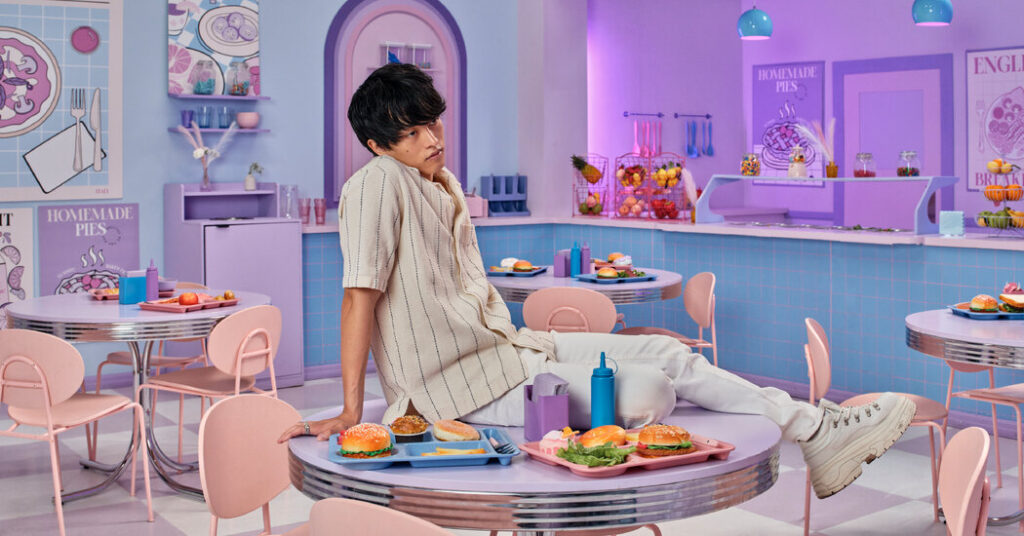
The video, part of his series “Alan’s Universe,” opens with paper airplanes zipping around a classroom whose pastel colors and clean-cut teenagers radiate “Saved by the Bell” aesthetics. The werewolf, played by Chow, shows up two seconds in and sinks his teeth into a hapless jock’s neck as his terrified classmates tumble out of their desks. A young woman screams, and we realize it is a dream sequence. The episode, published in late June, has been viewed more than 23 million times.
Those 18 seconds took Chow and his team four hours to nail, shooting take after take at his 10,000-square-foot production studio until they got the movement of the airplanes just right and the students falling to the ground with the proper thud.
“Most important scene of our episode!” Chow called out to start the shoot day. He knows that the 10-year-olds watching have other distractions and is determined to hold their attention: “The video clicks open, it’s explosive and then go, go,” he said later in an interview. But his audience also wants “story-driven video,” he added, filled with “emotion and moments and beauty.”
It can be hard to accomplish all of that. But more than a vast majority of people making videos on YouTube, Chow, 29, is among the 1 percent of the 1 percent, like MrBeast and Ms. Rachel, who have figured out something that is working. His videos are viewed one billion to 1.5 billion times a month on average. “Alan’s Universe” has 98.3 million subscribers — 35 million more than Taylor Swift — and this year became available on Prime Video and the Roku Channel. Chow is starting a pop group and has announced a partnership with the Korean skin-care brand Laneige. In July, he was named to Time’s list of 100 influential creators, alongside people like Joe Rogan, Alex Cooper and Kai Cenat.
“It’s 100 percent my intention to build this franchise,” Chow said, “into the next Disney.”
To do that, he will have to expand beyond YouTube, but he cannot ignore it, either, and that is the challenge for many content creators looking to level up.
A show made for Gen Alpha
Chow was born and raised in Plano, Texas, the son of a NASA engineer and a preschool owner, and grew up on a diet of “Family Matters,” “Hannah Montana,” “That’s So Raven” and other squeaky-clean sitcoms.
When he went off to college at the University of Southern California, his parents had moved to West Virginia, where they had no friends or family. So he started making videos that could make his mother laugh.
At U.S.C., he joined a club for students interested in becoming creators. He learned about the business of social media and that “you can actually make viral videos.”
The recipe is not really a secret: Hook viewers with a strong title and thumbnail image, keep them for the critical first few seconds, make sure a broad audience finds it relatable.
“It’s the difference between doing a video that’s really niche — ‘I spent 50 hours in Buc-ee’s,’ which is a gas station in Texas, which I know because I grew up in Texas — and ‘My Boyfriend Is a Werewolf?!’” Chow said. “Everybody knows what werewolves are and everyone is curious to see, ‘Oh, what is this concept going to be?’”
Some content creators attempt to tailor material to TikTok, Instagram and any other potentially profitable platform. But by 2020, Chow, aware that the Trump administration might ban TikTok, had also read the book “Essentialism,” whose message he summarized as “you can be good at many things or you can the best at one thing.” He threw himself into YouTube, specifically YouTube Shorts, videos often under a minute that are designed to be watched on phones.
Those early videos, which he eventually tapped Chelsea Sik, a U.S.C. classmate, to help him make, encapsulate some of Chow’s beliefs about what is effective. They are positive and high energy, built around wholesome themes. (“It doesn’t matter if you’re human or werewolf,” Sik’s character says in the werewolf episode. “Protecting each other is what makes us family.”) His YouTube Shorts videos often have little dialogue, making them accessible and language-agnostic.
But Chow knew that life lessons were difficult to impart in 60 seconds. So with Sik and some other friends, he made a five-minute episode, a sort of pilot for “Alan’s Universe.” It became the highest-performing video on the channel.
“I tried all these different things and I realized that because people watch this on Shorts all the time, they probably wanted this on long form,” he said. When he sprinkled in dialogue, viewership increased.
“We realized, ‘Oh, they actually want us to talk,’” he said.
Thus the beginning of “Alan’s Universe,” a series tracking Chow and his friends as they navigate high school, evil teachers, bullies and romantic snafus. Sik is now its lead actress.
The audience is heavily Generation Alpha, children roughly 7 to 14 who grew up with screens. His work is not so different from the Disney Channel and Nickelodeon shows that Chow and his cast mates came of age with.
“This show is for the children that are in middle school,” said Moris Zingman, 27, a lead producer on “Alan’s Universe,” “and this is their illusion of what high school looks like.”
‘You have to keep increasing the stakes’
Elements of “Alan’s Universe” splash across TikTok and Instagram, but it is YouTube, the No. 1 streaming platform, that powered its rise.
“Someone like Alan is defining what media and entertainment are for a new generation, both here and globally,” said Angela Courtin, a vice president of marketing at YouTube. Like many of the platform’s successes, Chow has formed a connection with his audience and responds to fans’ feedback, key parts of the “secret sauce for YouTube,” she said.
But being powered by YouTube also requires keeping up with its changing demands. People are watching longer videos, increasingly on their televisions, which has prompted Chow and other creators to create more episodic content. The change raises new creative hurdles.
“You have to keep increasing the stakes for 30 minutes, which is so much more difficult,” he said.
Among creators, the change in how people consume YouTube content and the move to a bigger screen has become a line of demarcation. Chow said he saw himself as part of a new wave of creators whose rise had been powered by this shift.
Michelle Khare, whose YouTube channel has more than five million YouTube subscribers, is also part of it. She previously made seven-minute videos about trying new Starbucks drinks but is now more likely to release a 47-minute episode of samurai training for her docuseries, “Challenge Accepted.”
Khare has a staff of six who work with dozens of freelancers. She called the operation “a modern production company,” noting that her team goes though development, production, post syndication and dubbing just like a traditional TV show. But creators like her are nimble and can adjust to audience feedback on the fly, she added.
Consider her recent video “I Tried Tom Cruise’s Deadliest Stunt.” To Khare’s surprise, the audience was invested in a segment that involved her getting protective scleral contact lenses put in.
“I thought they were going to want to see the physical training, the grit and the sweat,” she said. “But they were actually really interested in the technical component of the stunt. So for the very next episode that we’re releasing, I want to make sure that we have just as much focus on how we’re pulling it off as we do on my personal individual preparation.”
Making such cinematic content quickly gets expensive.
Chow discovered too late that although he could afford to rent a Burbank studio, he could not initially afford to build the sets he needed inside it.
Each time he made a change to scale up “felt like I had destroyed my life,” he said. And you do not get paid for videos you have not yet made, Chow added. So even now, he considers every video the team puts out to be “a big bet.”
The show makes money through advertising on the content, through campaigns like the new one with Laneige, as well as merchandise sales. Chow declined to say how much revenue his enterprise brings in.
A handful of YouTube personalities have struck lucrative deals. Puck reported this summer that MrBeast sold multiple seasons of his competition show to Amazon for almost $300 million. Netflix has already brought on Ms. Rachel. And this fall, a Dude Perfect documentary put the group of creators and their elaborate sports stunts in theaters nationwide.
Now, top creators like Chow have become less concerned about divining the secret sauce than a new challenge: How do YouTube’s stars maintain their popularity and grow it beyond the platform that has served them so well?
“YouTube is still our No. 1 priority,” Chow said.
But it has also become clear that fans want more than just videos. When Chow and his castmates performed at the creator festival VidCon, he realized it was time to get into music. Any efforts to expand beyond YouTube, he said, “really comes from the fans and how to serve them better.”
‘We get an idea and we shoot it’
Putting out even two episodes of “Alan’s Universe” a month requires 12-hour days, and by Hollywood standards, team members say, that is efficient.
“Things move a lot faster here,” said Laith Souqi, a line producer. “We have the standing sets and we have an inventory of props. So we get an idea and we shoot it.”
A trip to the “Alan’s Universe” studio reveals an industrious if unconventional group working in a still-evolving space. The prop department amounts to a tower of half-open Amazon boxes. Craft services equates to Chipotle. At a moment when traditional Hollywood is leaving Los Angeles, Alan and his team have put down roots.
On the day I visited, Chow watched recordings of his opening step-and-growl. He reshot it several times, worried he was not all that scary. Hours later, Chow — still in werewolf makeup — huddled with his creative team and decided to cut a battle scene; his audience might not like the twinge of violence, he reasoned, and, well, the scene was feeling a little long.
Writing and acting in the episodes has never been Chow’s biggest concern — he is trained in those disciplines, and he has help. It is the management role that he is still growing into.
“I always kind of thought, ‘OK, it’s just going to be me and a camera and maybe an editor,’” he said. But as “Alan’s Universe” has grown, he added, “I think I have just adjusted and said, ‘OK then, we have to turn up in this way in order to make this decision become the right decision.’”
Matt Stevens is a Times reporter who writes about arts and culture from Los Angeles.
The post ‘Alan’s Universe’ Shows What It Might Look Like to Win at YouTube appeared first on New York Times.