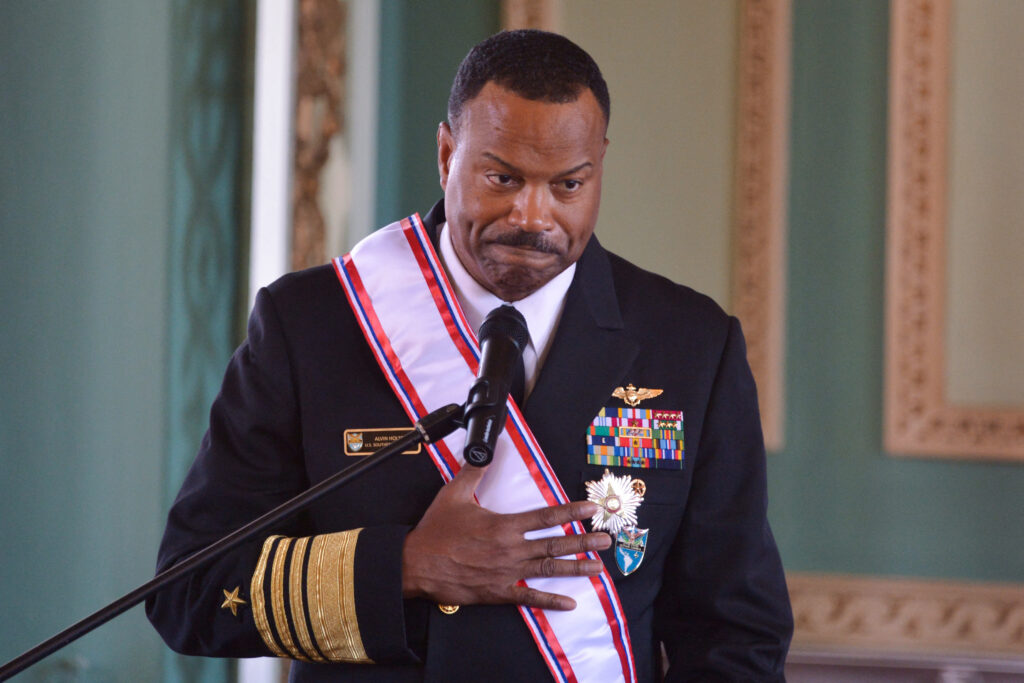
The top U.S. military officer overseeing operations in Latin America met privately with lawmakers on Tuesday, days before he is due to step down from his position prematurely amid tension with the Trump administration and its deadly counternarcotics campaign there.
Adm. Alvin Holsey, head of U.S. Southern Command, met in a classified session with Senate Armed Services Committee Chairman Roger Wicker (Mississippi) and the committee’s top Democrat, Sen. Jack Reed (Rhode Island). Reed, speaking to reporters afterward, said that Holsey “described the command relationships” he experienced and was “forthcoming,” though there is “still more to be gleaned.”
House Armed Services Committee Chairman Mike Rogers (Alabama) and Rep. Adam Smith (Washington), the top Democrat on that committee, scheduled a separate call with Holsey later in the day, said people familiar with the matter, who like some others spoke on the condition of anonymity because of the sensitivity of the issue.
The Armed Services committees in both the Senate and the House have opened fact-finding inquiries into a U.S. operation Sept. 2 that killed 11 alleged drug runners, including two men who survived the military’s initial strike on their boat in waters off Venezuela. Holsey’s interview was expected to cover a range of topics, including the controversial nature of his early retirement and bipartisan scrutiny of the decision-making on Sept. 2, people familiar with the matter said. Law of war experts have questioned whether the military’s killing of the two survivors was legal.
A spokesman for Holsey did not respond to requests for comment on Tuesday.
Holsey appeared before the senators by video teleconference, people familiar with the matter said, just ahead of a ceremony scheduled for Friday in which he is expected to step down a little more than a year after taking charge at Southern Command. Typically, top commanders there hold the position for about three years.
Holsey’s forthcoming retirement was disclosed in October and followed months of tension with Defense Secretary Pete Hegseth, people familiar with the matter said. At the time, these people said, Hegseth was unhappy with Holsey’s cautious approach as the administration, which has put significant emphasis on what it says are the national security imperatives inherent to the Western Hemisphere, looked to ramp up pressure on certain Latin American countries.
Hegseth, people familiar with the matter said, grew frustrated with how long it took Southern Command to comply with his requests, including to develop a plan for Panama. People familiar with the organization’s inner workings said the command has long been resourced more thinly than the military’s more high-profile organizations overseeing activities in the Middle East and in the Pacific, and for many years has relied on regional partners to complete missions.
Spokespeople for Hegseth previously have denied that there was tension between Holsey and Hegseth.
Later Tuesday, top Trump administration officials are expected to brief the “Gang of Eight,” a group of lawmakers that includes House and Senate leadership from both parties, plus the top Republicans and Democrats on each chamber’s Intelligence committee. Those lawmakers are due to hear from Secretary of State Marco Rubio, CIA Director John Ratcliffe, Hegseth and Gen. Dan Caine, the Joint Chiefs of Staff chairman, said people familiar with the matter.
It was not immediately clear what that conversation would entail. Lawmakers from both parties have for many weeks sought greater clarity on President Donald Trump’s objectives in Latin American, including his plans for Venezuela. Trump has repeatedly threatened to undertake military action there unless Venezuelan President Nicolás Maduro steps down.
Alex Horton contributed to this report.
The post Admiral pushed out by Hegseth meets privately with lawmakers appeared first on Washington Post.