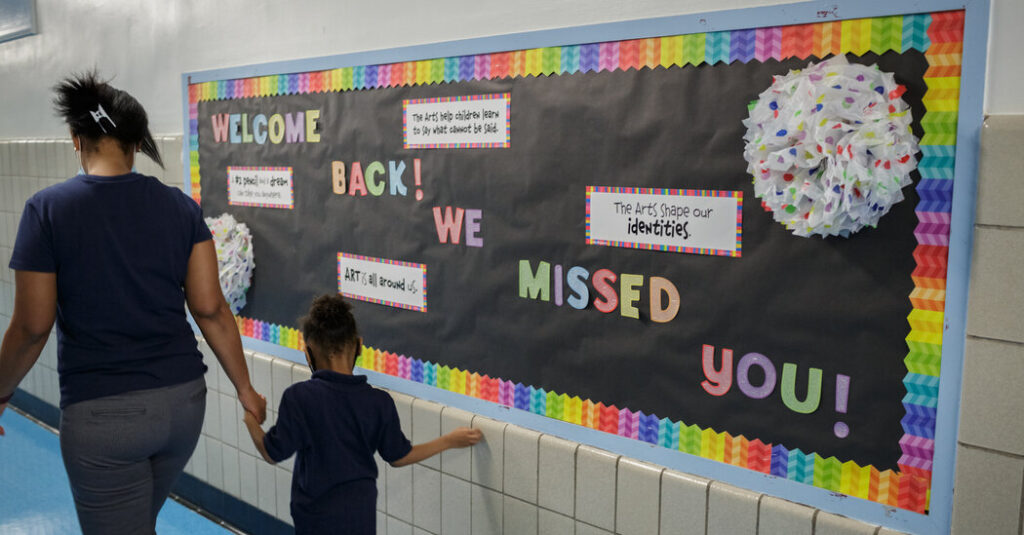
A study of nearly 200,000 California schoolchildren found that their mental health had improved significantly after schools reopened for in-person learning in 2021, evidence that its authors said shows that the risks of prolonged shutdowns were greater than policymakers understood at the time.
The study, published on Monday in the journal Epidemiology, tracked medical claims for 185,735 privately insured children ages 5 to 18 in California over the months before and after their schools reopened.
Nine months after schools reopened, the probability that a child would be seen by a provider for a mental health condition was reduced by 43 percent, the authors found. Spending on mental health medications decreased by 7.5 percent, and spending on other treatments, like therapy, decreased by 10.6 percent.
The improvements were more striking among girls.
Rita Hamad, a social epidemiologist at the Harvard T.H. Chan School of Public Health and a co-author of the study, said the findings suggested that officials in some parts of the country, in their focus on infection and transmission, had failed to fully consider the social costs.
“This is definitely a piece of evidence that I wish we’d had at the beginning of the pandemic to inform the conversations we were having,” Dr. Hamad said. “I think the decisions may have been different if we had seen that the benefits of school closures were being outweighed by risks like this.”
She noted that the sample included only children with private insurance, so it might underestimate the damaging effects. The team plans to follow up with an analysis based on Medicaid data.
Dr. Hamad said that, at the time, it was difficult to discuss the harmful effects of shutdowns without “people immediately jumping to very political, hyperpartisan responses.” She said she hoped that the study would contribute to “a more evidence-informed, balanced conversation” should a pandemic happen again.
“The hope really is to to inform policymaking the next time around,” she said.
The question of when to reopen schools divided many communities during the pandemic, often along partisan lines.
In March 2020, as the coronavirus swept the United States, around 55 million American schoolchildren abruptly stopped attending school in person. By fall of that year, many private and public schools, mostly in Republican-led states, reopened. Day cares, office buildings and restaurants sputtered back to life. But millions of public school students did not return to classrooms full-time for another year, until September 2021.
Five years later, a growing body of research has shown that longer shutdowns harmed children academically, without significantly stopping the spread of the virus.
Though it was clear that adolescents struggled with their mental health during the pandemic, evidence on the role of school shutdowns has been slower to emerge. Teasing out that effect is difficult because in 2021, many conditions were changing at once — vaccines had become widely available, and death rates were dropping, among other things.
The new study attempts to isolate the shutdown effect. California school districts reopened in a staggered fashion between August 2020 and June of 2021, creating what the study’s authors described as “a natural experiment” of comparing students whose schools had reopened and those whose schools had not.
The researchers tracked clinical coding for depression and anxiety and prescriptions of antidepressants and anti-anxiety medications. During the period when schools were shut down, 2.8 percent of children were seeing professionals for mental health care, they found, and the average monthly mental health care cost was around $50. Both measures began declining around four to six months after schools reopened, with a steeper decline between six and nine months.
Some experts said the time lag suggested other factors were behind the improvement. Benjamin Hansen, an economist who has studied links between school attendance and suicide, said the improvement might also reflect the relaxation of safety restrictions or the easing of the fear of infection.
“There is a delay which makes me wonder what else they could be picking up,” said Dr. Hansen, a professor of economics at the University of Oregon, who was not involved in the study. Six to nine months after schools opened, “vaccines came, and people stopped worrying about dying,” he said.
Dr. Hansen’s own work has found that, while in-person school benefits most children, it does not appear to help those who are struggling with suicidal behavior, and there is a seasonal drop in youth suicides during summer breaks. During the pandemic, he found, youth suicides declined early on and then rose by 15 percent with the return to in-person schooling.
Dr. Hamad acknowledged that the overlapping of various lockdown effects made it difficult to attribute mental health effects solely to school closures. “You can never truly disentangle this policy impact from other policies happening at the same time,” she said.
There is ample evidence that children and adolescents suffered from worse mental health when schools were closed, with less physical activity and more screen time. A 2022 systematic review published in JAMA Pediatrics found heightened symptoms of depression and anxiety in Britain, China, Canada and Bangladesh.
Christine M. Crawford, a child and adolescent psychiatrist at Boston Medical Center who was not involved with the study, said that while policymakers had considered the social cost of prolonged shutdowns, “they did not fully appreciate the magnitude of the impact it could have on kids’ overall well-being.”
In the future, she said, the mental health impact “should be strongly considered whenever making these sorts of decisions.” She added, though, that it was impossible to disentangle the stress and anxiety in children from coronavirus infections and deaths.
School closures are “just one piece of the puzzle,” she said. “The stress related to Covid-19 being out in the air was experienced differently by adults across the country. And if adults are struggling, we know that kids are struggling too.”
Ellen Barry is a reporter covering mental health for The Times.
The post Youth Mental Health Improved When Schools Reopened, Study Finds appeared first on New York Times.