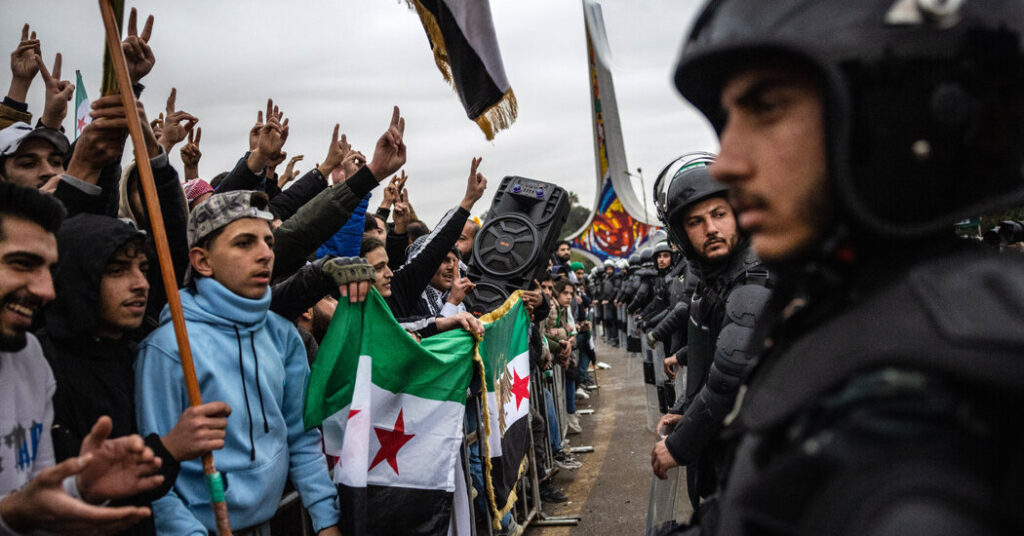
The call to prayer rang out through the cold, still air at dawn on Monday from the historic Umayyad Mosque in Damascus, Syria’s capital, officially beginning the celebrations commemorating a year since the fall of the dictator Bashar al-Assad and the end of his family’s decades-long tyrannical rule.
The festivities come as the country grapples with sectarian violence, deep economic challenges and security gaps that hinder any meaningful recovery. Its new leaders are also contending with how to build institutions that govern equitably for Syria’s estimated 25 million people, while balancing competing regional interests and navigating longstanding social, political and religious divisions.
But for the days leading up to the anniversary, many Syrians said they found reason to unite in joy in their newfound freedom.
Fireworks lit up the sky, music blared from cars and the country’s new flag was waved from balconies. Billboards, with slogans like “One country, one people” and “The dark era is over,” reminded people of what they had endured — and what they were now celebrating. At a military expo, officers demonstrated how their weapons, some handmade, helped topple a dictatorship.
On Monday, President Ahmed al-Sharaa joined the events, arriving at the Umayyad Mosque before sunrise to meet the throngs waiting for him.
“The oppression has ended,” said Mohamed Hariri, 48, a trader originally from Daraa, in southwestern Syria, but who was now in Damascus. “We now remain optimistic about the future.”
Mr. Hariri’s optimism was a stark contrast to the brutal legacy of the Assad dynasty, which ruled Syria for over five decades. Under both Bashar al-Assad and his father, Hafez al-Assad, the regime maintained control with an iron fist, silencing dissent through torture, imprisonment and fear.
Their ironclad control over the country held firm until the outbreak of civil war in 2011, which spiraled into a nearly 14-year catastrophe and claimed over a half-million lives by some estimates. Syrian refugees scattered across the globe and the country’s once-vibrant cities lay in ruins.
But all of that came undone last December, as rebels seized government strongholds, broke through army posts and swiftly captured the capital. Mr. al-Sharaa, a former commander of a rebel group allied with Al Qaeda, emerged as the country’s de facto leader and immediately began navigating the complex path to rebuilding Syria’s international standing.
Mr. al-Sharaa met with President Trump and spoke at the United Nations in September, the first for a Syrian leader in almost 60 years. He succeeded in getting the United States to lift most sanctions that crippled its economy. He urged international investors to fund Syria’s reconstruction through investment and trade.
“No challenge, no matter how great or heavy, will stand in our way,” Mr. al-Sharaa said at the mosque on Monday. “No obstacle will deter us. We will face every challenge ahead.”
Despite the optimism, worries persist.
Cuts to subsidies on bread and fuel have left citizens struggling with rising prices. With few job opportunities and low wages, many young Syrians said they saw emigration as their only hope for the future. Some Syrians who spoke to The New York Times in recent days expressed frustration over the government prioritizing billboards advertising the anniversary and luxury cars for officials.
“I see no development nor any hope,” said Azab Toumeh, 30, who works in a vegetable and fruit market in Damascus. She earns $6 a day, she said, and cares for her disabled sister and 14 children, including her brother’s children, who were orphaned after he was killed in the civil war.
Syria’s challenges are worsened by the immense task facing Mr. al-Sharaa’s government in navigating a fractured society. Sectarian violence has killed thousands over the past year. In March, armed men killed over 1,600 civilians, mostly from the Alawite minority, to which Mr. al-Assad belongs. In July, clashes between Druse fighters and government forces in the southern city of Sweida killed hundreds.
On Saturday, the Kurdish-led administration in the northeast banned any public gathering commemorating the anniversary, citing security concerns. The administration has rejected Mr. al-Sharaa’s push for central control and the relationship between the two sides has remained fraught.
“The rotten regime of Bashar is gone, but we are all in fear of what could happen next,” Zinan Othman, 47, who runs an appliance store in Wadi al-Mashari, a Kurdish-populated neighborhood in Damascus. “Nobody is being punished for incitement.”
For many, Monday’s celebration was bittersweet, especially for those whose loved ones are still missing. Tens of thousands of people deemed opponents of the Assad regime had been arrested by the former authorities and disappeared, with many either executed or killed ,according to human rights groups.
Sharifa Hazza, 51, last saw her husband, Basil, in 2018 at Sednaya, Syria’s most notorious prison. At an event for families of the missing and martyrs, she said she wanted the government to reveal what had happened to him, provide any clues or share any documents related to his case so that she can find closure.
“I need to know if he was shot, if he was hanged or anything that happened to him,” she said. “It is my right.”
Abdi Latif Dahir is the East Africa correspondent for The Times, based in Nairobi, Kenya. He covers a broad range of issues including geopolitics, business, society and arts.
The post With Fireworks and Parades, Syrians Celebrate Anniversary of al-Assad’s Fall appeared first on New York Times.