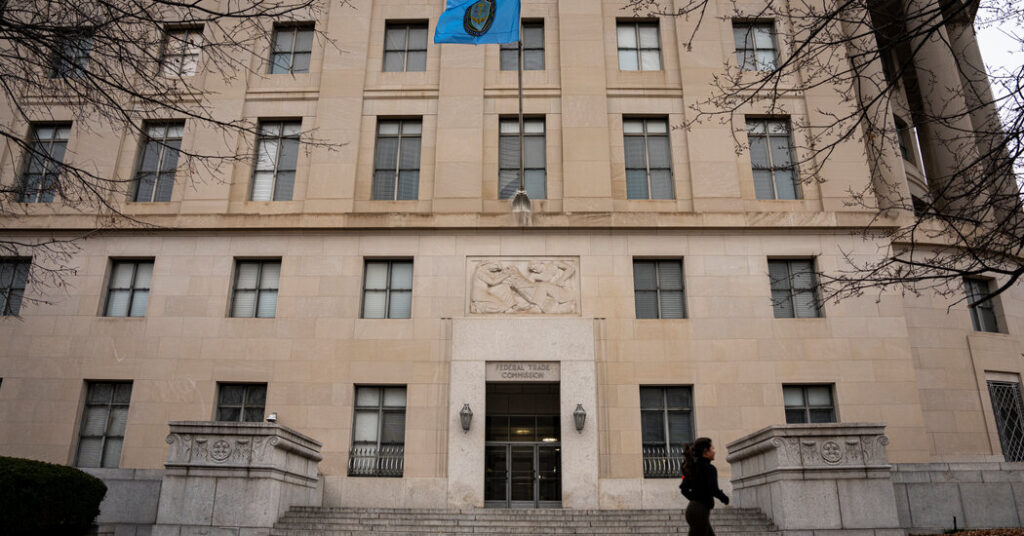
Monday’s arguments before the Supreme Court concern the Federal Trade Commission, a regulator that polices companies across the U.S. economy. The case involves President Trump’s firing of a Democratic commissioner of the F.T.C. and a decision from 1935, which said that Congress could put limits on the president’s authority to remove leaders of independent agencies.
Created by Congress in 1914, the agency has traditionally been governed by five commissioners — three members of the president’s party and two from another party. The agency’s chair, currently Andrew N. Ferguson, acts as its chief executive, directing a staff of lawyers, economists and technologists.
The agency’s first role is to enforce consumer protection laws. That means filing lawsuits against people and corporations that deceive consumers, target them with misleading advertising or violate their privacy.
In September, for example, the agency settled a lawsuit against Amazon that claimed the company had tricked people into signing up for its Prime subscription service and then made it hard for them to cancel. The company agreed to pay a $1 billion penalty and another $1.5 billion in refunds to consumers. Amazon also said it would stop using the tactics that lured customers into Prime subscriptions.
The F.T.C. also ensures companies are following antitrust laws, which bar abusive monopolies and forbid companies from doing deals that substantially reduce competition in the economy.
This year, the agency lost a lawsuit in which it had accused Meta of snuffing out nascent competitors to its Facebook social network when it bought Instagram and WhatsApp. It also sued Amazon in 2023 over claims the company had squeezed small merchants that sell products on its website. That case is scheduled to go to trial in 2027.
David McCabe is a Times reporter who covers the complex legal and policy issues created by the digital economy and new technologies.
The post What Is the Federal Trade Commission? appeared first on New York Times.