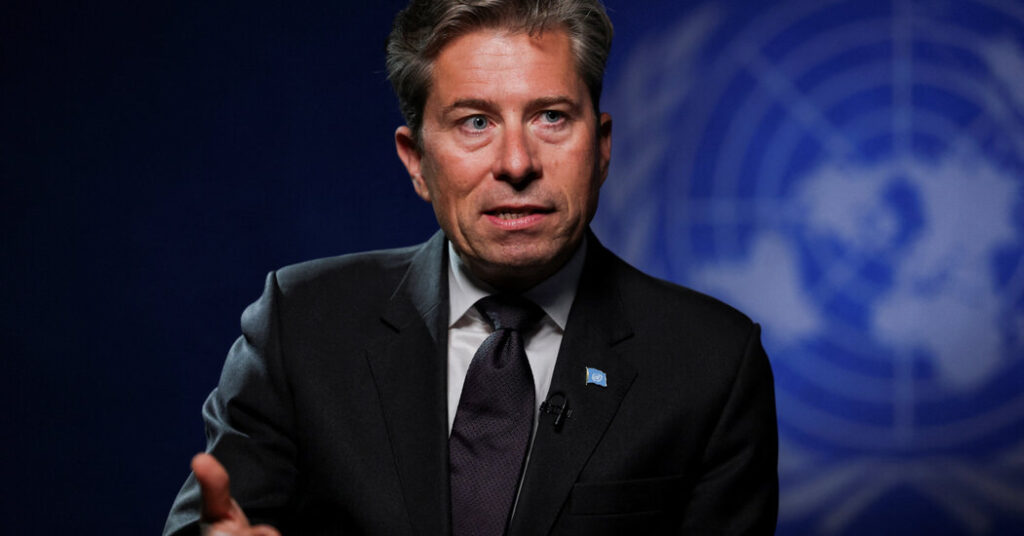
The United Nations plans to reduce by half the amount of money it requests from donor countries in 2026 to help people affected by war and natural disasters, a consequence of the drastic cuts by the United States and European governments to their foreign aid budgets.
Tom Fletcher, the United Nations under secretary general for humanitarian affairs, told reporters that after “excruciating life-and-death choices,” the priority for its 2026 fund-raising appeal, which started on Monday, is to raise $23 billion to deliver aid to 87 million people, about half the $47 billion that it requested in 2025.
Nominally, the U.N. and partner agencies are seeking $33 billion to reach 135 million victims of war and natural disasters in 2026 in its annual appeal to donor countries, but it has narrowed that fund-raising goal after failing to meet its targets for this year, Mr. Fletcher said. The U.N. Office for the Coordination of Humanitarian Affairs, which he leads, tried to raise $47 billion for aid operations in 2025 but scaled down that appeal to $29 billion midyear. It has received only $12 billion in 2025.
The humanitarian aid provided by the United Nations is financed almost entirely by voluntary donations from member countries, and most of those donations come from the United States and Europe.
“This is a heartbreaking report to share. There is pain on every page,” Mr. Fletcher said of the appeal. “We are overstretched, underfunded and under attack.”
The Trump administration has repeatedly questioned the value of the United Nations, pulled the United States out of several U.N. agencies, clawed back $1 billion in funding and told Congress that it plans to cut another $1 billion. European countries, including Britain, the Netherlands and Sweden, have also pulled back on U.N. funding and other forms of aid, to focus on defense and other domestic priorities.
Mr. Fletcher detailed the impact of those cuts on humanitarian aid programs: “Food budgets were slashed even as famines hit parts of Sudan and Gaza. Health systems broke apart. Thousands lost access to essential services,” he said.
More than 150 health facilities in Somalia were closed, and in Afghanistan, which is also experiencing rising malnutrition, the U.N. says it will be able to support only about a million people through the harsh winter months this year, compared with more than five million in 2024.
The challenge for international aid agencies, Mr. Fletcher said, will be to mobilize enough funds to avoid further reductions to its services in 2026 and beyond.
Mr. Fletcher said he had “practical, constructive conversations” almost daily with the Trump administration about what the United Nations is doing. But he will also be trying to attract new sources of money, including donations from the private sector, to try to bridge its funding gaps.
“I would be lying if I said this moment isn’t daunting,” Mr. Fletcher said. “It feels like we’re jumping off a cliff, not knowing whether anyone will catch us.”
The U.N. and international aid agencies estimate that a quarter of a billion people are in urgent need of humanitarian aid. The use of heavy weapons in conflicts in urban areas, the appeal notes, is driving up the toll of civilian casualties and the scale of destruction. Wars in Ukraine, Gaza and Sudan have also seen devastating attacks on hospitals and on those delivering humanitarian aid. The appeal reports that 705 aid workers have been killed since the start of 2024.
The U.N. aid plan for 2026, drawn up in consultation with more than 500 partner agencies, includes funding for people affected by several major conflicts. It includes $4 billion in emergency relief for Gaza, where aid entering the territory has increased since a cease-fire deal in October but, the U.N. says, remains well below the level of need; $2 billion for the millions displaced by the war inside Sudan and another $1 billion to support refugees who have fled from that conflict; $1.4 billion to aid victims of conflict in the Democratic Republic of Congo; more than $2 billion for emergency aid to Syria and nearly $3 billion for Syrian refugees.
But U.N. officials acknowledge that its financial pressures reflect donor impatience with inefficiency and duplication in the U.N.’s convoluted bureaucracy. In addition to the appeal from the humanitarian aid agency, other U.N. agencies are also reaching out to donor countries, in some cases with overlapping appeals: The U.N. refugee agency is calling for $8 billion for operations in 2026. The Food & Agriculture Organization, one of two U.N. agencies tackling food security, has recently appealed for $2 billion for 2026, and Mr. Fletcher will soon issue a separate call for support for the U.N. Central Emergency Relief Fund.
The 2026 aid plans try to address these concerns, Mr. Fletcher said. The U.N. will deliver more aid through local partners and provide more cash assistance, to lower the costs of delivering aid. It will also focus only on the most acute emergencies, leaving longer-term needs to development agencies and international financial institutions.
The post United Nations Cuts Its 2026 Emergency Aid Budget in Half appeared first on New York Times.