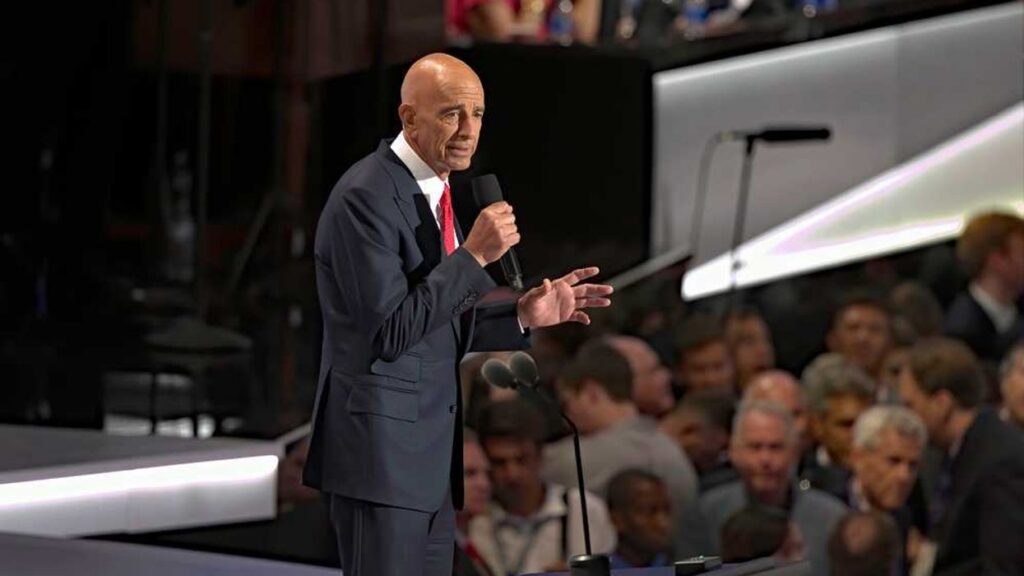
Tom Barrack, President Donald Trump’s ambassador to Turkey and special envoy for Syria, faced backlash Monday after arguing that US-backed Middle Eastern monarchies—most of which are ruled by prolific human rights violators—offer the best model for governing nations in the tumultuous region.
Speaking at the Doha Forum in Qatar on Sunday, Barrack, who is also a billionaire real estate investor, cautioned against trying to impose democratic governance on the Middle East, noting that efforts to do so—sometimes by war or other military action—have failed.
“Every time we intervene, whether it’s in Libya, Iraq, or any of the other places where we’ve tried to create a colonized mandate, it has not been successful,” he said. “We end up with paralysis.”
“I don’t see a democracy,” Barrack said of the Middle East. “Israel can claim to be a democracy, but in this region, whether you like it or not, what has worked best is, in fact, a benevolent monarchy.”
Addressing Syria’s yearlong transition from longtime authoritarian rule under the Assad dynasty, Barrack added that the Syrian people must determine their political path “without going in with Western expectations of, ‘We want a democracy in 12 months.’”
U.S. Envoy Sparks Controversy with Praise for Monarchies Over Democracies U.S. Special Envoy to Syria, Tom Barrack, stirred debate by saying, “Israel may call itself a democracy, but in this region, the system that has historically worked best—whether you support it or not—is a… pic.twitter.com/Vq3WX2Ytts — ME24 – Middle East 24 (@MiddleEast_24) December 7, 2025
While Barrack’s rejection of efforts to force democracy upon Middle Eastern countries drew praise, some Israelis bristled at what they claimed was the suggestion that their country is not a democracy, while other observers pushed back on the envoy’s assertion regarding regional monarchies and use of what one Palestinian digital media platform called “classic colonial rhetoric.”
“The reality on the ground is the opposite of his claim: It is the absence of democratic rights, accountable governance, and inclusive federal structures that has fueled Syria’s fragmentation, empowered militias, and pushed communities toward separatism,” Syrian Kurdish journalist Ronahi Hasan said on social media.
Ronahi continued:
When an American official undermines the universal principles the US itself claims to defend, it sends a dangerous message: that Syrians do not deserve the same political rights as others and that minority communities should simply accept centralized authoritarianism as their fate. Syria doesn’t need another foreign lecture romanticizing monarchy. It needs a political system that protects all its people—Druze, Alawite, Kurdish, Sunni, Christian—through genuine power-sharing, decentralization, and guarantees of equality.
“Federalism is not the problem,” Ronahi added. “The problem is denying Syrians the right to shape their own future.”
Abdirizak Mohamed, a lawmaker and former foreign minister in Somalia, said on social media: “Tom Barrack made public what is already known. The US labels dictators and monarchies benevolent when their behavior is aligned with US interest, and when their behavior isn’t aligned with US interest they are despots. Labeling dictators benevolent is [an] oxymoron that shows US hypocrisy.”
For nearly a century, the US has supported Middle Eastern monarchies as successive administrations sought to gain and maintain control over the region’s vast oil resources. This has often meant propping up monarchs in countries such as Saudi Arabia, Iran (before 1979), the United Arab Emirates, Bahrain, and Qatar—regardless of their often horrific human rights records.
While nothing new in terms of US policy and practice in the region, the Trump administration’s recently published National Security Strategy prioritizes “flexible realism” over human rights and democracy and uses more candid language than past presidents have in explaining Washington’s support for repressive monarchs.
“The [US] State Department will likely need to clarify whether Barrack’s comments represent official policy or personal opinion,” argued an editorial in Middle East 24. “Regardless, his words have exposed an uncomfortable truth about US foreign policy in the Middle East: the persistent gap between democratic ideals and strategic realities.”
“Perhaps the most troubling aspect of this episode is what it reveals about American confidence in its own values,” the editorial added. “If US diplomats no longer believe democracy can work in challenging environments, what does this say about America’s faith in the universal appeal of its founding principles?”
The post Trump official rebuked for declaring that a ‘benevolent monarchy’ is best for Middle East appeared first on Raw Story.