When a U.S. general publicly declared that Mexico was a haven for Russian spies, Mexico’s president at the time dismissed it outright.
“We don’t have information on this,” President Andrés Manuel López Obrador told reporters the next day, in March 2022.
That was not true.
His top aides had repeatedly heard from Washington about the increase in Russia’s covert activities in Mexico, according to nine current and former American and Mexican officials. In fact, Mr. López Obrador had been told about the problem directly, said three of the U.S. officials briefed on the discussions.
The C.I.A. had even compiled a list of more than two dozen Russian spies posing as diplomats, but Mexican officials refused to kick them out of the country, five of the officials said.
The United States did secure a major promise from Mexico in 2023, several of the people said: Under pressure, Mexico agreed to let U.S. officials weigh in on Russians applying for diplomatic credentials, and they have rejected some of them.
But even after a new president took office in Mexico last fall, the Russian spies already in the country were not expelled, according to six current and recently departed officials.
“The Mexican government did help, but they could have done a lot more,” said Juan González, the director for Western Hemisphere affairs on the National Security Council during the Biden administration. “We gave them names of Russian spies who were posing as diplomats at the embassy in Mexico City. These were seasoned spies, who had been on sophisticated operations across Europe.”
Mexico’s proximity to the United States and the cover provided by tourism for spies to operate has allowed Moscow to significantly ramp up espionage activities in the country in recent years, U.S. officials say. Moscow can fly spies and informants from the United States to beach destinations like Cancún, which millions of Americans visit every year — providing a convincing cover that raises few red flags.
Spies and their handlers meet among tourists, sunbathers and surfers, officials say, handing off intelligence gathered in the United States while using Mexico to evade Washington’s sophisticated surveillance systems.
Russia is also increasing disinformation efforts, especially online, to turn Mexicans against America and Europe, causing British and French officials to raise concerns with Mexico’s Foreign Ministry, officials said.
Those efforts prompted the U.S. Embassy in Mexico City to appoint its first Russia watcher this summer, and the French Embassy to create a disinformation officer role.
The Mexican government declined to comment.
The Russian Embassy said in an email that Russian diplomatic missions were “frequently the target of unfounded accusations of espionage” and that Russia and Mexico have had “a wide range of bilateral relations.”
It is not clear whether the United States is still pushing for expulsions under President Trump, whose policy toward Russia has swung between courting the Kremlin and threatening it.
But Mr. Trump has in essence resurrected the Monroe Doctrine, officials and analysts say, seeking to assert Washington’s supremacy in the Americas. U.S. officials say that has given them some direction to make sure that actors like Russia and China do not gain a foothold in the region.
The White House did not respond to a request for comment.
In recent years, Moscow has also dispatched high-level officials to the region, including Nikolai Patrushev, the head of Russia’s Security Council and a longtime aide to President Vladimir V. Putin.
“The significance of this region for Russia is growing rapidly,” Mr. Patrushev said while touring it last year. “These are countries standing at the forefront of the struggle for the true sovereignty of Latin America.”
‘The Vienna of Latin America’
Russia has long used Mexico as a base for espionage operations, earning it the nickname “the Vienna of Latin America” during the Cold War. But American officials say those efforts scaled up after Russia invaded Ukraine in 2022.
That year, the United States and its European allies expelled more than 100 Russian intelligence officers from their countries. They had already forced out scores of Russians from embassies and consulates a few years earlier, after the poisoning of a former Russian spy in Britain.
American and European officials then watched as Moscow relocated spies to Mexico City, according to eight current and former Western officials. Several of the officials interviewed by The New York Times spoke on the condition of anonymity because they had not been authorized to speak publicly.
The U.S.-led push to support Ukraine, they said, drove the Kremlin’s need for more intelligence on Washington, and some of Russia’s most skilled intelligence agents are now based in Mexico’s capital.
The agents face little resistance, officials say, because Mexico’s counterintelligence agencies are more focused on domestic issues like drug traffickers, and less experienced with foreign espionage activities.
“If you are going to handle and recruit spies, proximity is key and that’s what Mexico offers,” said Duyane Norman, the C.I.A.’s chief of operations in Latin America until he retired in 2019. “Russia can act with greater impunity in Mexico — there are not as many eyes on them as in the U.S. or Canada.”
Only a few cases have emerged in public, including that of a Mexican citizen, Héctor Alejandro Cabrera Fuentes, who was arrested in 2020 trying to board a flight from Miami to Mexico. In Florida, prosecutors said, Mr. Fuentes had tried to gather information on a confidential U.S. source who had “provided information about the Russian government to the U.S. government.”
Mr. Fuentes pleaded guilty in 2022, and now lives in Mexico. He declined to comment.
C.I.A. Files and U.S. Warnings
While most operatives remained hidden, some signs of Russian interest are in plain sight.
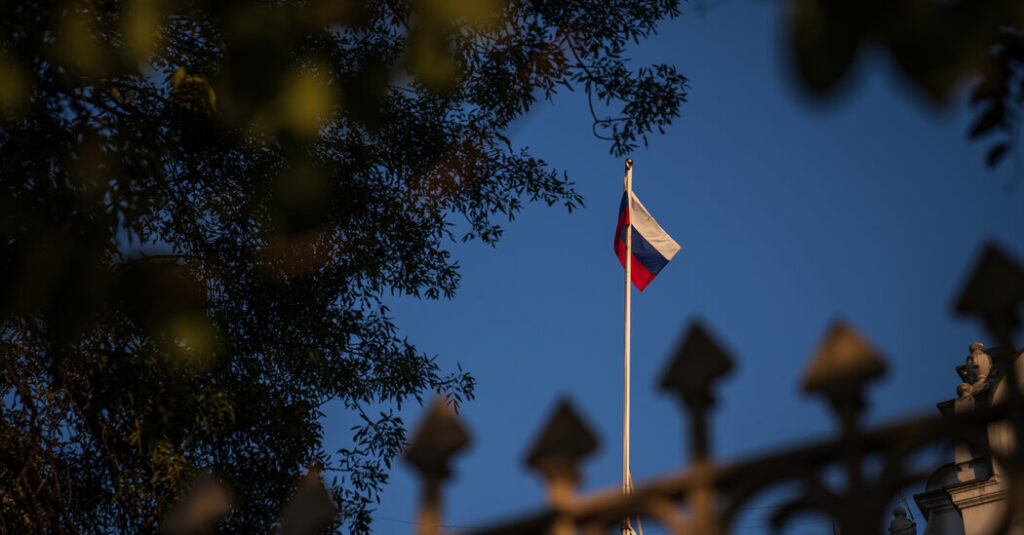
Russia’s embassy in Mexico City is one of its largest around the world, with 85 diplomats listed there even though Mexico and Russia have few cultural, military or economic ties. In contrast, Mexico has 16 diplomats at its Moscow embassy, according to its Foreign Ministry.
The C.I.A. put together thick files on people stationed at the Russian Embassy, with details of their past posts and specific espionage operations in Europe and the United States, according to three American officials briefed separately by the agency.
Since 2022, U.S. officials have raised concerns about Russian spies to Mexico’s president, foreign minister and others “multiple times,” said Mr. González, the former Biden administration official. Another American official said the same concerns were raised with the government of Mexico’s current president, Claudia Sheinbaum, who took office last fall.
But the concerns were dismissed as paranoia, another official said.
Other American officials who raised the list said that when they followed up they were told the Mexican officials never received it, that the list was too vague to act on or that junior officials misplaced it.
Eventually, Gen. Glen VanHerck, the head of U.S. Northern Command, aired the concerns in public testimony to the Senate in March 2022.
“The largest portion of G.R.U. members in the world is in Mexico right now,” said General VanHerck, referring to Russia’s main military intelligence agency. “Those are Russian intelligence personnel, and they keep an eye very closely on their opportunities to have influence on U.S. opportunities and access.”
Mr. López Obrador then brushed the general’s remarks aside.
By late 2022, Washington had grown so concerned over Russia’s spy buildup that Wendy Sherman, then deputy secretary of state, raised the issue with Mexico’s foreign minister, according to several people with knowledge of the meeting. (Ms. Sherman declined to comment.)
Marcelo Ebrard, the foreign minister at the time, tried to wave away the concerns, these people said, saying the Russians on Washington’s list were not “a problem.”
Ms. Sherman replied: “They are a problem. We know, we kicked many of them out of D.C. and now they are here.”
Mr. Ebrard promised to investigate, the people with knowledge of the meeting said. But every time American diplomats followed up, Foreign Ministry officials claimed they never received the list.
Mr. Ebrard declined to comment, and aides to Mr. López Obrador said he was not speaking to the news media.
In the following year, Washington’s concerns grew as hundreds of thousands of migrants, including Russians, gathered at the U.S.-Mexico border.
The Biden administration worried that Russia could plant spies among them, and dispatched Liz Sherwood Randall, the top homeland security adviser, to raise the issue with Mexican officials in several meetings, including with Mexico’s president, according to two people with knowledge of the talks. Ms. Sherwood-Randall declined to comment.
Mexico said it would keep an eye on Russian asylum seekers, according to those people, alerting U.S. officials to any suspicious behavior.
‘One of Moscow’s Key Priorities’
As U.S. officials pressed Mexico to act on spies, they also struggled to secure cooperation on the world stage, despite the country being a major ally on security and trade.
Mexico initially voted at the United Nations to condemn Russia’s invasion, but it has not sent aid to Ukraine or imposed sanctions on Russia. And as the United States tried to isolate Russia, Mexican lawmakers formed a Mexico-Russia “friendship committee” and its president defended a Russian military unit taking part in a Mexican parade in 2023.
Mexico’s current president, Ms. Sheinbaum, has largely held to the country’s longstanding policy of neutrality, in which it preserves relations with countries like Russia and Venezuela despite U.S. pressure.
Under Ms. Sheinbaum, Mexico voted at the United Nations this year to reaffirm Ukraine’s sovereignty. But when the Group of 7 nations later met in Canada, she did not meet Ukraine’s president, according to two people familiar with the matter, and Ukraine’s foreign minister did not speak with Mexico’s at the U.N. General Assembly this fall.
In contrast, Mexico’s top diplomat met with Russia’s foreign minister this summer in Brazil, with the officials expressing warm relations and mutual interests.
Mexico’s tolerance of Russia, American officials say, may reflect the politics of its governing party, Morena, which dominates the federal government. The party includes a wide range of politicians, but at its core are many ardent leftists who are deeply suspicious of the United States over its history of invasions, coups and influence campaigns in Latin America.
Morena officials did not respond to a request for comment.
Russia has openly courted countries in the region, too. During his tour last year, Mr. Patrushev pledged to help countries curb U.S. influence, saying good ties with Latin American governments were “one of Moscow’s key priorities.”
But covert activities are critical, experts say, and not limited to Mexico. The Kremlin for years used Brazil as a launchpad for elite intelligence officers, and used allies like Cuba and Venezuela as operational hubs.
If the United States was supporting Ukraine, then Russia had reasoned it would “start messing” with U.S. neighbors, said Mr. Norman, the former C.I.A. official. “Mexico is the gateway to Latin America, and the Russians know that.”
Galia García Palafox and Emiliano Rodríguez Mega contributed reporting from Mexico City, and Milana Mazaeva from Tbilisi, Georgia.
Maria Abi-Habib is an investigative correspondent reporting on Latin America and is based in Mexico City.
The post The U.S. Gave Mexico a List of Russian Spies. Mexico Let Them Stay. appeared first on New York Times.