Imagine you’re preparing to board an international flight at a U.S. airport. Instead of juggling your belongings as you pull out your passport for the gate agent, you barely break your stride as you head onto the jetway. The agent reviews your identity on a computer screen.
This swift identity-confirmation process, powered by facial recognition, could someday be coming to airports across America. But travelers will see it first at Orlando International Airport, which will test new biometric technology for select international departures next month.
Passengers leaving the United States from Orlando could encounter one of three 90-day pilot programs, including a “contactless corridor,” a subtly defined zone with several mounted cameras that can simultaneously process several people in motion.
The corridor is a collaboration among three biometric technology companies — Paravision, AiFi and Embross — and pairs cameras and artificial intelligence with facial-recognition and movement-tracking software.
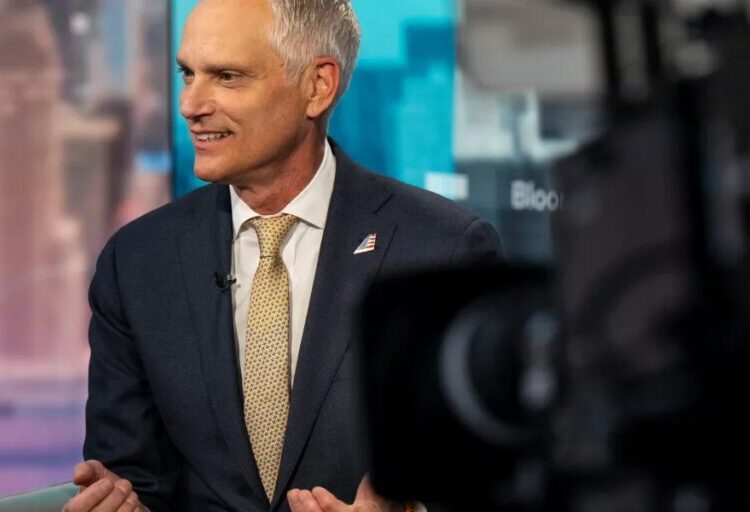
“Our goal is that you don’t have to tell travelers to do anything specific at all,” Joey Pritikin, Paravision’s chief product officer, said during a recent demonstration of the product at the airport’s innovation lab. “The idea is to make the technology disappear,” he added. “We know exactly who is where, when.”
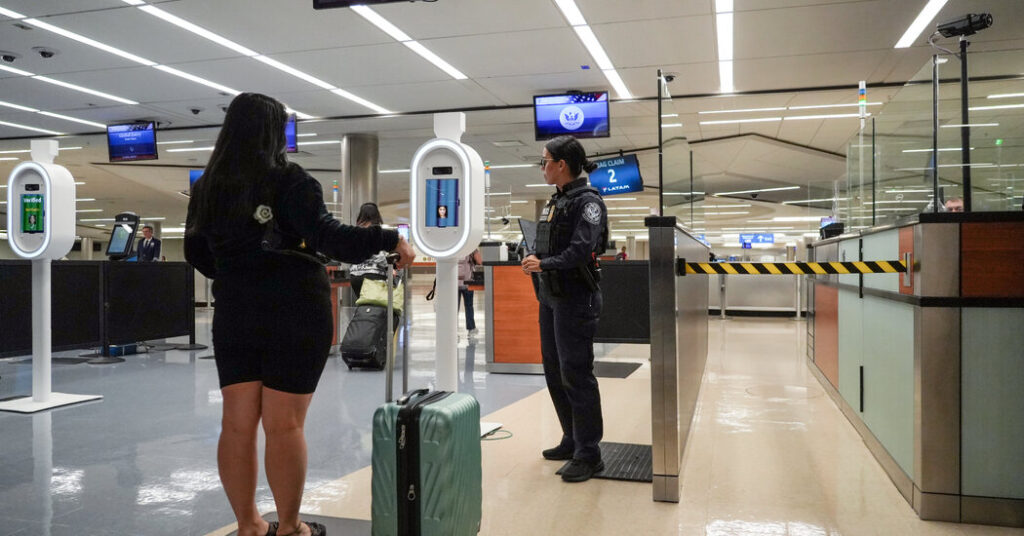
As passengers approach the gate agent, cameras capture their biometrics, which are rapidly matched against government records, including a photo database of travelers, to confirm their identities and their authorization to be in the United States. The gate agent reviews this information on a separate screen.
Biometric identity verification, optional for American citizens but required for foreign visitors, dates back to a 2001 congressional mandate in the aftermath of Sept. 11. The technology has long raised concerns among privacy experts, who question how biometric data is used and stored, as well as its accuracy.
Helping Families Wait Less
Orlando International, Florida’s busiest airport, with 56 million passengers so far this year, has emerged as a prominent testing ground for biometric technology. This is, at least in part, because facial recognition helps efficiently process the many families who come to visit attractions like Disney World and the new Universal Epic Universe theme park. At the airport on a recent Thursday, multigenerational families and children clutching Disney stuffed animals and wearing Minnie Mouse ears filled the security lines.
“Technology enables us to move passengers more effectively without compromising safety and security,” said Lance Lyttle, the chief executive of the Greater Orlando Aviation Authority, which manages the airport. International destinations served by the airport include cities like Frankfurt, Paris and São Paulo, Brazil.
In May, Orlando International teamed up with U.S. Customs and Border Protection to introduce a faster biometric process for Americans entering the country. The optional program, called enhanced passenger processing, uses facial recognition to confirm travelers’ identities at the C.B.P. checkpoint without requiring them to show a passport. It is now available at more than a dozen U.S. airports, including Kennedy International in New York and Charlotte Douglas International in Charlotte, N.C.
In 2018, Orlando was the first airport in the U.S. to commit to using facial recognition to process all international arrivals and departures. To date, it has installed biometric exit at 65 of its 113 gates.
Next month, in addition to the biometric corridor, passengers will see two other pilot programs at separate gates, both intended to speed up passenger verification using biometrics. One consists of tall, white kiosks made by the tech vendor iProov, and the other is hardware by the biometrics company Aware that can quickly capture and simultaneously process several people.
The new technology could simplify getting through airport checkpoints, said Dominic Forrest, iProov’s chief technology officer.
“No getting your passport out, no getting your ticket out,” Mr. Forrest said. “Four people at a time, people carrying kids, people pushing wheelchairs. That’s what the technology can do.”
Momentum at the Gate
C.B.P.’s mission to create a biometric entry-exit system dates back decades. While biometric entry for arriving international passengers, in use since January 2004, is fully operational at airports, biometric exit for departing flights has lagged because of operational and logistical challenges, including the cost. Generally, airlines and airports pay for the biometric exit equipment.
However, the pace has picked up this year, with biometric exit now available at dozens of airports. A new federal rule that goes into effect on Dec. 26 will further supercharge biometric exit to expand to all airports, seaports and land crossings across the country. C.B.P. estimates that this could be accomplished within the next three to five years. Biometric entry and exit will now also be required of all non-U.S.-citizen travelers; previously, children under 17 and adults over 79 were exempt.
Diane Sabatino, the acting executive assistant commissioner for field operations at C.B.P., emphasized that the biometric entry-exit system always starts with security — identifying travelers and their authorization to be in the country.
In the 2025 fiscal year, which ended on Sept. 30, about 52 percent of departing air travelers were biometrically confirmed, a C.B.P. spokeswoman said. Since June 2017, 848 million people have undergone the process. As of this month, more than 529,000 foreign nationals who have overstayed visas have been identified using this process.
Ms. Sabatino said biometric entry and exit benefited travelers by increasing speed and convenience. American citizens, she added, can choose to opt out in favor of a traditional inspection by a C.B.P. officer, and she reiterated that the process would always be optional for U.S. citizens.
The U.S. Travel Association, a trade group that promotes travel to and within the country, supports the biometric entry-exit expansion. In a statement, the group called the rule a major step to modernize borders — one that is comparable to the requirements of other countries, such as the United Kingdom. The biometric system will also ease traveler “burdens and bottlenecks” by helping them move through the airport faster, the group said.
Privacy experts see the technology differently. Jeramie Scott, a lawyer with the Electronic Privacy Information Center, a Washington-based nonprofit, said that the United States lacks comprehensive regulation of facial recognition to restrict its use and protect First Amendment rights.
“The ease of implementation is what, in part, makes facial recognition such a dangerous technology to implement at such a broad scale,” Mr. Scott said. “The government will seek to expand its use, thus shifting the control over identification from the person to the government.”
Still, biometric technology has proliferated at airports, making its way to security checkpoints, departure gates and C.B.P. inspection areas. Biometric experts and C.B.P. officials say that privacy, data security and consumer trust are constantly being weighed.
“We want to be sure that we are taking into consideration the concerns, the equities,” Ms. Sabatino said. “But a port of the future, you know, five years down the road, maybe it’s 10 years down the road, it’s moving through at speed.”
Follow New York Times Travel on Instagram and sign up for our Travel Dispatch newsletter to get expert tips on traveling smarter and inspiration for your next vacation. Dreaming up a future getaway or just armchair traveling? Check out our 52 Places to Go in 2025.
Christine Chung is a Times reporter covering airlines and consumer travel.
The post New Biometric Tech May Let You Keep Your Passport in Your Pocket appeared first on New York Times.