This article contains spoilers for “It: Welcome to Derry.”
Send all the soldiers and adolescent sleuths you want: You will not find Madeleine Stowe on social media. “I’ve tried it,” said the actress. “I hate it. I got rid of it. I don’t like breaking that wall. I don’t want to do that to the audience.”
Keeping secrets from the audience of HBO’s “It: Welcome to Derry” has been part of Stowe’s remit all season long. She stars as Ingrid Kersh, a kind-hearted nurse at a psychiatric hospital. She bonds with two of the show’s heroes: Lilly (Clara Stack), a child mourning the comically macabre death of her father, and Hank (Stephen Rider), a Black movie theater owner with whom Ingrid has an affair.
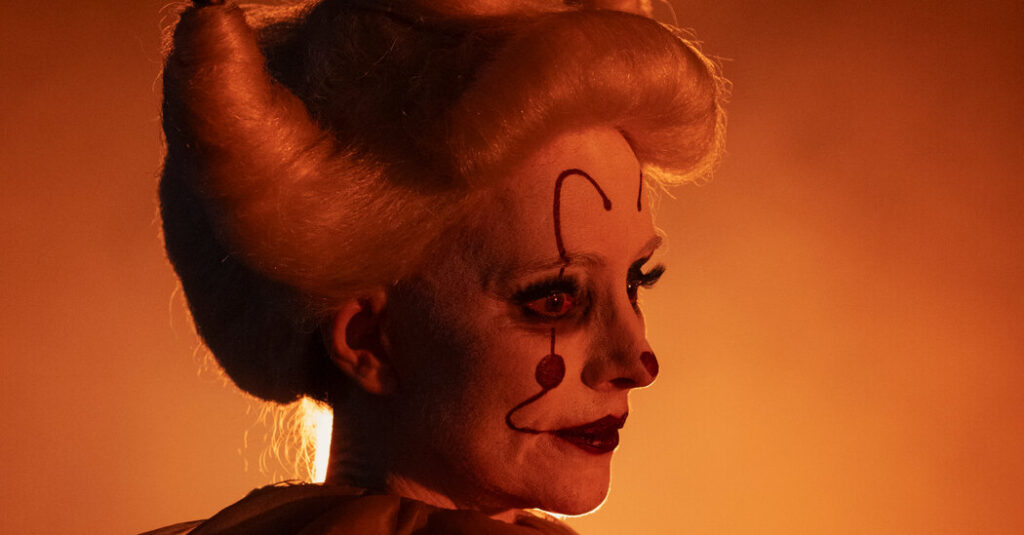
But like the town of Derry, Maine, itself, which is the home of an immortal, shape-shifting, child-killing entity known as It, Ingrid is hiding a deep-rooted darkness. Years earlier, she lost her father (Bill Skarsgard) when the two of them were in town with the carnival, in which he performed as Pennywise the Dancing Clown. The creature had been so taken by Bob’s ability to engross his young audience that It devoured him and took his shape.
Convinced that this means her father is still in there somewhere, Ingrid has spent a lifetime in Derry trying to get him back. Adopting her late mother’s clown persona, Periwinkle, she directs a racist lynch mob to the Black nightclub where Hank, accused falsely of murder, is hiding. The ensuing bloodshed attracts Pennywise (the monster version, also played by Skarsgard), just as she hoped. But as we see by the end of Episode 7, which aired on Sunday, her hopes of a family reunion are short-lived.
Ingrid, her father and their mysterious link to It have been a subject of speculation since Stephen King unleashed the best-selling horror novel “It,” his 1986 magnum opus. In the book, an aged version of Ingrid, referred to as Mrs. Kersh, is introduced as one of It’s manifestations; her appearance in the 2019 film “It: Chapter Two,” as played by Joan Gregson, added further nightmare fuel. (That film’s director, Andy Muschietti, is a creator of the series and directed four of its eight episodes.)
Over a video call from her home in Memphis last week, Stowe repeatedly connected the evil in Derry with troubling events in present-day America. She will miss the killer clown’s town, though, and still would like a souvenir: “There’s only one thing I want,” she said. “One of those ‘Welcome to Derry’ postcards.”
It has been several years since you were last onscreen. What drew you to “Derry”?
I was told that Andy wanted to speak to me about this project, but he didn’t want me to see the scripts ahead of time. He wanted to talk to me about it first, and he spent an hour walking me through it. Andy doesn’t lecture about politics, but it was very clear to me that, since time immemorial, we’ve been dealing with a kind of insatiability. It spoke to me about these particular times that we’re living in — the fascism.
Stephen King is a major figure in pop culture, and that comes with a pretty intense fandom. Were you ever concerned by how people might react to the show’s changes to the novel?
It was never, ever a concern. Stephen King is such a beautiful writer, and his work is so rich. When somebody like Andy calls you, and he loves that work and sees it and understands it — he’s taken it into his body, basically — and he says, “Would you do this with me?” I’m like, “Yeah, of course.” Why wouldn’t I?
Ingrid does not appear evil at first. Was it challenging to keep that aspect of the character under wraps?
Andy actually loved her very much! He feels that she was good in her heart. That wasn’t a difficult thing to portray. There’s a sense that Ingrid is stunted. She’s caught in the age when this terrible tragedy happened. She’s been in a state of suspension all these years, waiting for the impossible, waiting for her father to be reclaimed. She sees something in this girl Lilly, and her compassion for her is very real — but then it stops, because there’s something else that’s really driving her. Part of that involves Pennywise’s trickery over her, the illusion that he’s created.
But when I see what’s going on right now, there are grand illusions happening before our very eyes. And nobody believes that they’re a bad human being. You can see that in the Epstein emails, for instance. It’s fascinating to me, watching Epstein have conversations with Larry Summers: They’re saying certain things about Donald Trump, but nobody’s looking to themselves. They view themselves as the good guys. In Ingrid’s mind, she thinks she can extract her father from It and bring him back to himself, and all the rest will end. It’s an “end justifies the means” situation.
I was surprised to find myself genuinely moved by the tender relationship between Ingrid and her father. Even their clown act was a thoughtful way to mourn the wife and mother they lost. I can see how losing him, too, would damage her.
Right. They create this sense of magic together. When you’re somebody who’s experienced trauma twice and you’ve had a taste of something that sweet, how do you move on from that?
I think Ingrid bounced around from foster home to foster home. In my mind, she probably had been institutionalized. So what does she do? She stays and ends up working there. But I find her love for her father to be a moving, touching thing, as horrifying as it is.
What about Ingrid’s affair with Hank? Was she setting him up to engineer Pennywise’s return all along?
Oh, I think she loved him. In fact, [the producers] went back and forth about whether I go in and try to save Hank and his daughter. Her feelings for him are very real, but she’s seeing these supernatural things start to happen, and her love for her father is even larger.
Pennywise has been scaring me since I first read the book as a seventh grader. Was working with Bill Skarsgard in his full killer-clown kit intimidating?
I felt for him, because his makeup is quite burdensome. And he has a rather frail-looking body. When you see him, he’s just super tall. But when he became that person, and you look at his face, he was a complete 180 from the man walking around. He’s a daunting actor.
He’s excellent at capturing Pennywise’s cheerful sadism.
Sadism has really come out of its closet. We’re now living in a time where sadism seems to be embraced. Pennywise embodies that sadism, that cruelty for the sake of cruelty. It’s insatiability, that’s all it is. There’s this thing in human nature where there’s never enough. You can’t get rid of it, but you can regulate it, and you can contain it. But it takes a lot of courage to do that.
Pennywise couldn’t go undetected for so long if the people of Derry didn’t cover it up and look the other way.
Well, it’s like the erasure of history, how they’re trying to change things at Monticello or the National Archives, or ban any mention of Jan. 6. This is really happening. It’s a prescient story.
The post ‘It: Welcome to Derry’: Madeleine Stowe on Playing Evil’s Little Helper appeared first on New York Times.