
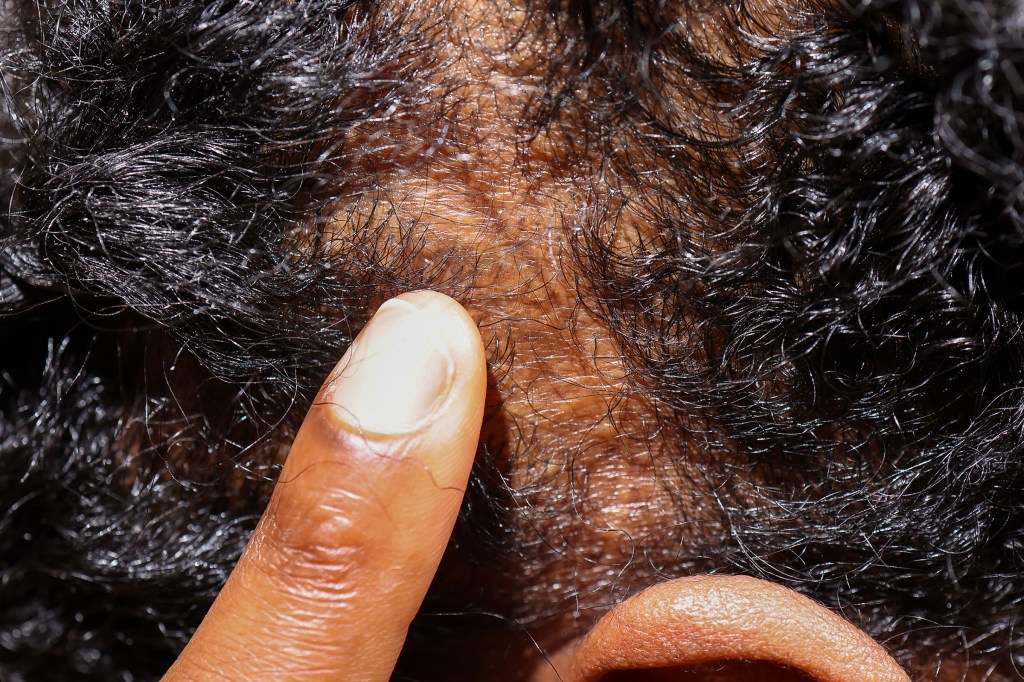
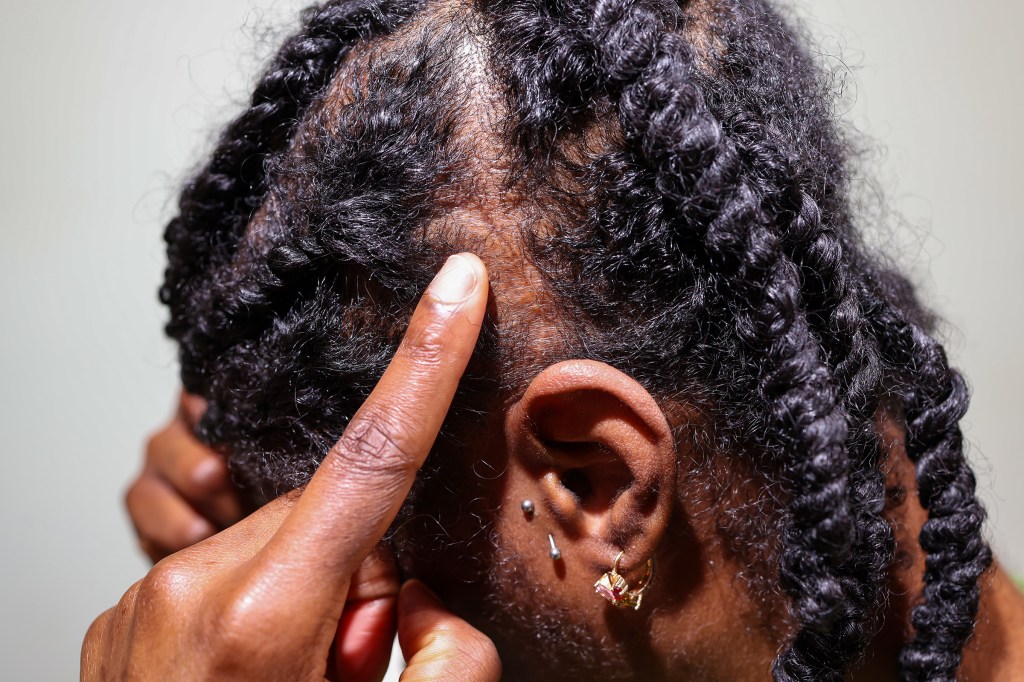
Elizabeth Fleurisma tears up as she runs her fingers over the scars that map her scalp.
The Long Island mom was stunned to discover at the age of 30 that she had a brain tumor the size of a lime.
She survived a 16-hour surgery and weeks of radiation — yet a piece of the tumor remains lodged in her skull, disrupting her daily life.
“When I came out of surgery, when I came home, it’s almost like I didn’t even know my environment,” Fleurisma, who turns 33 this week, told The Post.

“Sometimes when I’m trying to speak, I’ll forget a word,” she added. “It’s not easy healing from these things or getting back to where you left off.”
Fleurisma, who lives in Centereach, believes her meningioma came from the use of Depo-Provera birth control for eight years.
She’s one of 75 New Yorkers suing Pfizer, the manufacturer of Depo-Provera, for allegedly failing to adequately warn users of the increased risk of potentially devastating brain tumors.
“I’ve filed cases on behalf of about 150 women and have many other clients that we’re still evaluating, and Elizabeth’s tumor is the largest of all the ones I’ve seen,” Fleurisma’s attorney, Ellen Relkin, told The Post.
Over 1,700 lawsuits have been separately filed in federal court. Plaintiffs claim that Pfizer knew or should have known about the higher meningioma risk but intentionally concealed this information to protect profits.
Pfizer told The Post that it “believes these claims are without merit and will vigorously defend against these allegations.”
The statement continued: “The Company stands behind the safety and efficacy of Depo-Provera, which has been used by millions of women worldwide and remains an important treatment option for women seeking to manage their reproductive health.”
What is Depo-Provera?
Reproductive health was top of mind for Fleurisma after she gave birth to her son in 2011 at the age of 18.
She experimented with birth control pills, but found that she struggled to take them consistently.

Her gynecologist suggested Depo-Provera, a popular contraceptive that has been used at some point by nearly 25% of sexually active women.
The injection is given in the upper arm or buttock every three months.
It contains progestin, a synthetic hormone that prevents pregnancy by pausing ovulation, blocking sperm from reaching any eggs and making the uterine lining unsuitable for implantation.
Research suggests that prolonged use of certain progestins — including medroxyprogesterone acetate, like in Depo-Provera — significantly increases the risk of developing intracranial meningiomas.
“The relationship between sex hormones and meningioma tumors has been known since the 1920s, and the presence of progesterone receptors in meningioma tissue has been reported since the 1970s,” Fleurisma’s suit reads.
“Several scientific studies have established that progesterone, its synthetic analogue progestin, and Depo-Provera in particular, cause and/or substantially contribute to the development and growth of intracranial meningioma tumors.”

These slow-growing tumors arise from the meninges, the membranes that protect the brain and spinal cord. They are usually benign, meaning they don’t typically spread like cancer, but they can press on nearby brain tissue, nerves or vessels.
Fleurisma doesn’t recall her gynecologist talking with her about possible side effects of Depo-Provera, only that there was a very slim chance she could get pregnant.
Potential side effects listed on the label include bone mineral density loss, a slightly increased risk of breast cancer, blood clots, stroke, ectopic pregnancy, severe allergic reactions and loss of vision, among others. Meningiomas aren’t mentioned.
Pfizer claims it asked the US Food and Drug Administration to add a warning after reviewing new research in 2023 suggesting a link between Depo-Provera use and meningiomas, according to Reuters.
The FDA reportedly rejected the request, saying that “the findings of the available observational studies alone do not support the addition of a warning.” Pfizer resubmitted the FDA application in June 2025.
Inside Fleurisma’s emotional battle
Fleurisma said she started taking Depo-Provera in 2014 at the age of 21. She had no issue until early 2023.
“I was having severe headaches, fatigue,” Fleurisma recalled. “It was excruciating pain that I kept feeling, and I wasn’t able to bear it anymore.”

She rushed to the hospital one night after feeling her temperature rising. Doctors revealed the unthinkable — a brain tumor.
“It was very shocking news, because I’ve never been through a crisis like this before,” Fleurisma said.
The months that ensued are a blur. She had a craniotomy in July 2023 at Stony Brook University Hospital, but not all of the tumor could be removed.
That meant she had to undergo radiation five times a week for about a month, a total of 27 sessions, according to her lawsuit.
These appointments, each lasting less than two hours, had her wearing a radiation mask that looked like it came out of “Star Wars.”
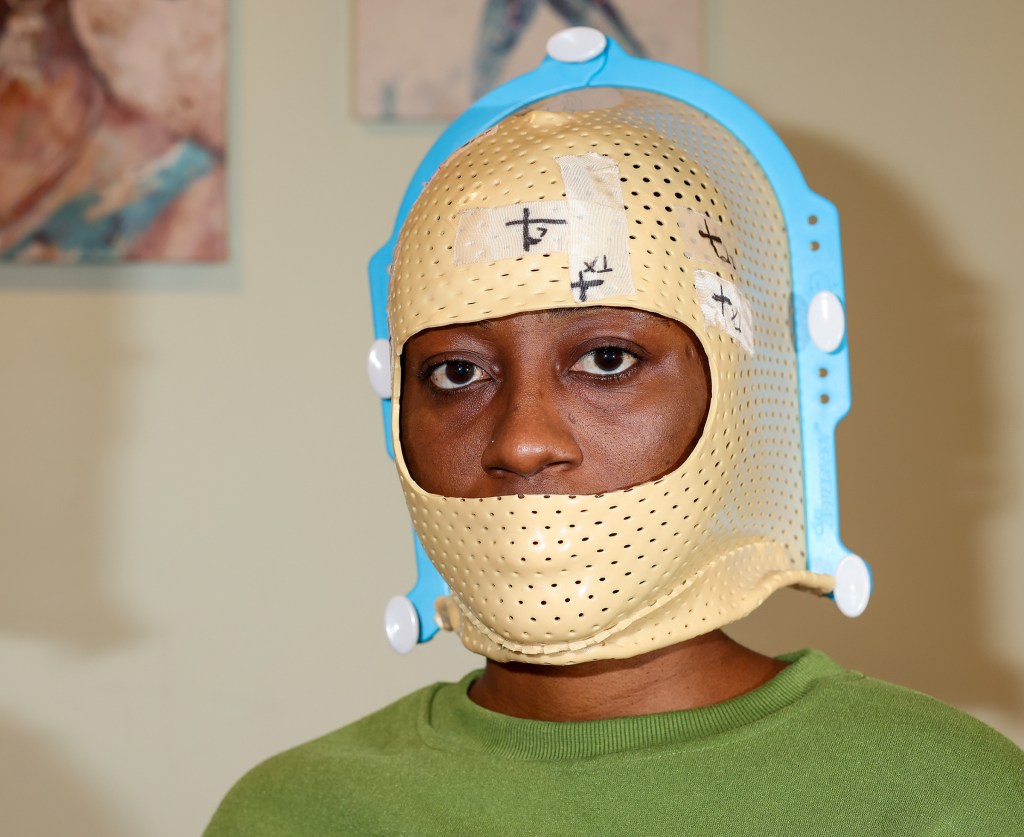
The mask held her head and neck in place, allowing for precise delivery of the radiation.
“You sort of just lay there,” Fleurisma said of the treatment.
“[The staff asked], ‘What would you like to listen to to help keep calm?’ ” she added. “And I’m just thinking of the next vacation I want to take, my favorite food, to keep your mind off of what is truly going on.”
On the road to recovery
Recovery has challenged Fleurisma at every turn, from the big hurdles to the tiny frustrations.
She sent her son, now 14, to temporarily live with his father because she could not care for him.
And she watched in horror as the scars took shape and her hair fell out.
The fight isn’t over. Fleurisma meets with her radiologist annually to make sure the remaining tumor piece hasn’t grown.
She said in her suit that she still experiences vision troubles, headaches, nausea and dizziness.
Before this ordeal, Fleurisma worked as a residential manager supporting adults with intellectual and developmental disabilities.
“As soon as I found out about the diagnosis, everything stopped from there because I couldn’t bear these headaches at work,” she said.
“I was in the process of recertifying [as a certified nursing assistant] and also becoming a mental health hygienist, so all of these things were put on hold. Two years later, now I’m back where I started, so it’s not easy.”
She’s now studying to become a medical assistant in the hopes of joining the pediatrics field.
Fleurisma stopped taking Depo-Provera in 2023 on the advice of her neurosurgeon.
She sued Pfizer in March 2025 to “let women know that they have a voice.”
“Some women … don’t ask questions, and that’s what I didn’t do,” she added. “You have a voice, you speak on your health, and you take care of your health.”
The post I developed a brain tumor the size of a lime at 30 — now I’m one of over 1,700 women suing my birth control company appeared first on New York Post.