If you had to sum up Frank Gehry’s career in a single word, the obvious choice would be Bilbao. The architect’s design for an outpost of the Guggenheim Museum in the northern Spanish city didn’t simply open in 1997—it detonated. Practically overnight, its billowing, titanium-sheathed forms helped transform a moribund industrial port into a global destination, and turned their rumpled Los Angeles architect into a household name. The project’s ebullience also gave the field of architecture, which had been busy rehashing postmodernism, a swift, deconstructivist kick in the rear—showcasing the swooping forms that were now feasible with ever more sophisticated design technologies. It sent writers reaching for their most sensational metaphors. In a legendarily overheated article, the New York Times architecture critic Herbert Muschamp likened the building to Marilyn Monroe: “voluptuous, emotional, intuitive and exhibitionist.”
Gehry, who died on Friday at his home in Santa Monica, California, at the age of 96, will forever be associated with high-profile projects such as Bilbao, as well as Walt Disney Concert Hall, which in 2003 brought elegant sparkle to a dour part of downtown Los Angeles. In the coming days, his legacy will be heavily scrutinized—praised for its breakthroughs but also criticized for forces it helped unleash. Bilbao sparked a starchitectural arms race, in which no city seemed to be complete without the eye-grabbing stamp of some jet-setting Pritzker Prize–winner (almost always a man). Gehry also cranked out his share of bombastic duds, such as the Experience Music Project, in Seattle, a jumble of jarringly colorful blobs, and the Grand L.A., a behemoth mixed-use development that has failed to draw much life to its neighborhood.
To look only at the overwrought megaprojects, however, is to miss one of Gehry’s crucial achievements: his ability to turn an existing building, no matter how ordinary, into something humane and delightful. It may seem absurd to hail Gehry, of all architects, for his adaptive reuse and remodeling jobs, but these projects, many of which are scattered around Los Angeles, reveal a thoughtful, even humble, approach to space. They also bear the imprint of an unmistakable SoCal informality. (Gehry was born in Toronto but moved to L.A. as a teenager and remained there for the rest of his life.) As he once told his biographer, Paul Goldberger, he found the rigid perfectionism of old guard modernists, such as Mies van der Rohe, suffocating: “I just couldn’t imagine living in it. It seemed almost militaristic that you couldn’t throw your clothes on a chair.”
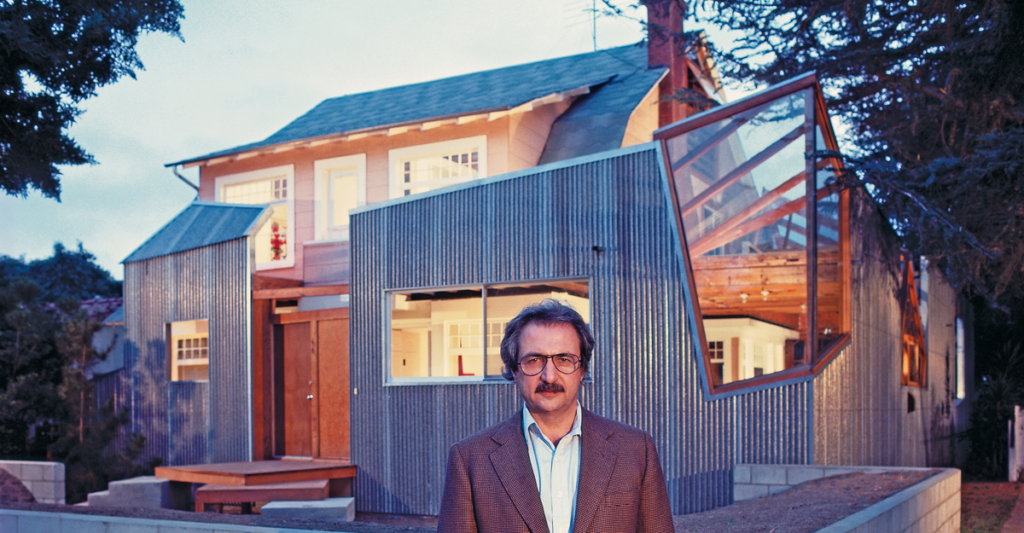
The most visible of his remodeling projects is the home he devised for himself and his wife, Berta Aguilera, in 1978—a gut remodel and expansion that reimagined a pink Dutch Colonial Revival bungalow as a wild experiment. He stripped the interior to expose wooden joists and studs. He extended the kitchen over the driveway, leaving the asphalt as flooring. (“Easy to mop,” he told the Los Angeles Times.) He wrapped the entire addition in a corrugated metal wall punctured by strategically placed windows and cutouts. Above the front door, a new deck was bounded by chain-link fencing. From all sides, the contours of the original house remained visible through the metal—the architectural equivalent of one of Vermeer’s milkmaids dressing up as a robot.
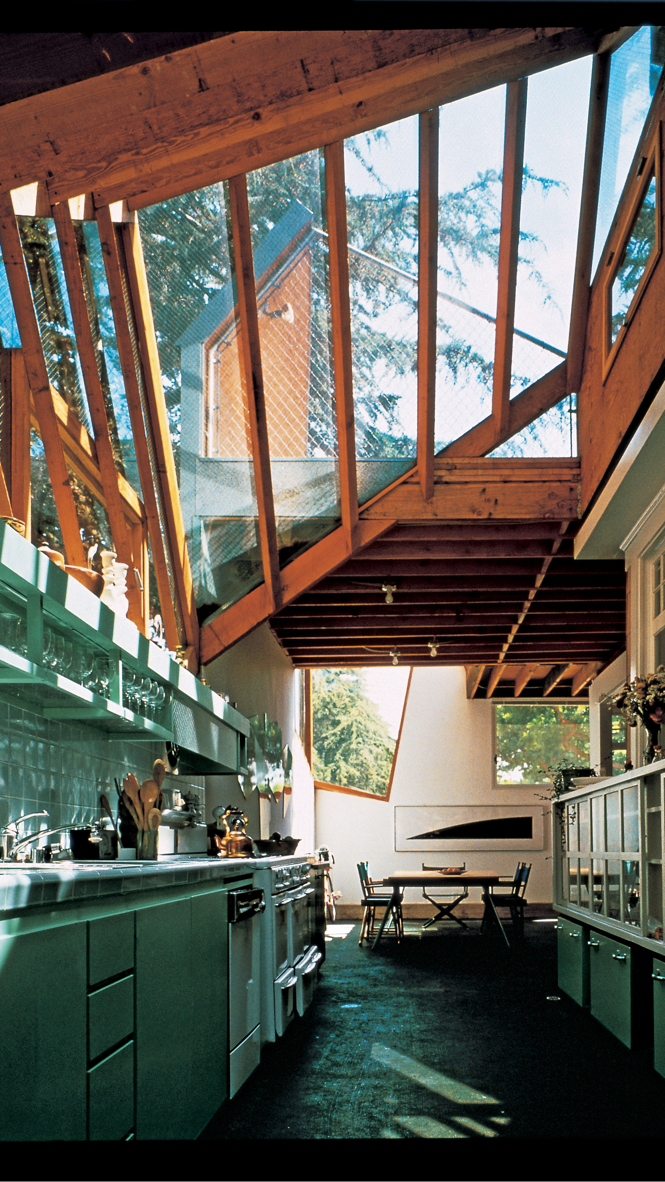
The architecture world adored it. (The house was cited by the committee that awarded Gehry a Pritzker in 1989.) His neighbors, not so much. One of them took legal action to halt construction; another regularly brought his dog to leave gifts out front. A man informed an architect in Gehry’s office that the building resembled “a Tijuana sausage factory.” But the fuss over its form overlooked the experience of residing within. In his redesign, Gehry made over a dim first floor into an open space saturated with daylight. The oddly angled windows framed views of mature trees that surrounded the property and, in combination with generous skylights, they offered a constant play of shadow and light. In a 2021 interview with the critic Mimi Zeiger, he described it as a “kinetic lightshow.”
This showy renovation, now quite beloved, functioned as an architectural calling card. But Gehry also knew how to intervene in subtler ways. Throughout his career, he helped reimagine a number of cultural hubs frequented by Angelenos. In the late 1970s, he expanded Gemini G.E.L., the legendary printmaking studio and exhibition space on Melrose Avenue that once nurtured artists including Ed Ruscha, Robert Rauschenberg, and Vija Celmins. These are simple rooms, largely devoted to the messy labor of art making, but they sneak in architectural flourishes such as a tilted skylight over a set of rough wooden stairs, which makes ascending to the second floor feel a little bit like entering a geometric abstraction.
Gehry kept an equally light touch in his renovation of an old warehouse and police garage in downtown L.A. that, in 1984, became the first home of the Museum of Contemporary Art, Los Angeles. He added a sequence of gallery walls, along with other necessary infrastructure, but for the most part, he left the industrial guts intact. The building, which still serves as a display space for MOCA in addition to a purpose-built location a mile away, is the opposite of Bilbao: rugged, unfussy, merged with its urban context. An early pioneer of the warehouse-as-museum, the Geffen Contemporary, as it’s now called, has proved to be the ideal container for exhibitions that would be difficult to stage anywhere else. These include the ongoing “Monuments,” which brings together decommissioned Confederate monuments and contemporary art in a devastating critique of white-supremacist aesthetics. Few U.S. museums could accommodate such a show (the monuments are massive). More significant, the industrial interiors avoid romanticization. MOCA, like many of Gehry’s early projects, is rough around the edges—what you see is what you get.
In 2021, the architect completed construction on the Beckmen YOLA Center, a permanent home for the Los Angeles Philharmonic’s youth orchestra. The center, which offers free music instruction to disadvantaged children, was carved out of a modernist bank building in downtown Inglewood that had been repurposed as a Burger King. It now features a flexible rehearsal and performance space with collapsible walls. Between practice rooms of different sizes are cozy nooks lined in plywood where guests can comfortably hang out. “It’s not a precious building,” Gehry told me upon its opening. “But it’s precious in what it does.”
In some ways, the Beckmen was a full-circle moment for the nonagenarian, a return to his roots as a designer who could find in the mundane an element of the extraordinary. It reflected none of the ego of a late-career starchitect. You won’t find the billowing forms that were the marker of the Gehry brand. What you’ll encounter is a welcoming hall filled with sunshine and the cacophony of young musicians. A building that had been deemed unfit for anything other than fast food was remade, with simple materials, into a space of art and collective transformation for Angelenos who may not know who Frank Gehry was. Great legacies have been built on less.
The post Frank Gehry’s Best Work Was Not His Flashiest appeared first on The Atlantic.