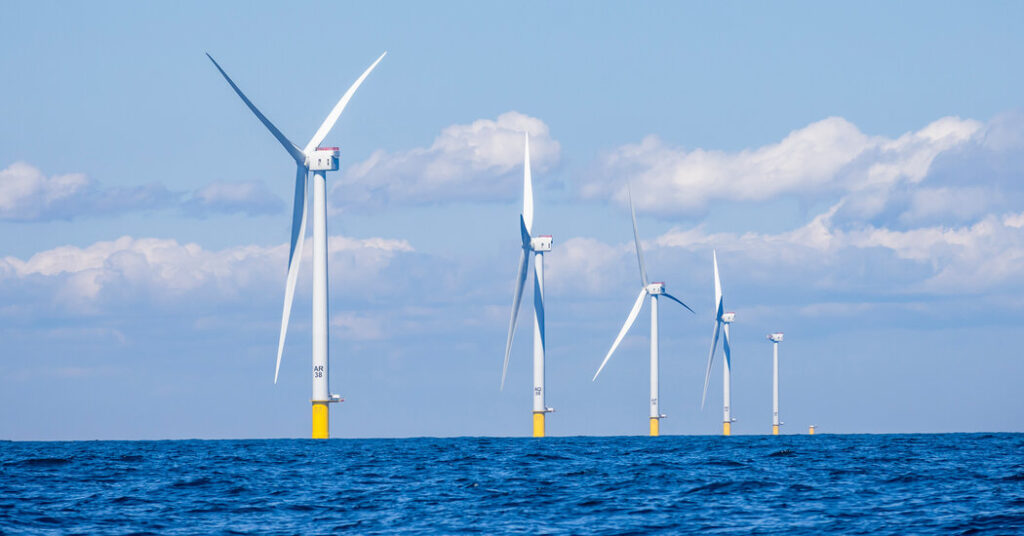
A federal judge on Monday struck down President Trump’s halt on approvals of all wind power projects in federal waters, dealing a significant legal setback to the administration’s campaign against offshore wind farms.
Judge Patti B. Saris of the U.S. District Court for the District of Massachusetts wrote that the president’s sweeping executive order, which halted all leasing of federal lands and waters for new wind farms, was “arbitrary and capricious,” violating federal law.
Judge Saris, an appointee of President Bill Clinton, said the Interior Department had not provided a “reasoned explanation” of its decision to stop approving offshore wind projects, as required by the Administrative Procedure Act. Instead, she said, the “agency defendants candidly concede that the sole factor they considered in deciding to stop issuing permits was the president’s direction to do so.”
Mr. Trump, a longtime critic of wind power, issued the executive order on his first day back in office in January. At the time, states like Maryland, Massachusetts, New Jersey and New York had been planning to build more than a dozen large wind farms in the Atlantic Ocean to meet their renewable energy goals.
The order effectively put a stop to many of those efforts. At the moment, one offshore wind farm has been completed and five more are under construction in U.S. coastal waters. But developers have been unable to receive permits for additional wind farms, and some planned projects have been canceled altogether.
Led by New York, a coalition of 17 states and the District of Columbia challenged the executive order in court in May. They were joined by the Alliance for Clean Energy New York, a nonprofit advocacy group based in Albany, N.Y.
“As we look to build the electric grid that will power America’s future, wind energy is a key component,” Marguerite Wells, the executive director of the Alliance for Clean Energy New York, said in a statement. “With this ruling behind us, projects can now be judged on their merits.”
Representatives for Gov. Kathy Hochul, Democrat of New York, did not immediately respond to a request for comment.
Asked about the ruling, Taylor Rogers, a White House spokeswoman, said in an email that the Biden administration had given offshore wind projects “unfair, preferential treatment while the rest of the energy industry was hindered by burdensome regulations.” She said that Mr. Trump’s executive order, had it remained in effect, would have spurred federal agencies to study whether offshore wind projects were raising energy costs for American families.
Yet the impact of the judge’s order could be limited, according to a research note by analysts at ClearView Energy Partners, a consulting firm. That’s because the courts typically cannot compel federal agencies to approve new projects. Many wind developers could also be reluctant to submit additional projects for federal permits under Mr. Trump, the analysts wrote.
In addition to the freeze on new permits for wind farms, the Trump administration has sought to revoke permits that were issued by the Biden administration for wind farms off Maryland and Massachusetts. It has also attempted to halt construction of two wind farms that were already partly built, including Empire Wind off Long Island and Revolution Wind off Rhode Island.
Those efforts have also faced pushback from the courts: In September, a federal judge issued a preliminary ruling that construction could restart at Revolution Wind, saying that the administration’s stop-work order threatened “irreparable harm” to its developer. (The Trump administration has also allowed work at Empire Wind to restart after negotiations with Ms. Hochul.)
Mr. Trump has disparaged wind power ever since he failed 14 years ago to stop an offshore wind farm visible from one of his golf courses in Scotland. He has called wind turbines ugly, expensive and inefficient. He railed against renewable energy during his presidential campaign last year, when he also promised oil and gas executives that he would make policy changes that would help their industry, such as rolling back environmental rules.
In September, the White House took the extraordinary step of instructing a half-dozen agencies to draft plans to thwart the country’s offshore wind industry as it intensified its attack on wind energy.
Karen Zraick contributed reporting.
Maxine Joselow covers climate change and the environment for The Times from Washington.
The post Federal Judge Finds Trump’s Halt on Offshore Wind Is Illegal appeared first on New York Times.