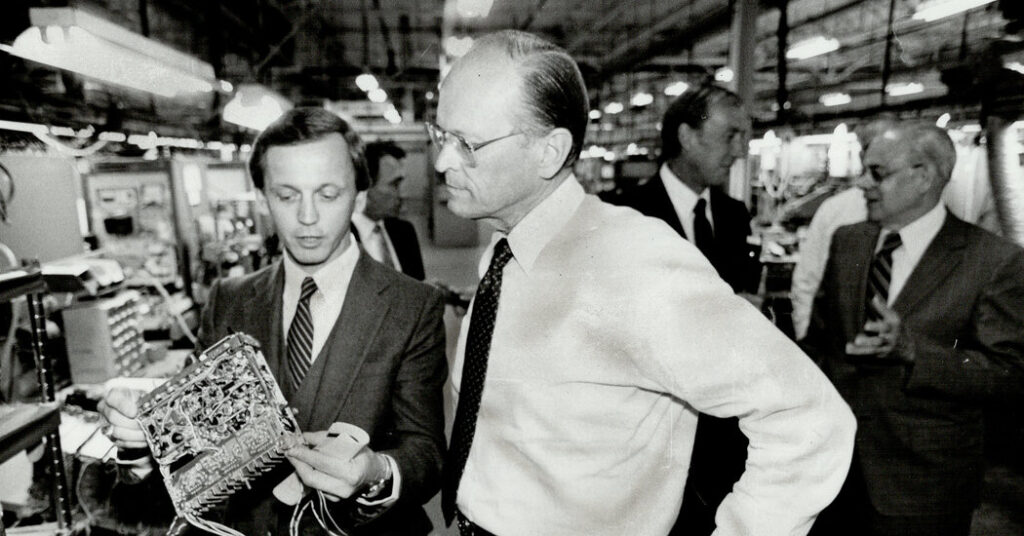
Donald E. Petersen, who became president of the Ford Motor Company as it teetered on the brink of bankruptcy in 1980 and, with budget mastery and aerodynamic new cars, turned a billion-dollar loser into the most profitable automaker in Detroit history, died on April 24, 2024, at his home in Bloomfield Hills, Mich. He was 97.
His death was announced at the time by a funeral home and reported by a handful of news outlets. It came to the attention of The New York Times only recently, in reviewing an obituary about Mr. Petersen that had been prepared in 2020.
In the competitive executive suites of the Big Three automakers, where infighting and power plays separated winners from losers, Mr. Petersen was a straight-talking former Marine with a mechanical engineering degree and, colleagues said, abiding commitments to high-quality cars and a nonpolitical management style.
Mr. Petersen began his 40-year Ford career in 1949 and worked his way up through the management ranks, largely in product-planning divisions. Those positions gave him broad experience in research and development, supplies and subsidiaries, international operations, and the designs of trucks and cars. He helped develop Ford’s Thunderbird, LTD, Mustang, Maverick and Continental Mark III cars.
By 1977, he was an executive vice president and a member of Ford’s board of directors.
When Mr. Petersen was named president of the company in March 1980, Ford, the nation’s No. 2 carmaker after General Mothers, was in deep trouble, hit hard by an energy crisis, a recession and soaring inflation. The company had lost $1.17 billion in 1979, the second straight annual loss and a 30 percent decline from its 1977 performance. Ford stock was selling for under a dollar. Bankruptcy rumors swirled on Wall Street.
Working with Ford’s chief executive, Philip Caldwell, Mr. Petersen began with belt-tightening, ordering plant closings and cost cuts. The work force was slashed by 100,000 through layoffs, attrition and automation, and by making cars less expensively in Mexico and South Korea. Like some industries in Japan, he gave assembly-line workers a say in operations. Union contracts reflected concessions on both sides.
Still, Ford’s losses were persistent: $1.54 billion in 1980, $1.06 billion in 1981 and $658 million in 1982. In spring 1983, they turned a corner with a $211 million quarterly profit. With costs down $4 billion a year, Ford began to buy back 30 million shares of its stock, 10 percent of the outstanding total. It raised dividends and shared profits with workers.
Behind the scenes since 1980, Mr. Petersen had also been developing new statistical-based controls for the design and manufacture of cars. He had abandoned the traditional top-down chain of command in favor of a “team” approach of shared responsibilities.
And in late 1985 (for the 1986 model year), Ford introduced its Taurus and a near-twin, the Mercury Sable, both mid- to full-sized cars with rounded aerodynamic lines, front-wheel drives and fuel efficiency that met stringent economy standards. These innovative cars, which had power windows and door locks and other electronic functions, had taken five years to develop at a cost of $3 billion.
Their arrival was a milestone for Ford and led to an American automobile design revolution as General Motors and Chrysler adopted many of the new cars’ features. Ford’s breakthrough was a process to design and manufacture cars using statistical control ideas developed by W. Edwards Deming, the efficiency expert hired to bring a “culture of quality” to Ford.
The Ford Taurus and Mercury Sable became huge success stories. They were named the nation’s best-designed cars in a survey of design professionals. Taurus won the 1986 Motor Trend Car of the Year Award and became America’s best-selling car. About 200,000 were sold in the 1986 model year and, by 1991, when production of the first-generation Taurus ended, some 2 million had been sold.
Profits exploded. In 1985, Ford made $2.52 billion, and Mr. Petersen was elevated to board chairman and chief executive, replacing a retiring Mr. Caldwell. The company became the most profitable automaker in history in 1986, taking in $3.29 billion. It raised that to $4.63 billion in 1987 and set an industry record of $5.3 billion in 1988.
For 1986 and ’87, Ford earnings exceeded those of its giant rival General Motors for the first time since 1924. Ford’s stock price soared, and Mr. Petersen was named “CEO of the Year” by Chief Executive magazine.
Addressing a stockholders meeting in 1988, Mr. Petersen said that Ford had more than $10 billion in cash reserves and that, stepping outside its core auto business, would diversify, investing more heavily in new products and technologies, buying financial services companies and developing a third business sector in electronics. He also said that over the next five years Ford would invest “substantially more” in cars than the $16.6 billion it had spent in the previous five years.
“After losing $3 billion in the early 1980s, Ford has become the comeback story of the decade, the world’s most profitable car company and more,” Fortune magazine reported. “It provides a model for how to transform a struggling also-ran into a worldbeater. In its home market, Ford is humiliating its biggest rival.”
There was only one blemish on the Petersen horizon. His relationship with some members of the Ford family became strained when, after the death of the patriarch and former chairman, Henry Ford II, in 1987, he opposed the successful candidacies of Edsel B. Ford II and William Clay Ford Jr., great-grandsons of the founder Henry Ford, to the board’s executive and finance committees.
At the pinnacle of his success in November 1989, Mr. Petersen, at 63, announced his early retirement and in March 1990 stepped down 18 months before he had planned to do so. He had previously said that he would not stay beyond his normal retirement date, in 1991, because of concerns about his health. He said he hoped “to do something else with my life,” and wanted to give Harold A. Poling, Ford’s 65-year-old chief operating officer, a chance to serve as chief executive.
The explanation struck many in business as disingenuous. While company leaders stuck by the story, several senior Ford officials said privately that Mr. Petersen had been insensitive to the Ford family, which controlled 40 percent of the shareholder votes, and that his early retirement had been part of a leadership change planned by the board to keep Mr. Poling and Ford’s other most experienced executives in place during what they foresaw as hard times approaching.
Donald Eugene Petersen was born on a farm in Pipestone, Minn., on Sept. 4, 1926, the youngest of three sons of William and Mae (Peterson) Petersen. The father, a Danish immigrant wheat farmer, had asthma and moved his family to the West Coast for the drier climate. During the Depression, he was a service station attendant, garage mechanic and shipyard hand.
In Portland, Ore., Donald attended Washington High School and played on varsity football and basketball teams before graduating in 1943.
At the University of Washington, he joined a Navy Reserve program that helped pay his college expenses. He completed his college course work in three years and graduated in 1946 with a bachelor’s degree in mechanical engineering. Following 10 months of active duty with the Marines, he enrolled in the Graduate School of Business at Stanford University in 1947 and finished his degree two years later.
In 1948, Mr. Petersen married Jo Anne Leonard, known as Jody. They had two children, Leslie Carolyn and Donald Leonard. His wife died in May 2024. In addition to his children, he is survived by one granddaughter and two great-granddaughters.
After retiring, Mr. Petersen served on corporate boards, including those of Hewlett-Packard, Boeing and Dow Jones, and wrote a book, “A Better Idea: Redefining the Way Americans Work” (1991, with John Hillkirk). In 1992, he was inducted into the Automotive Hall of Fame.
“Ford’s achievement under Petersen is indisputable,” Fortune reported in 1991. “His ideas on participative management, teamwork and the importance of quality to the customer were in perfect tune with the best business thinking of the 1980s.”
Robert D. McFadden was a Times reporter for 63 years. In the last decade before his retirement in 2024 he wrote advance obituaries, which are prepared for notable people so they can be published quickly upon their deaths.
The post Donald E. Petersen, Who Rescued Ford Motor Co., Dies at 97 appeared first on New York Times.