When President Donald Trump imposed a travel ban from several Muslim-majority countries in 2017, Democratic advocates and lawmakers raced to airports across the country to protest. They held news conferences and visited detention centers the following year when Trump began separating migrant children from their parents.
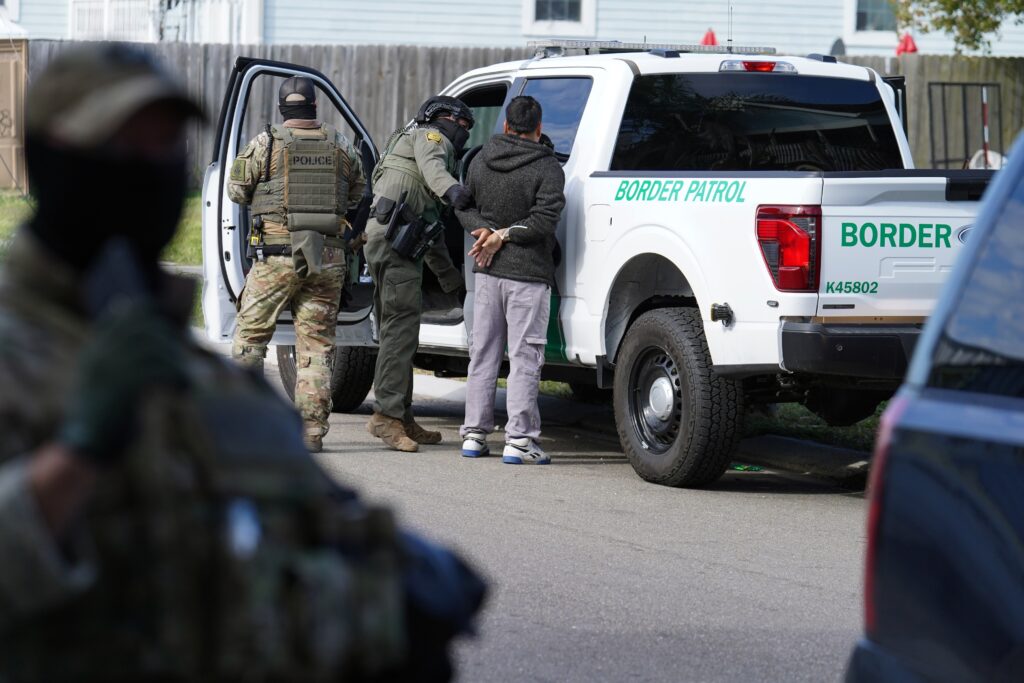
Trump has unleashed even more draconian immigration policies in his second term that have amounted to the harshest crackdown on immigrants since World War II. But Democrats have not mounted the same unified and visible pushback, even as Trump has halted immigration applications from 19 countries, deployed federal agents into minority communities and called Somali immigrants “garbage.”
“The targeting of immigrants, the targeting of Muslim communities — we’ve seen this rhetoric climb over the past several months and I anticipate it getting worse,” said Abdullah Hammoud, the Democratic mayor of Dearborn, Michigan, an Arab-majority city where Trump has deployed federal agents in recent weeks.
“The fact that we do not have a strong counterresponse from [Democratic] elected officials at all levels of government is the most frightening, especially when the vitriol is coming from the highest office in the world,” Hammoud said. “Communities are looking for people with courage, people with a backbone, who are willing to stand up.”
The hesitation among many leading Democrats to forcefully challenge Trump reflects a rapid shift in the politics of immigration since Joe Biden won the presidency in 2020. At the time, leading Democrats advocated for more compassionate and lenient immigration and border policies in response to Trump’s crackdown in his first term, with many supporting plans to decriminalize illegal crossings.
But Biden’s failure to stem a surge of migrants at the U.S.-Mexico border until his final months in office helped propel Trump’s 2024 victory and Republican control of Congress. Democrats have since struggled to coalesce around an alternate immigration plan, making it more difficult for them to criticize Trump’s approach. And in recent weeks, a series of off-year and special elections focused on affordability have helped Democrats perform above expectations, prompting party leaders to encourage a relentless focus on the cost of living and health care.
Instead of staging a unified response on immigration, Democratic leaders have largely relied on a small cadre of lawmakers to express the party’s objections to Trump’s immigration policies. Over the past two weeks, Sen. Mark Kelly (D-Arizona), Sen. Tina Smith (D-Minnesota), Rep. Ilhan Omar (D-Minnesota) and Sen. Jeanne Shaheen (D-New Hampshire) are among those who have condemned Trump’s policies and rhetoric.
“Going after a large group of people, most of which I think are just trying to live their lives, raise their families, go to work every day, the U.S. government harassing them years later does not make a lot of sense to me,” Kelly said on CNN last week, days after Trump indefinitely halted immigration from Afghanistan after an Afghan national shot two National Guard members in Washington.
The Trump administration is sending a “message that they don’t want Brown people coming to the United States” by halting immigration applications from what it called developing nations, Kelly said in an interview on NBC.
Beyond such comments, immigration advocates and local Democrats say the louder, party-wide backlash they expected hasn’t materialized.
Andrea Flores, a former immigration adviser for Presidents Barack Obama and Biden, said Democrats perceived the 2024 election results as a failure on immigration. But Flores argued that much of the voter backlash was to Biden’s governing failures on immigration rather than to specific Democratic policies.
Since then, many Democrats have sought to prove they are tough on immigration and serious about border security by voting for Republican-led measures. And it has caused many Democrats to remain relatively silent even as Trump ignores court orders and imposes an immigration crackdown far more severe than his first term.
Democrats “cannot agree on how they want to approach this issue post-election and things are getting worse and more extreme,” Flores said. “It’s devastating for the people being impacted because I talk to people on the ground all the time who say it feels like there’s no political party fighting for them. There’s one targeting them — not one fighting for them.”
Beyond the handful of outspoken congressional lawmakers, Democratic governors and local lawmakers have said in public and in private that they have been surprised and disappointed by the lack of a unified response from party leaders as their states and cities have dealt with ICE raids, deployment of National Guard troops to quell protests, and the apparent lack of due process for their residents — legal and illegal — who have been whisked off the streets and detained.
Whit Ayres, a GOP pollster, said Trump’s vow to deport undocumented immigrants accused of committing crimes has widespread support. But other elements of Trump’s agenda face overwhelming opposition, Ayres said, including deporting those who have no criminal record, those who have lived in the U.S. for more than 10 years and those who arrived in the country as children.
“Some people have obviously talked about it but it’s hardly been at the top of the agenda for Democrats,” Ayres said. “They felt burned by the Biden failures to control immigration and I think that’s what’s causing their reticence.”
Neera Tanden, who led the White House Domestic Policy Council under Biden, said voters do not trust Democrats on immigration, making it more difficult for lawmakers to push back.
“To criticize Trump’s policies in a persuasive way, you have to have policies that actually secure the border and create order at the border,” said Tanden, now the president and CEO of the Center for American Progress, a Democratic think tank that has put forward an immigration plan.
Some Democrats, including Sen. Ruben Gallego (D-Arizona) and the congressional Hispanic Caucus, have put forward immigration plans. But party leaders have not embraced those proposals, instead arguing that any immigration change must be bipartisan, even as Republicans have shown no willingness to negotiate. Last year, Republicans abandoned a bipartisan plan they helped draft, after pressure from Trump to avoid giving Biden a win during the presidential campaign.
Despite the political challenges, several Democrats this year have visited detention centers or confronted Trump officials directly about their policies.
In June, Sen. Alex Padilla (D-California) attended a press briefing held by Homeland Security Secretary Kristi L. Noem in his native Los Angeles. At the time, the city was engulfed in protests after federal agents arrived to target undocumented immigrants. In response to the unrest, Trump ordered thousands of military personnel deployed to the city.
Padilla asked Noem in the middle of her remarks why she was using a small number of immigrants who committed crimes targeted for deportation to justify what he viewed as an outsize federal response. Federal agents forced Padilla to the ground and handcuffed him as they forcibly removed him from the news conference.
Sens. Dick Durbin (D-Illinois) and Tammy Duckworth (D-Illinois) tried multiple times to visit Illinois’ Broadview ICE Processing Center after reports of inhumane conditions and mistreatment of detainees. Several others visited facilities in their states or conducted oversight of detention centers.
And Sen. Chris Van Hollen (D-Maryland) flew to El Salvador in April to meet with Kilmar Abrego García, a Maryland man who Trump officials admitted was mistakenly deported.
In an interview, Van Hollen said the reaction to his trip showed him that many Americans were “horrified at the way that Trump has been grabbing people off the streets without due process and locking them up and detaining them.” He added that Trump’s second term has been a challenge for Democrats because, compared to his first term, “there’s lawbreaking going on everywhere.”
“I would like to see a broader response,” Van Hollen said. “We can walk and chew gum at the same time. Trump’s poisonous comments in the last week have really put immigrants and other communities in danger.”
Immigration continues to be one of Trump’s strongest political assets. Polls show several of his hard-line policies have gained support since his first term, and voters express significantly greater confidence in his handling of the issue than Democrats’.
But Trump’s approval ratings — and voter attitudes toward immigration — shifted significantly in his first months in office. A July Gallup poll found that 35 percent of Americans approved of Trump’s handling of immigration, down from 46 percent in February, while 62 percent disapproved. The same poll found that 79 percent of American adults think immigration is good for the country, while the number who want immigration reduced dropped from 55 percent a year earlier to 30 percent in the July poll.
Nadia Mohamed, the Somali American mayor of St. Louis Park, a suburb of Minneapolis where Trump has targeted immigrant communities in recent weeks, said Democrats representing Minnesota have been vocal in defending Somalis against Trump’s attacks. She has been encouraged to see more Democrats condemning Trump’s remarks but would like to see the party as a whole be more outspoken.
“They need to be more vocal in the uptake of Islamophobia and xenophobia and discriminatory practices toward our most vulnerable communities,” Mohamed said. “Especially when it’s those communities that turn out in numbers for Democrats.”
Caroline O’Donovan contributed to this report.
The post Democrats, who bludgeoned Trump on immigration in term 1, have grown quiet appeared first on Washington Post.