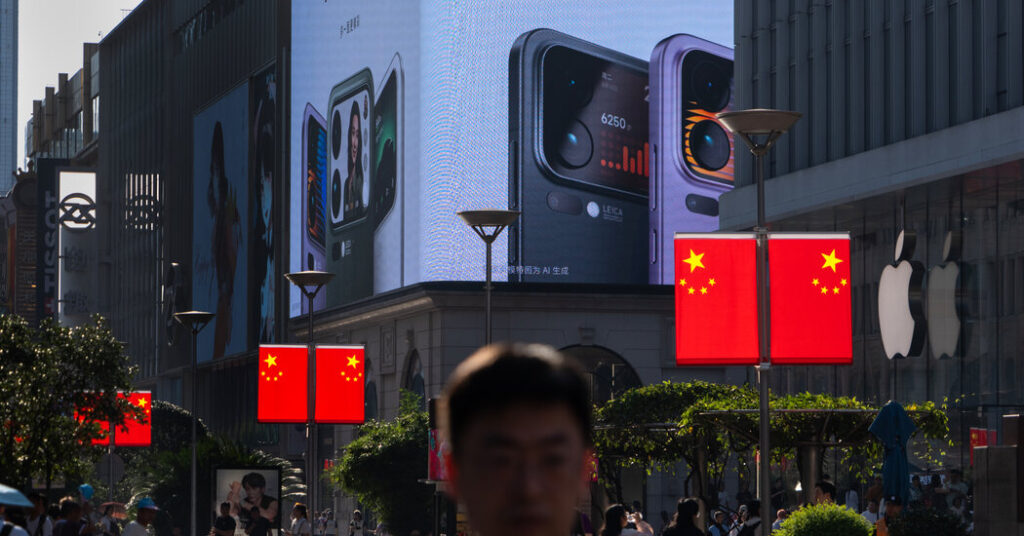
A night at the Waldorf Astoria hotel in the heart of Manhattan starts at about $2,000. A night at the Waldorf Astoria in the heart of Beijing costs about $340.
Hotel rooms are not all that is cheap right now in China. A Big Mac from McDonald’s costs half as much in China as it does in the United States. Made-in-China goods are cheaper, too: A OnePlus 15 smartphone is $999 in the United States and $692 in China. A BYD Seal plug-in hybrid car sells for $15,500 inside China, including computer-assisted driving, and about $50,000 elsewhere, without assisted driving.
Large discrepancies between prices inside and outside China point to the biggest distortion in the global economy today: the low value of China’s currency. A combination of low interest rates, slowing economic growth and government policies have kept the country’s currency so weak — undervalued by as much as a third, even some Chinese economists estimate — that prices in China look cheap by international standards.
The weakness of China’s currency, the renminbi or yuan, is not the only reason prices are low in China. A persistent and steep decline in housing has erased much of the savings of Chinese households, leaving them reluctant to spend. Chronic overcapacity at Chinese factories after years of debt-fueled investment has left companies frantically cutting prices for the fewer customers they have left inside the country.
The currency remains one of the biggest — and most sensitive — issues in China’s economy. It takes about 7.1 renminbi to buy a single dollar these days. That weakness has powered China’s exports to remarkable heights. Official data released on Monday showed that China’s world surplus in exports over imports this year has already exceeded $1 trillion.
Chinese officials scrupulously avoid discussing the low value of the currency, which has helped create millions of jobs at Chinese export factories. But some well-connected Chinese economists are starting to say that the weakness of the renminbi is way out of line with economic fundamentals.
Before his recent retirement from China’s central bank, Sheng Songcheng was the director general of its financial surveys and statistics department. He was one of the few officials with almost unlimited access to economic data in a country that releases fairly little to the outside world.
Now teaching at the China Europe International Business School in Shanghai, Mr. Sheng gave a little-noticed talk in late November about purchasing power parity. That is the economics concept of what currency exchange rates would need to be for similar goods and services to cost the same in different countries.
“From the perspective of purchasing power parity, the exchange rate wouldn’t be 1 to 7, it might be 1 to 5 or even 1 to 4,” Mr. Sheng said at a finance conference, according to a video recording of the event. “Some have calculated that if the exchange rate truly reflected purchasing power parity, one dollar would exchange for only about 3.5 yuan.”
If the renminbi were to strengthen significantly past 5 to the dollar, China would pass the United States as having the world’s largest economy when measured in dollars.
China’s currency is so weak that the number of Chinese tourists flocking to Europe has halved since 2019 as they choose far less expensive trips at home instead. The average traveler spent just $125 for a trip during the country’s weeklong national holiday at the start of October, according to government data.
The currency’s recent weakness began with the two-month Covid-19 lockdown in Shanghai in the spring of 2022. The lockdown caused a precipitous, nationwide plunge in consumer confidence, which has never recovered. Many Chinese households and companies have responded by selling their renminbi to buy dollars and other foreign assets, from houses to mines and companies. The investment exodus from the renminbi has also contributed to soaring prices for gold.
China’s central bank responded by allowing the country’s currency to fall steeply from the first days of the lockdown through the end of 2022. It has then kept the currency at roughly the same level for the past three years.
The renminbi had begun to recover slightly in the last several weeks. But the central bank stepped in Thursday to slow the gains, acting to prevent speculators from putting bets on a big appreciation of the renminbi.
Changes in price levels inside and outside China have accentuated the effect from China’s weak currency. While prices in China have been flat or falling for the past several years, prices have been rising elsewhere. Producer prices charged by factories and other businesses climbed 35 percent in Europe in the past five years and 26 percent in the United States.
With China’s currency not strengthening to offset these changes in prices, it has become even more appealing for companies to move production to China.
The weakness of the renminbi has helped fuel a 16-fold increase in Chinese car exports to the European Union over the past five years.
Another former Chinese central banker, Miao Yanliang, told Bloomberg last week that, “The present moment may indeed be a window of opportunity to allow for yuan appreciation.”
Ruoxin Zhang contributed research.
Keith Bradsher is the Beijing bureau chief for The Times. He previously served as bureau chief in Shanghai, Hong Kong and Detroit and as a Washington correspondent. He lived and reported in mainland China through the pandemic.
The post China’s Weak Currency Is Powering Its Exports, Drawing Criticism appeared first on New York Times.