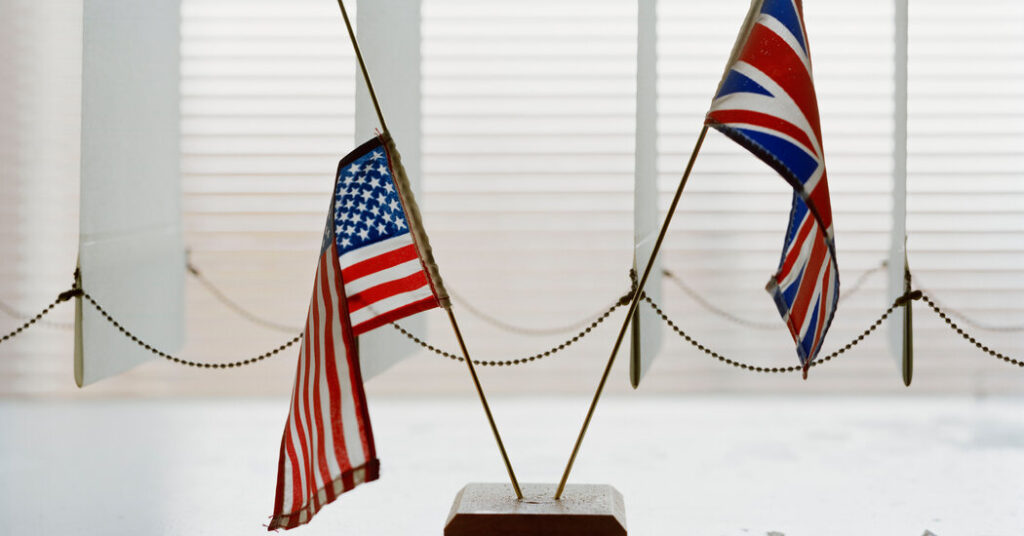
Ask Americans to close their eyes and imagine the future, and they probably won’t picture Britain. That’s the land of yesterday: castles, warm beer, an actual king. But a new paper argues that events on the other side of the Atlantic Ocean — specifically Britain’s post-Brexit struggles — offer a preview of what tomorrow may hold for the United States.
The 2016 decision to exit the European Union has been nothing short of an economic disaster. The paper, published last month by the National Bureau of Economic Research, estimates that Britain’s annual economic output is about 6 to 8 percent smaller than it would be if British voters had chosen to remain in the European Union. That’s a bigger loss of output than Britain experienced at the nadir of the recession that followed the 2008 financial crisis. It’s a bigger hit than if every bank, brokerage and hedge fund in London were suddenly to disappear.
The authors, a group of five American and European economists, describe their findings as a warning to the United States. There aren’t a lot of examples of developed nations pulling back from global markets. The British experience thus offers one of the few points of comparison for President Trump’s restrictionist trade policies. “In the case of Brexit,” the paper dryly concludes, “there was a substantial economic impact on the United Kingdom.”
The back story is by now familiar. During the second half of the 20th century, the United States led a global effort to reduce barriers to trade. By any reasonable reckoning, the benefits outweighed the costs. But political elites made little effort to minimize those costs, and we are living through the backlash.
The paper describes Britain’s departure from the European Union as an instance of “‘reverse’ trade reform.” Mr. Trump, during his first presidential campaign, called it a preview. In August 2016, two months after Britain’s surprise vote to leave the European Union, Mr. Trump posted on Twitter, “They will soon be calling me MR. BREXIT!”
The president and the Brexiteers shared a fear of strangers. Mr. Trump has built his political career on the argument that the rest of the world is taking advantage of the United States. Trade, in his view, is other countries draining our wallets. Immigration is other people stealing our jobs. International treaties are handcuffs limiting America’s sovereignty.
Even now, as the downsides of Brexit have become impossible to ignore, Mr. Trump has remained a fan. Asked this summer whether Britain had made the most of its departure from the European Union, Mr. Trump said the execution had been “on the sloppy side, but I think it’s getting straightened out.”
To assess the consequences of Brexit, the new study draws on a regular survey of businesses, including thousands of firms that employ about 10 percent of private sector British workers.
The most interesting finding — and the most significant for the United States — is that uncertainty caused more damage than changes in the rules of trade. Businesses can adjust to a new set of barriers; what has really bedeviled companies in the decade since Brexit is confusion about what they are supposed to be adjusting to.
Mr. Trump’s erratic trade policy has sown confusion, too. By one measure, the first big round of tariff announcements in April sent uncertainty about economic policy in the United States to the highest monthly average in at least four decades, exceeding even the peak reached during the Covid-19 pandemic. Eight months later, that index of economic uncertainty remains at a higher level than at any time between 1986 and 2019 — a period that includes the dot-com crash, the aftermath of 9/11 and the global financial crisis.
Smaller businesses have been hit hardest. They find it more difficult to adjust. They lack the political power to secure special exemptions. Even the paperwork of new rules weighs more heavily. Shannon Bryant, the president of Trade-IQ, a Wisconsin firm that helps companies navigate trade rules, recently told The Los Angeles Times that small firms were facing “death by a thousand paper cuts.” One example: A new requirement that importers document the origins of metal content in their products.
A second takeaway from the Brexit paper is that damage accumulates gradually. Predictions that Mr. Trump’s tariffs would strike the American economy like a hurricane have not come to pass, but that was never the danger. Brexit has caused damage slowly and quietly, as companies have invested a little less, hired a little less, innovated a little less. It’s the cumulative effects that have been profound.
There are differences between the economic situation of Britain in 2016 and the United States today. Britain’s economy was sagging even before Brexit; the American economy is riding an A.I. boom. The British economy is also more than twice as dependent on trade as the American economy, and thus more vulnerable.
And there is one more difference, which could yet be the most important.
Brexit was a one-way street. Britain can’t simply vote to rejoin the European Union; a campaign to assert British sovereignty has ironically left the nation even more dependent on the good will of its European neighbors. By contrast, American voters retain the power to check Mr. Trump’s political project by installing a Democratic congressional majority next year, and to reverse it by electing a different president in 2028.
The Times is committed to publishing a diversity of letters to the editor. We’d like to hear what you think about this or any of our articles. Here are some tips. And here’s our email: [email protected].
Follow the New York Times Opinion section on Facebook, Instagram, TikTok, Bluesky, WhatsApp and Threads.
The post Brexit Was Britain Slapping Itself. Why Is America Doing the Same? appeared first on New York Times.