GIA KOURLAS
Traces of Emotion Found in Movement’s Wake
Dance is a physical act but what it leaves behind is emotion — energy in motion. Emotion was often the bedrock of the dances and dance artists who rose to the top this year. There was the meteoric rise of the choreographer Robbie Blue, whose “Better in Denim” commercial for the Gap and choreography for Doechii sparked a new kind of dance fever. And on the basketball court of the New York Liberty, the Timeless Torches, a team of dancers all 40 and older, celebrated their 20th anniversary, continuing the troupe’s mission while pointing out a universal truth: On or off the stage, embracing movement is the foundation for a full life.
Here is my favorite from the year, and nine more in no particular order:
Twyla Tharp at New York City Center and American Ballet Theater
Tharp commemorated her 60th year choreographing dances with two stellar programs. The first, at City Center, presented her exceptional group of dancers in “Diabelli,” a little-seen classic from 1998, and the new “Slacktide,” to Philip Glass. At Ballet Theater, her dances were celebrated on a program that included two masterpieces: “Bach Partita” (1983) and “Push Comes to Shove” (1976). Her dances are crystalline works of American classicism and, choreographically, no one else comes close. (Read our feature about Ballet Theater’s all-Tharp program.)
Rennie Harris Puremovement, ‘American Street Dance Theater’
Harris is not just a choreographer but an educator, a word that can seem dry. Harris, though, is enthralling, whether making dances or imparting wisdom about their origins. In this full-length work, performed at the Joyce Theater, he pointed a lens on Chicago footwork, Detroit Jit and Philly GQ, with local dancers doing the honors; Ayodele Casel, in a tap solo, was astonishing, too. From start to finish, the show was a testament to the generous breadth of Harris’s artistry. (Read our review of “American Street Dancer.”)
‘Times Four/David Gordon: 1975/2025’
Before David Gordon’s death, in 2022, he spoke to his son-in-law, the choreographer Wally Cardona, about bringing back “Times Four.” The project fell through, but Cardona couldn’t stop thinking about that 1970s duet, which Gordon had made for himself and his wife, the dancer Valda Setterfield. This fall, Cardona staged a new version, which he danced with Molly Lieber in the very SoHo loft in which it was made. It was a ravishing experiment, merging the past with the present as their bodies spoke a language of repetition, rigor and unsettling depth. (Read our feature about “Times Four.”)
Monica Bill Barnes & Company: ‘Many Happy Returns’ and ‘Lunch Dances’
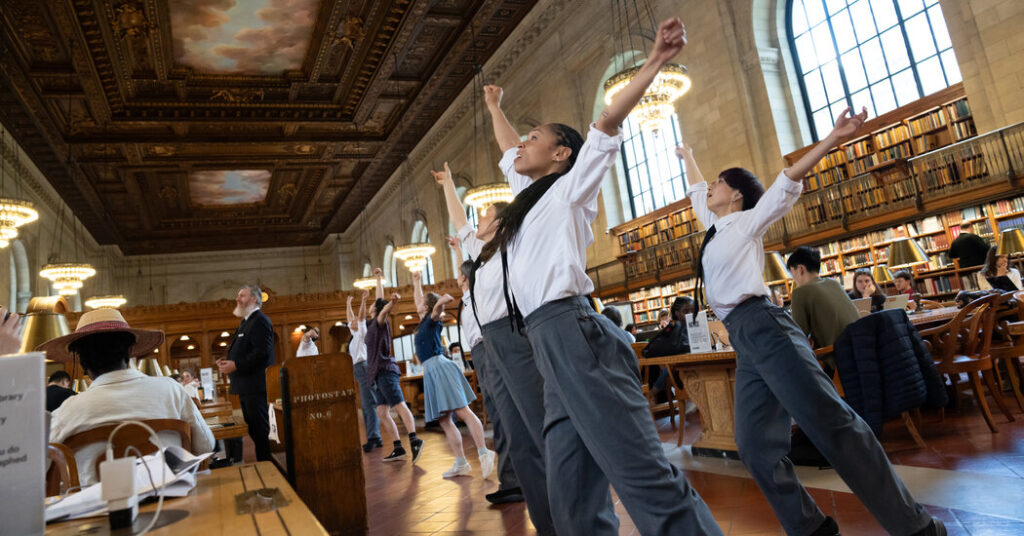
Monica Bill Barnes & Company is a two-person venture led by Barnes and Robbie Saenz de Viteri, whose aim is to bring dance to places it doesn’t usually go. Along with the witty “Many Happy Returns” at Playwrights Horizons, the duo unveiled “Lunch Dances” at the New York Public Library, which involved traveling throughout the space, as fictional characters engaged in research projects came to life — dancing out their inner worlds. It will be back in 2026, with dates to be announced early next year. (Read our review of “Many Happy Returns” and our Critic’s Notebook on “Lunch Dances.”)
Lexee Smith
Smith is a free spirit whose work straddles commercial and experimental forms in unexpected ways. As a creative partner of the singer and dancer Addison Rae, she has elevated Rae’s style and approach, but Smith’s own dance videos are where her voice truly comes alive. Enigmatic, sly, sexy but forthright, her movement investigations and still lifes, like one of her dirty Agent Provocateur heels and her even dirtier feet, merge dance and fashion in piercing ways. She’s funny, she’s introspective, she’s our very own Isadora Duncan. (Read our Critic’s Spotlight about Lexee Smith.)
Tiler Peck, ‘A Suite of Dances’
This year in a festival of works by Jerome Robbins, Tiler Peck made her debut in “A Suite of Dances,” a solo created for Mikhail Baryshnikov. Peck — who also curated the festival — was the first woman to dance the role, and she was a marvel of timing and nuance, slipping and splintering through the solo’s tricky changes of direction with a light touch that recalled a common Robbins instruction: “Easy baby.” (Read our interview with Tiler Peck.)
Alexa West, ‘Jawbreaker Part 1 Part 2’ at 99 Canal
For this tense two-part work, which opened at Pageant in Brooklyn in September and was reimagined for 99 Canal in Manhattan in November, West covered both spaces in mint-green plastic. Like some sort of haunted underwater dream, five dancers hopped on one foot, wound an arm furiously or hovered in a plank before collapsing onto the gleaming, sticky floor. In Part 2, they traded jeans and tops for white-blouse leotards and took turns dancing on or around a beam — a medley of gymnastics and ballet — separated by a lamppost. They moved with flinty fortitude, never giving up but with the frightening sense that time was, and is, running out. (Read our feature about Pageant.)
Kim Brandt, Beach Sessions
In August, Kim Brandt, a dance artist with venerable site-specific chops and a master’s degree in sculpture, presented “Wayward,” a work that stretched across the sand horizontally for Beach Sessions. At Rockaway Beach, Brandt’s approach of dancers moving with a hive mind and her perspective — to have the audience facing the dunes and the Queens neighborhood — was striking and a testament to the collective power of dancing, and living, side by side. (Read our feature about Kim Brandt at Beach Sessions.)
Leslie Cuyjet at the Center for Performance Research
The start of the year brought the searing and inventive “For All Your Life” by the choreographer and dancer Leslie Cuyjet. In a tour de force performance — the clarity of her spoken text matched the force of her sharply etched movement — she explored Black life and death. Inspired by her great-grandfather, the president of a Black-owned life insurance company, Cuyjet questioned the value system of art and life in blistering ways. (Read our Critic’s Notebook featuring “For All Your Life.”)
Trajal Harrell
In “Monkey Off My Back or The Cat’s Meow” the choreographer made a dance worthy of the Park Avenue Armory’s enormous drill hall. The spectacle was entrancing: 17 dancers and actors lived out their runway dreams on a Mondrian-inspired floor. But the best part was the pursuit of intimacy in a fractured world. All the while, Harrell was magnetic, moving as if he were being guided by a spirit inside of him racing to get out. (Read our feature about Trajal Harrell.)
Honorable mentions: Ralph Lemon and Darrell Jones’s “Low”; Moriah Evans’s “Harboring” at the Snug Harbor Dance Festival; Florentina Holzinger’s “Tanz” (R.I.P. to the great Beatrice Cordua); Ayodele Casel’s “The Remix”; Jack Ferver’s “My Town”; Alexei Ratmansky for “Paquita”; Kyle Abraham for “When We Fell”; Jamar Roberts for “Foreseeable Future”; and the debuts of Mira Nadon in “Swan Lake”; Indiana Woodward in “Theme and Variations,” Dominika Afanasenkov in “Errante”; Jake Roxander in “Push Comes to Shove” and Zimmi Coker in “Rodeo.”
BRIAN SEIBERT
New Festivals, Veteran Dance Makers
This year, the notably new arrived in the form of festivals, which mainly imported excitement from abroad. (92NY’s Uptown Rhythm Festival was a notable exception, a welcome showcase of American talent and traditions.) The strongest work came from old hands, who presented both revivals and fresh efforts. Here, in chronological order, are my top five choices.
Twyla Tharp
In her 60th year of making dances, Tharp managed to stand out twice. In March, an anniversary program at City Center offered “Slacktide,” one of her best new works in years, alongside the New York premiere of “Diabelli,” a little-seen masterpiece from 1998, set to Beethoven’s monumental “Diabelli Variations.” Then, in October, an all-Tharp program at American Ballet Theater brought back “Push Comes to Shove” (1976), her character-defining star vehicle for Mikhail Baryshnikov, and “Bach Partita” (1983). The new casts of “Push” struggled to recapture the work’s spirit, but “Partita” proved once again a brilliance approaching the level of Bach, Beethoven or Balanchine. (Read our reviews here and here.)
Batsheva Dance Company
This March, with the war in Gaza raging, a visit by the most prominent dance company in Israel was unavoidably colored by politics and the shadow of death. Ohad Naharin’s “Momo,” his best work in years, managed to reflect the context and still preserve the ambiguity of art. Two dances performed at once, with its cast divided into separate tribes, “Momo” disturbingly exposed what we recognize and what we ignore, painfully expressing both the impossibility of coexistence and the inevitability. (Read our review of “Momo” here.)
Pam Tanowitz
For years now, a Pam Tanowitz premiere at Bard SummerScape has pretty much guaranteed aesthetic pleasure. “Pastoral,” her latest, did not disappoint. The score, by Caroline Shaw, playfully sampled and screwed with Beethoven’s “Pastoral” symphony, while the décor (by Sarah Crowner), lighting and costumes created a continuously changing environment of painterly grace. Tanowitz’s witty, complex choreography suggested not the storm and stress of nature, but nature contemplated in the tranquillity of art. (Read our review of “Pastoral” here.)
Compagnie Basinga
Down to Earth, a new festival of free multidisciplinary performance in public spaces, brought work to New York from parts of the world where public-space art is better supported. Best of all was the French high-wire troupe Compagnie Basinga. Its show at South Street Seaport was charmingly low-key, roping in the audience to help assemble the rigging. But the marvel was the chief walker, Tatiana-Mosio Bongonga. Doing headstands and splits on the wire, she danced up there with such smiling equipoise that a viewer’s anxiety about potential falls was transformed into pure joy. (Read our story about the Down to Earth festival here.)
William Kentridge
The most ambitious new festival was Powerhouse: International, which imported works into a renovated Brooklyn power plant with exposed brick and preserved graffiti. There was approachable skateboarding on ramps and rails and what felt like an EDM club under an ice shelf, but the best use of dance came in what was called an opera: “Sibyl,” by the artist William Kentridge. In concert with South African vocal harmonies and Kentridge’s animated ink drawings, the spinning and churning motion of the performers deepened the terrible beauty of messages scattered by the wind. (Read our story about Powerhouse: International here.)
Roslyn Sulcas
My Heart Belonged to Ballet
I always hope to find riveting new dance voices, but my most transcendent experiences this year were from two established ballet choreographers, and from repertory staples, given new life and verve through inventive reimagining and glorious interpretations.
I saw noteworthy contemporary work this year, including Akram Khan’s “Thikra”; Crystal Pite and Simon McBurney’s “Figures in Extinction” for Nederlands Dans Theater; and Marina Abramovic’s “Balkan Erotic Epic,” which — while not exactly a dance — made adroit, ingenious use of movement.
But my heart belonged to ballet. Here, in mostly chronological order, are my Top 5.
William Forsythe
In May, the Dresden Frankfurt Dance Company performed a mesmerizing new William Forsythe work, “Undertainment,” in Dresden. Sixteen intensely alert dancers create a soundscape — gasping, vocalizing, finger-clicking, whistling — all the while moving with rigorous precision through fluid, unpredictable formations, rarely touching but occasionally mysteriously aligned.
A month earlier, English National Ballet offered three Forsythe pieces: the witty “Herman Schmerman” quintet (1992); the irresistibly bouncy “Playlist (EP)” (2022); and the austerely elegant “Rearray (London Edition 2025)” — all invigorating reminders of the way Forsythe has extended ballet’s technique and its possibilities.
‘Sylvia’ (Paris Opera Ballet)
The ballet “Sylvia,” first performed at the Paris Opera in 1876, has an enchanting score by Delibes and a strong-willed heroine who — for once! — doesn’t die or need a kiss from a prince. Manuel Legris makes the most of its great dance roles in his 2018 version, which the Paris Opera Ballet acquired this year, really leaning into the detailed footwork, the swift changes of direction and the detailed épaulement (the angled coordination between hips, shoulders and head) that characterize French training. The effect is totally charming. (Read our feature about “Sylvia.”)
‘A Midsummer Night’s Dream’ (Staatsballett Berlin)
The Romanian choreographer Edward Clug created an utterly magical, contemporary “Midsummer Night’s Dream” for the Staatsballett Berlin. Set to a richly atmospheric score by Milko Lazar, the ballet has a minimal set that deploys a large rock, projections of greenery and glimpses of forest. All is suggestion: a fairy corps de ballet, with fabric-covered faces and leaf hands; Tatiana’s fantastically clad attendants; grotesque insect figures and a few props. Clug tells the story with skill, verve and humor, creating vivid personalities and consistently inventive choreography, especially for Puck, an androgynous, quicksilver spirit who is the focal point of the ballet.
‘Giselle’ (National Ballet of Japan)
The stakes were high for Miyako Yoshida, the director of the National Ballet of Japan and a former Royal Ballet principal, who brought her production of “Giselle” on tour to the Royal Opera House this summer. The company has rarely toured internationally, and “Giselle” is familiar to London audiences. But it couldn’t have been more of a triumph for the Japanese troupe. The dancing and acting were consistently superb. The Wilis’ near-uncanny uniformity of line and floating lightness evoked an eeriness (even scariness) that made you better understand the Romantic fascination with the supernatural at the time of the ballet’s creation in 1841. (Read our notebook about “Giselle.”)
Alexei Ratmansky (Royal Danish Ballet)
Alexei Ratmansky began creating “The Art of the Fugue” at the Bolshoi Ballet in Russia, but left Moscow before finishing it, when Russia invaded Ukraine. Now he has completed it for the Royal Danish Ballet, and despite this painful context for Ratmansky, the new work, set to Bach’s magisterial composition, is as abstract and unsentimental as it is theatrical and moving. Divided into five sections, each with a different mood and tone, the ballet offers itself as a corollary to Bach’s universe of mathematical order and beauty. Here is geometry and poetry fused, a bulwark against the human follies of war and dissent. (Read our review of “The Art of the Fugue.”)
Gia Kourlas is the dance critic for The Times. She writes reviews, essays and feature articles and works on a range of stories.
The post Best Dance Performances of 2025 appeared first on New York Times.