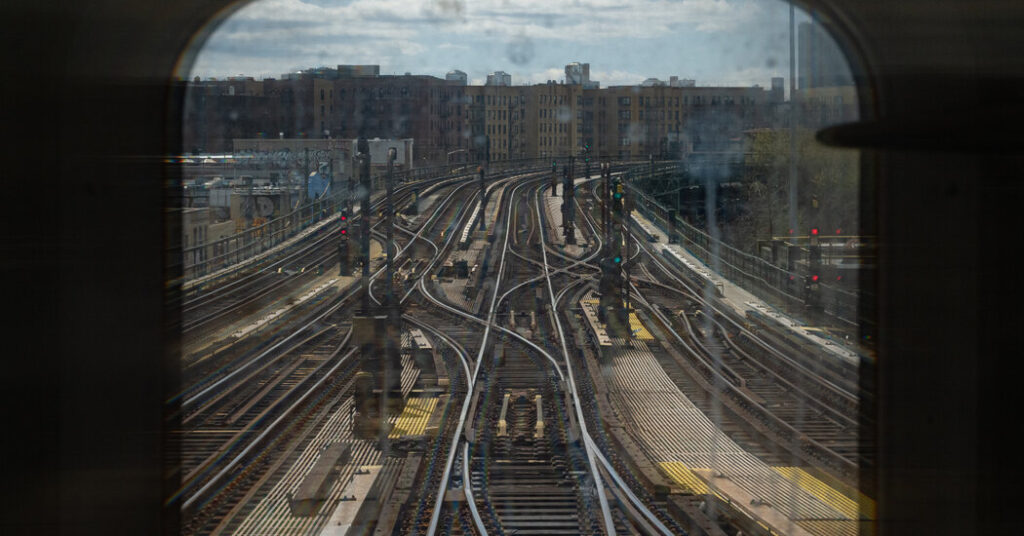
Subway operators in New York City who witness people being struck on the tracks often struggle to get the support they need.
The agency that oversees the subway, the Metropolitan Transportation Authority, says it has a range of resources in place to help affected operators cope with the aftermath of driving a train that strikes someone.
But records and interviews suggest that the M.T.A. has lagged behind other American transit agencies in making sure its employees take advantage of those services.
To compare the experiences of operators involved in train strikes in New York with those of drivers in other cities, The New York Times analyzed local and national transportation data and conducted dozens of interviews with subway operators, mental health experts and transit officials across the United States.
Here’s what the examination found:
Train strikes are common in New York — and on the rise.
More people per year are struck by trains in New York than in all other American transit systems combined. The M.T.A. has reported more than 250 train strikes in each of the past two years, the highest level in at least a decade. The number has risen even as similar incidents across other American transit systems have fallen, but the reasons for the increase are not clear.
Demetrius Crichlow, the president of the M.T.A. division that runs the subway, said the uptick was linked at least in part to a long-simmering mental health crisis.
But federal transportation records show that less than a quarter of train strikes last year stemmed from people deliberately jumping onto the tracks. The remaining incidents were attributed to accidents and other causes, including people who were trying to retrieve their belongings; passengers who fainted; people who were fighting and fell; and people who were attempting to cross the tracks.
Train operators often return to work soon after an incident.
Some train drivers have felt pressure to return to duty before they were ready because they could not afford to miss pay.
That was the case with Nioka Baptiste. She had been on the job for about six months when she experienced her first train strike. She took time off, but was still completing her probationary period and would have been ineligible for full benefits and pay until that period had ended, so she went back to work.
About five months later, she was involved in another strike. Ever since, Ms. Baptiste, 46, has carried a feeling of dread when she is at the controls. Sometimes, she imagines seeing people in the tunnels who aren’t there.
Train drivers said they were not aware of the resources available to them.
Experts say the best way to head off post-traumatic stress disorder is by beginning treatment within 24 hours of a train strike, but most of the more than two dozen train drivers The Times surveyed said they were not aware of their options.
Most said they were never contacted by a clinician after an incident, even though such outreach is required by protocol.
Some declined assistance because they were worried about being perceived as weak. Others said they were only able to get help by chance, because they happened to know someone who had been through therapy before them.
Mr. Crichlow said that train operators are all made aware of the resources available to them during their job orientation.
“I really have faith in our process,” he said.
Other transit systems appear to do a better job at making sure workers get help.
While the M.T.A. is much larger than all other American transit systems, it appears to do less than others to ensure that operators involved in strikes get the support they need.
San Francisco’s system, which employs a fraction of the number of operators New York does, provides 24-hour access to licensed therapists through a third-party provider. Los Angeles does as well, and it proactively reaches out to operators to remind them of workers’ compensation options and other resources. The Massachusetts Bay Transportation Authority has made it a goal to increase operators’ engagement with the employee assistance program.
The M.T.A. says it offers some version of most of these services. But state records suggest most operators involved in train strikes in New York City are not taking full advantage of them.
The M.T.A. said that only 21 New York City subway train operators contacted its employee assistance program in 2024, a year when the system employed more than 3,600 drivers and recorded at least 254 people hit by trains.
Bianca Pallaro is a Times reporter who combines traditional reporting with data analysis skills to investigate wrongdoing and explain complex issues by turning numbers into insightful information.
The post 4 Takeaways From The Times’s Examination of N.Y.C. Subway Collisions appeared first on New York Times.