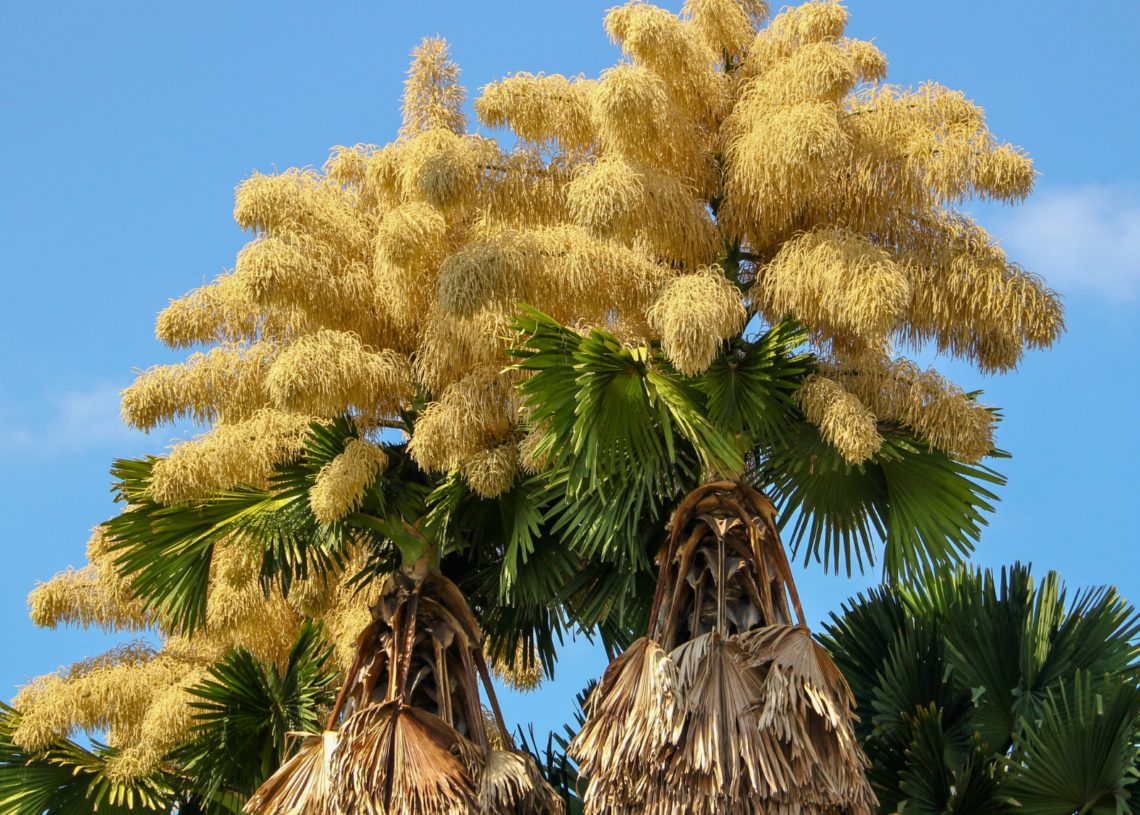
There’s something oddly comforting about a plant that spends half a century minding its business, then surprises everyone with one final spectacle before bowing out. Rio de Janeiro is getting that moment right now.
Decades-old talipot palms, planted in the 1960s by landscape legend Roberto Burle Marx, are flowering for the first and only time. People strolling through Flamengo Park are stopping mid-walk, tilting their heads back, and realizing they’re watching a once-in-a-lifetime event.
The talipot palm isn’t shy about any of this. As it nears the end of its 40- to 80-year life, it sends up a massive central plume filled with millions of creamy-white flowers. Reuters reported that it can produce up to 25 million blossoms in a single bloom. The plume shoots above the palm’s wide fan leaves like a final announcement after decades of storing energy for this one moment.
Locals are treating the trees like limited-edition art. A civil engineer named Vinicius Vanni told the Associated Press he was hoping to gather seedlings to plant for future generations. “I probably won’t see them flower,” he said, “but they’ll be there for future generations.” That might be the closest thing to optimism any of us get this week.
These palms originally came from southern India and Sri Lanka. Burle Marx brought them to Brazil while designing Aterro do Flamengo, and a matching batch was planted at Rio’s Botanical Garden. Their synchronized bloom isn’t magic. Biologist Aline Saavedra explained that they share the same origin, metabolism, and exposure to Brazilian daylight cycles, so they matured at nearly identical rates.
Saavedra said the event holds an environmental message. The trees may be enormous, but they’re gentle guests. They grow slowly, they’re not invasive, and strict environmental laws regulate the movement of foreign species anyway. What interests her is the way people respond when they see something rare that took decades to transpire.
“This palm species gives us a reflection on temporality, because it has roughly the same lifespan as a human being,” she said. She added that Burle Marx hoped these trees would invite a more poetic view of the landscape.
Once the flowers dwindle, the palms will naturally die. Their leaves will dry, their trunks will lose strength, and the cycle will end. But at the Botanical Garden, the process doesn’t stop there. Staff collect the fruits and grow new seedlings.
The bloom won’t last long, and the palms won’t either, but their seedlings will. For a species that takes half a lifetime to make a single gesture, that continuity is enough.
The post The Stunning First and Final Bloom of Rio de Janeiro’s Talipot Palm Trees appeared first on VICE.