For decades, West Point cadets have been assigned to read Michael Walzer’s book “Just and Unjust Wars” as a primer on what the military academy describes as “the ethical and moral dimensions of warfare.”
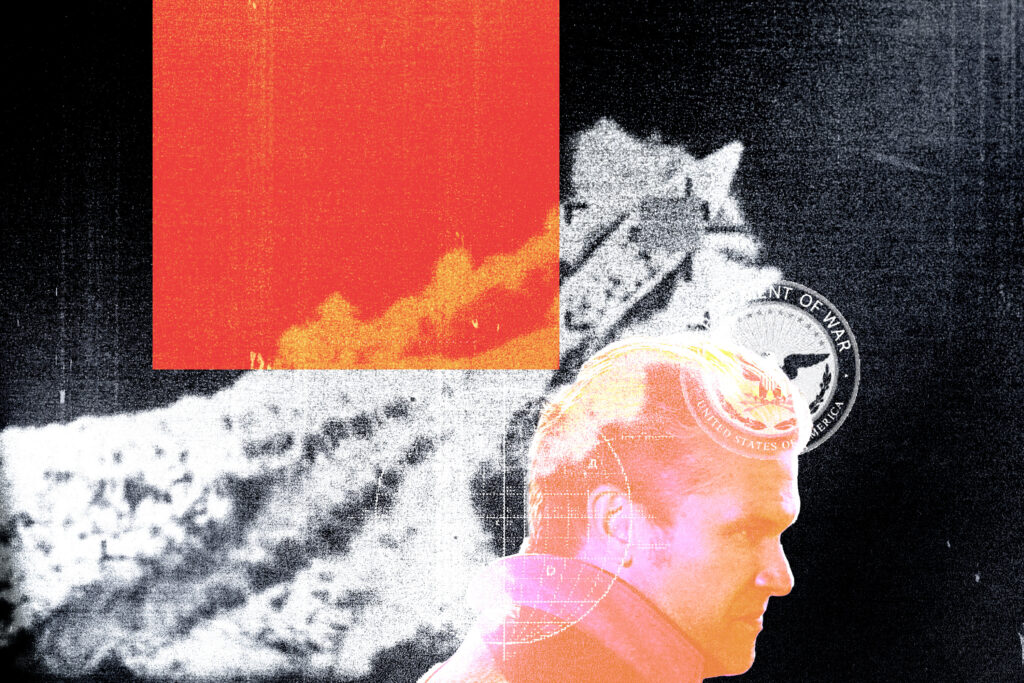
Defense Secretary Pete Hegseth didn’t attend West Point. He’s a Princeton grad who joined the National Guard and fought in Iraq and Afghanistan. But he wrote extensively about the rules of war before becoming secretary of defense — and his view was essentially the opposite of philosophers like Walzer. Instead of counseling careful norms of behavior, Hegseth railed at “the folly of international law, and the crazy maze of rules of engagement.”
Hegseth launched a frontal attack on the laws of war in his 2024 book, “The War on Warriors.” He wrote: “If our warriors are forced to follow rules arbitrarily and asked to sacrifice more lives so that international tribunals feel better about themselves, aren’t we just better off winning our wars according to our own rules?! Who cares what other countries think.”
Hegseth’s “who cares?” doctrine is now being tested in a congressional review of what happened on Sept. 2, when Adm. Frank M. Bradley ordered a second strike on an alleged Venezuelan drug-smuggling boat that killed two survivors of a first attack. Was Bradley simply following Hegseth’s prior order to destroy the vessel? And if so, was that order legal and appropriate?
There are more questions: Were the two survivors helpless and out of combat, perhaps making Hegseth’s or Bradley’s actions a war crime? Or were the haggard survivors still a threat because they might somehow get help and return to Venezuela and the drug trade? Is the administration legally right in claiming that the strike was justified by an “armed conflict” against “terrorist” drug traffickers and, if so, do the laws of war apply? If this isn’t a war, do the strikes amount to murder?
We don’t have answers to these questions after Bradley’s closed-door testimony Thursday. But the bipartisan congressional investigation is a heathy sign of accountability for Hegseth’s Pentagon. After 11 months when the rubric seemed to be “anything goes,” civilians and military must now think more carefully about what constitutes a “legal order” — and whether they could face serious consequences if they act without proper authority.
Hegseth built his career, in part, on challenging the laws of war. As a Fox News commentator, he crusaded for Navy SEAL Eddie Gallagher, who was found guilty of posing with an enemy corpse in Iraq — a war crime. Hegseth helped persuade President Donald Trump to exonerate Gallagher.Hegseth’s commentary similarly helped to secure to the pardons of two Army officers charged with war crimes in Afghanistan.
Hegseth traces his antipathy to military lawyers to an experience in 2005 in Iraq. A representative of the Judge Advocate General Corps (a “jagoff,” in Hegseth’s word) briefed Hegseth’s platoon on rules for shooting Iraqis carrying rocket-propelled grenades. Hegseth writes that he countermanded the advice: “I will not allow that nonsense to filter into your brains. Men, if you see an enemy who you believe is a threat, you engage and destroy the threat.”
As defense secretary, Hegseth has continued to resist accountability for alleged war crimes. In October, for example, he ordered that 20 Medals of Honor be preserved for soldiers who had fought in the 1890 Wounded Knee massacre that killed as many as 300 Lakota Sioux Indians, including many women and children. In a video, Hegseth lauded the soldiers who conducted this assault: “We salute their memory, we honor their service, and we will never forget what they did.”
I wish that Hegseth’s disdain for the laws of war was unique. But while the vast majority of U.S. military personnel have behaved honorably, there have been appalling exceptions in conflicts recent and long ago.
Recall the Abu Ghraib photos and videos that showed American guards sexually humiliating and abusing Iraqi prisoners in 2003. They appeared to shock consciences around the world. U.S. military courts convicted 11 low-ranking soldiers. But senior officers who had overseen the detention facility, including the overall U.S. commander in Iraq, Lt. Gen. Ricardo Sanchez, were cleared or never charged.
The My Lai massacre in Vietnam in 1968 left similar indelible memories. According to a U.S. Army estimate, American soldiers killed 347 unarmed civilians, mostly women and children. Witnesses testified that the company commander, Capt. Ernest Medina, told his troops to take no prisoners: “They’re all VC [Viet Cong], now go and get them.” He was acquitted of involuntary manslaughter. Lt. William Calley, who led the force into the village, was convicted of murder but paroled after three years of house arrest.
Sometimes in America it’s the accusers who face the harshest penalties. Three of the SEALs who testified against Gallagher were shunned and soon left the Navy. The message, Gallagher told Hegseth in his first public interview after Trump restored his rank, was: “You are part of a brotherhood. You are there to watch your brother’s back, he’s there to watch your back. You just stay loyal.”
A tragic example of reprisal against a whistleblower was the Sand Creek massacre in 1864 in Colorado that killed approximately 230 Cheyenne and Arapaho people, mostly women, children and the elderly, according to a history compiled by the National Park Service. The leader of the American force, Col. John Chivington, was never charged. Capt. Silas Soule, who prevented his soldiers from participating, protested the massacre to his superiors. He was assassinated the next year in Denver.
The history of warfare is, in part, about the barbarity of killing and attempts to restrain it. Walzer explains that English knights refused to kill their prisoners at the Battle of Agincourt in 1415 partly because of “the dishonor that the horrible executions would reflect on themselves.” Gen. Erwin Rommel, a German general in World War II, disobeyed an order by Adolf Hitler, his commander in chief, to shoot enemy prisoners. A German soldier who refused to shoot prisoners was charged with treason and executed, Walzer notes.
West Point students study Walzer because America has a tradition of valuing honor and lawful conduct in battle. But the Trump administration’s strange, undeclared war against Venezuelan drug smugglers reminds us that rules for armed conflict can become fuzzy — and how easy it is to make excuses for questionable actions. “In moral life, ignorance isn’t all that common; dishonesty is far more so,” Walzer writes.
The Venezuela campaign has now killed 87 people and sunk 23 boats. A perverse benefit of this devastation is that it has brought a day of reckoning for Pete Hegseth’s Pentagon — and a reminder of why warriors need rules.
The post The dangers of Pete Hegseth’s ‘who cares?’ doctrine appeared first on Washington Post.