The last time President Trump issued a national security strategy, eight years ago, it heralded a return to superpower competition, describing China and Russia as “revisionist” powers seeking to upend American dominance around the world.
“China and Russia challenge American power, influence and interests, attempting to erode American security and prosperity,” he wrote in a document that reflected the influence of his advisers in his first term. “They are determined to make economies less free and less fair, to grow their militaries, and to control information and data to repress their societies and expand their influence.”
Eight years later, that diagnosis seems truer than ever. The two U.S. rivals have deepened, and occasionally exaggerated, their “partnership without limits.” China’s nuclear force has more than doubled since the 2017 strategy was published; its military runs exercises encircling Taiwan; and its cyber attackers have drilled into American telecommunications, corporate and government infrastructure.
Russia has engaged in a nearly four-year-long war in Ukraine and a shadow war against U.S. allies across Europe.
Yet a reader of Mr. Trump’s 2025 strategy would barely know any of that. While the headlines have focused on how European allies must end mass migration and elect “patriotic” parties or face “civilizational erasure,” what is most striking about the 33-page document is what it ignores.
Russia is mentioned in only four paragraphs, and never in tones of condemnation for its invasion of a neighboring state, leading to a war that has produced more than 1.5 million casualties. Instead, it portrays the United States as something of a neutral negotiator that can diminish tensions between Russia and Europe and “reestablish strategic stability” with Moscow.
And there is virtually no discussion of the daily battle in cyberspace against China’s state-sponsored hackers, after the administration warned last week of another deep penetration of American corporate and government computer networks.
But those are hardly the only direct threats to the United States that seem odd by their omission.
In 2017, Mr. Trump was threatening “fire and fury” against North Korea, which at the time had one to two dozen nuclear weapons. The 2017 strategy notes that the country “seeks the capability to kill millions of Americans with nuclear weapons,” and delves into its chemical, biological and cyber capability. Today, after years of failed diplomacy, North Korea has 60 or more nuclear weapons.
Yet the country is never mentioned in the new strategy. Iran is barely mentioned, and then in contradictory terms. Mr. Trump’s introduction boasts that in June, “we obliterated Iran’s nuclear enrichment capacity.” Then, on the report’s penultimate page, a more careful assessment says that the United States “significantly degraded Iran’s nuclear program.”
“The document is silent on how the administration is going to prevent Iran from reconstituting its degraded program,” Scott D. Sagan, a Stanford University professor who writes extensively on nuclear strategy, noted on Saturday.
No strategy can deal with every threat posed to the United States, of course, and those that try to often read more like a laundry list of challenges. The new report says in its opening paragraphs that it is focused on just a few major national security threats, and that the goal is “to ensure that America remains the world’s strongest, richest, most powerful and most successful country for decades to come.”
“Not every country, region, issue or cause — however worthy — can be the focus of American strategy,” the document says. It then goes on to put the first priority on the Western Hemisphere. Most of that involves updating the Monroe Doctrine — which declared the Americas and their surrounding waters as Washington’s sphere of dominance — with a “Trump corollary.” Not surprisingly, it focuses on limiting migration and drugs.
Still, the move away from discussion of the immediate and long-lasting competition among the world’s two largest economies and three largest nuclear powers is jarring.
There is no discussion of superpower struggle or strategies of containment. The document argues for a quick end to the Ukraine war, on terms that would preserve a Ukrainian state, as a way of achieving that ill-defined “strategic stability” with the United States. And even though more pages of the document are focused on China than on any other nation, it dwells far more on the commercial relations than the strategic competition.
China’s nuclear expansion, which has fixated the Pentagon and strategic planners for years, gets only glancing mention, and there is barely a mention of the remarkably sophisticated, extensive cyber attacks that have burrowed deeply into American telecommunications and utility systems and stayed there, despite years of efforts to oust them.
“The section on Asia is striking,” said Peter D. Feaver, a professor at Duke University who runs its American Grand Strategy program. “When discussing economic competition, China is mentioned explicitly and in granular detail. But when discussing military threats in the Indo-Pacific, the language becomes very vague.”
He added: “Unlike Trump’s first security strategy, China is not identified by name as a country that poses a military threat, which may be the loudest omission in the entire document.”
Yet it is not the only arena in which the competition with China is soft-pedaled, at least in comparison to Mr. Trump’s first strategy and the one that followed from the Biden administration.
“Think about the list of challenges where China presents the greatest threat to the U.S. in the next few decades,” said R. Nicholas Burns, who served as ambassador to China until January and, as a career foreign service officer, ambassador to NATO. “It’s who will emerge most powerful in technology — A.I., quantum computing, biotechnology, cyber. They are linked to the intense military competition we have with China every day throughout the Indo-Pacific.”
They are mentioned only in passing, Mr. Burns noted. “Nor is there mention of the fact that the E.U. and NATO countries have been critical partners with us in sanctioning Beijing for its support for Russia in Ukraine, on Taiwan and on human rights — on our side of the strategic competition,” he added. “In fact, strangely and falsely, there is more condemnation in the report of our European allies than our adversaries China and Russia.”
In fact, Russia is not condemned for its invasion of Ukraine, or the evidence that Mr. Putin was considering the use of tactical nuclear weapons inside the country, most dramatically during a crisis in October 2022.
While the last major nuclear arms control treaty with Russia, New START, expires in two months, there is no discussion of avoiding a renewed, expensive and destabilizing arms race. Instead, the strategy extols missile defenses, “including a Golden Dome for the American homeland,” a project Mr. Trump announced within months of taking office.
But while billions of dollars are being spent on the project already, there is no mention in the strategy of the fact that one of its key elements — placing missile interceptors in space — could prompt a race among the superpowers to place nuclear weapons into orbit as well.
It is unclear why the administration turned sharply away from the discussion of superpower competition that it began in 2017. Partly it may be personalities. The national security adviser who oversaw the drafting of the 2017 document, Lt. Gen. H.R. McMaster, believed the American defense establishment was moving far too slowly in confronting new realities after nearly two decades of focus on counterterrorism.
He succeeded, and one of the few areas of bipartisan agreement in Congress has been the need to counter China’s rising military and technological power, and Russia’s renewed threats to Europe. But the worldview of the key authors of the 2025 document is significantly different. The approach to the Western Hemisphere echoes the public comments of Secretary of State Marco Rubio, who is also the acting national security adviser.
The discussion of Europe and “civilizational extinction” seems drawn from the speech Vice President JD Vance delivered at the Munich Security Conference in February.
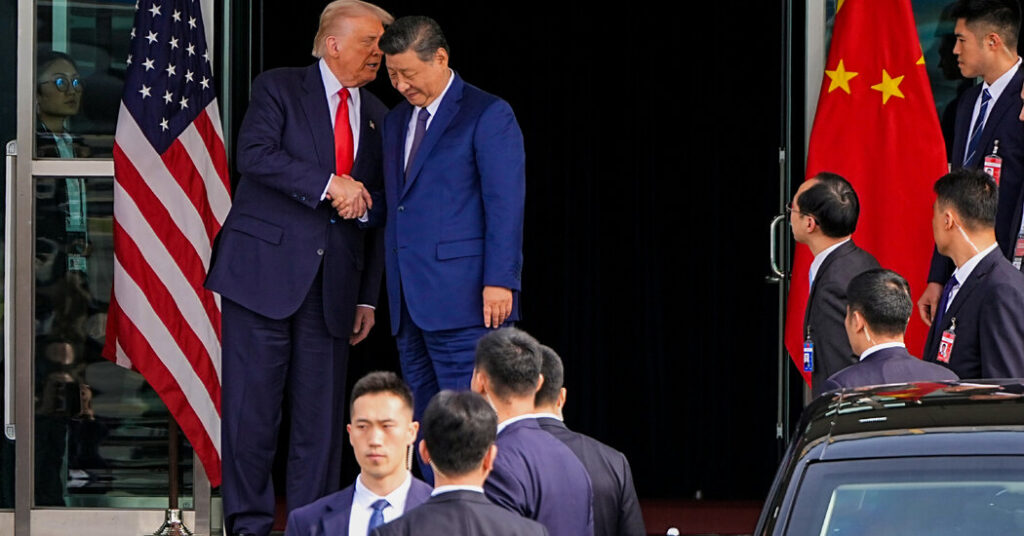
But the caution about China appears to have come from the Treasury, and from Mr. Trump himself, who has said he is looking forward to visiting Beijing in April to strike even larger trade deals.
David E. Sanger covers the Trump administration and a range of national security issues. He has been a Times journalist for more than four decades and has written four books on foreign policy and national security challenges.
The post Superpower Competition: The Missing Chapter in Trump’s Security Strategy appeared first on New York Times.